



Use Wozber and land your dream job
Create Resume
No registration required
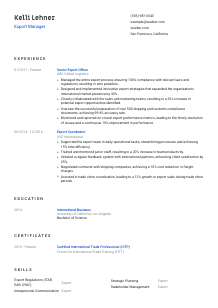
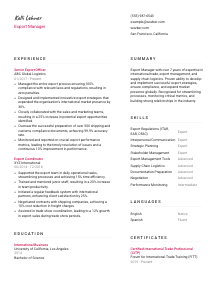
Navigating global markets, but your resume doesn't catch the right wave? Shore up your credentials with this Export Manager resume example, created with Wozber free resume builder. It shows how to translate your international acumen and supply chain expertise to match job specifications, setting your career on a trajectory as impressive as the goods you oversee!
Export management sits at the point where commercial growth meets regulatory risk. Hiring teams want to see that you can move goods across borders without creating exposure for the business, whether that means handling export controls, keeping shipping documentation clean, or resolving delays with freight partners and customs stakeholders before they affect revenue.
For this kind of role, the first screen often comes down to whether your resume makes your compliance scope and international trade results easy to trace. Wozber's free resume builder helps you shape that experience into an ATS-compliant resume by aligning your wording with the posting's terminology, so the hiring team can quickly see your command of export operations, market expansion, and issue resolution.
This section is simple, but it still carries screening value. For an Export Manager, it should confirm who you are, how to reach you, and any practical requirement that affects eligibility before a reviewer even gets to your trade experience.
Use your full name as the header in a clean, readable format. Keep it more prominent than the rest of the contact details so the document feels professional and easy to reference during interviews, internal reviews, and ATS exports.
Place "Export Manager" directly under your name when that is the role you are pursuing. This helps position you correctly from the first line, especially when your recent titles include adjacent functions such as Export Coordinator, Trade Compliance Specialist, or International Sales Operations.
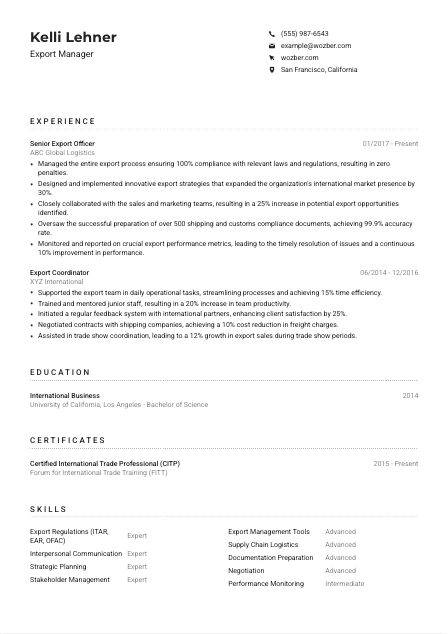
Add a reliable phone number and a professional email address. If the posting includes a location requirement, reflect that clearly in this section. In the example, listing San Francisco, California directly supports a stated requirement and removes a basic screening question before it slows your application down.
If you include LinkedIn or a professional website, make sure it supports your resume with matching titles, dates, and trade-related experience. For export roles, a profile that shows international business exposure, compliance work, logistics coordination, or cross-border sales support can reinforce your positioning.
Skip details that do not affect your candidacy, such as age, marital status, or a full street address. Export hiring decisions are shaped by regulatory knowledge, operational judgment, documentation accuracy, and international stakeholder management, not by unrelated personal data.
Your header should answer the practical basics fast: who you are, what role you are targeting, how to reach you, and whether any location requirement is already met. That keeps attention on your export experience instead of avoidable logistics.




This is the section that usually decides whether you move forward. Export Manager resumes need to show control over compliance, documentation, partner coordination, and performance improvement, not just general operations experience.
Pull the core responsibilities from the job description and use them to shape your bullets. For an Export Manager, that often means export compliance, shipping and customs documentation, collaboration with sales teams, international customer support, and reporting on export metrics. If the employer names ITAR, EAR, or OFAC, mention those only where you have genuine working exposure.
List positions in reverse chronological order with job title, company name, and employment dates. Clear progression matters in export hiring because it shows whether you have moved from coordination and documentation work into ownership of compliance decisions, partner management, and strategic market development.
Each bullet should pair a core export activity with a result. Instead of saying you "handled shipments," show what you managed and what improved: customs documentation accuracy, market expansion, freight cost control, on-time export processing, or issue resolution. The sample resume does this well with bullets tied to compliance, strategy, and cross-functional collaboration.
Quantify impact with metrics that matter in international trade. Strong examples include zero compliance penalties, percentage growth in international market presence, document accuracy rates, freight savings, turnaround time improvements, or the number of export files processed. The example's 100% compliance, 30% market growth, and 99.9% documentation accuracy all show how measurable export work reads on a resume.
Prioritize experience tied to cross-border shipping, export controls, international customers, channel development, or supply chain coordination. If you have broader operations or sales experience, keep only the parts that support export management, such as contract negotiation, trade show support, logistics planning, or partner communication across regions.
A well-built experience section should show that you can keep exports compliant, move shipments without friction, and support international growth with disciplined reporting and coordination. Make each bullet earn that conclusion.
Education is rarely the deciding factor for a seasoned Export Manager, but it still matters because it confirms foundational training in business, trade, logistics, or international relations. Keep it direct and relevant.
If the role calls for a bachelor's degree in Business, International Relations, or a related field, make that easy to find. A degree such as International Business, Supply Chain Management, or Global Trade should be listed exactly and without extra clutter so the requirement is satisfied at a glance.
Include your degree, field of study, school name, and graduation year or date. Simple formatting works best here because education is usually scanned quickly after experience and before certifications or skills.
When your academic background directly supports export work, do not bury it. In the example, a Bachelor of Science in International Business immediately reinforces readiness for cross-border commerce, market expansion, and trade operations.
If you are earlier in your career, selected coursework in international trade, customs compliance, logistics, global marketing, or supply chain management can help bridge limited experience. For candidates with several years in export operations, this usually adds less value than stronger achievement bullets elsewhere.
Honors, research, student projects, or trade-focused activities are worth adding only when they support the role. A capstone on global supply chains or student leadership in an international business association can help newer candidates show early commitment to the field.
This section should confirm the academic baseline the employer asked for and support your trade profile without competing with your experience. If the degree aligns cleanly, let that do the work.
Certifications can carry real weight in export hiring because they point to current knowledge in trade practice, compliance, and international business standards. They are especially helpful when the role involves regulated products, licensing, or higher compliance exposure.
List certifications that reinforce export management, trade compliance, customs knowledge, or international business operations. A credential such as CITP is directly relevant because it supports your expertise beyond a general business background.
Choose credentials that align with the actual demands of the job, especially if the posting emphasizes export regulations, documentation, or international market development. A shorter list of high-value certifications works better than a long list of loosely related training.
Include earned dates and renewal windows when applicable. This is useful in export and compliance work because regulations, documentation standards, and control frameworks change over time, and current certification can suggest active engagement with the field.
If you are aiming for senior export roles, continue adding learning that supports compliance oversight, trade operations, or regional market knowledge. That could include formal certification, regulator training, or specialized coursework tied to export controls or logistics systems.
The right certification section tells a hiring team that your export knowledge is not static. It shows continued investment in the regulations, documentation standards, and trade practices the role depends on.
An Export Manager skills section should do more than collect buzzwords. It should quickly show whether you can manage compliance risk, coordinate cross-border operations, and work with sales, logistics, and international partners in a practical business setting.
Start with the language used in the job description. For this role, that includes export regulations, export management software, interpersonal communication, international customer relationships, and performance reporting. If you have hands-on knowledge of ITAR, EAR, and OFAC, name those frameworks directly rather than hiding them inside generic compliance wording.
Export managers need both operational control and external-facing communication. Pair hard skills such as shipping documentation, licensing, customs compliance, and logistics coordination with softer but role-critical abilities such as negotiation, stakeholder management, and cross-functional collaboration with sales and marketing teams.
Resist the urge to turn this into a master inventory. Group and prioritize skills that are central to export work first, then list supporting capabilities. Wozber's ATS-friendly resume template can help you organize these terms cleanly so both ATS systems and hiring managers can immediately spot the trade, compliance, and commercial skills most relevant to the role.
A hiring team should be able to scan this section and understand your mix of regulatory knowledge, logistics capability, and international relationship management within seconds. If those three areas come through clearly, the section is doing its job.
Language skills can be genuinely useful in export roles, especially when the work includes overseas clients, distributors, customs communication, or regional market development. List them with the same precision you would use for any other business qualification.
If the posting calls out English proficiency, include it clearly. That matters in export roles because documentation, internal reporting, partner communication, and regulatory correspondence often depend on precise written English.
List the languages most useful to your target markets or the employer's footprint first. English usually appears first when it is required, followed by other languages that could support negotiations, distributor relationships, or smoother communication with overseas customers.
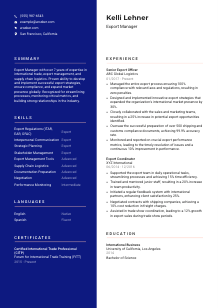
Extra language ability can strengthen an export application when it helps with customer service, market expansion, or partner coordination. In the example, Spanish adds commercial value because it can support communication across large international trade markets, even though it is not listed as a formal requirement.
Use clear levels such as Native, Fluent, Professional Working Proficiency, or Conversational. Export work often involves contracts, shipment updates, and compliance-sensitive communication, so overstating ability can quickly become a credibility problem.
Only emphasize languages that make sense for the type of export business you are targeting. A broad language list is less useful than one or two languages that clearly support the company's regions, customers, or channel partners.
For an Export Manager, language skills matter when they improve communication across borders, reduce friction with partners, or support market growth. Present them as practical assets, not decoration.
The summary should quickly establish your level, your export scope, and the kind of results you bring. For this role, that usually means a blend of compliance command, international market execution, and operational follow-through.
Start with your years of experience and your primary area of strength, such as export management, international trade, or cross-border logistics. This immediately tells the reader whether you are a strategic export lead, a compliance-heavy operator, or a candidate growing into broader ownership.
Use the first two lines to surface the points that matter most for the target role. That could be years in export operations, deep knowledge of regulated trade environments, international sales support, or measurable success expanding overseas markets.
Build the summary around the work the employer actually needs done. For this posting, that includes managing the export process, ensuring compliance, developing export strategies, supporting international opportunities, and tracking performance metrics. The example summary succeeds because it combines regulatory control, growth results, and process improvement in a compact way.
Aim for 3 to 5 lines with no filler. Avoid generic claims about being results-driven or detail-oriented unless you immediately anchor them in export outcomes, such as zero penalties, improved documentation accuracy, or market expansion across specific regions or channels.
When this section works, the reader immediately understands your export background, your level of ownership, and the results you are most likely to repeat. That gives the rest of the resume a clear commercial and compliance context.
An effective Export Manager resume shows that you can protect compliance, keep international shipments moving, and support commercial growth with disciplined execution. Every section should reinforce that picture, from your title and location details to your metrics on documentation accuracy, market expansion, and partner coordination.
Use Wozber's AI resume builder to align your wording with the job description, strengthen ATS optimization, and present your background in an ATS-friendly resume format that highlights the trade, compliance, and cross-functional experience hiring teams want to see. The final read should make one thing easy to judge: you can manage export operations with confidence and control.




