



Use Wozber and land your dream job
Create Resume
No registration required
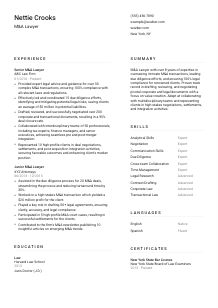
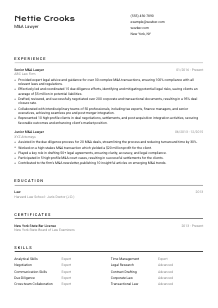
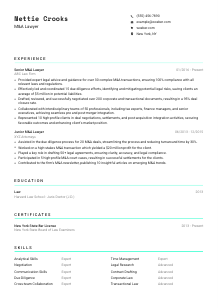
Navigating complex mergers, but your resume feels like a hostile takeover? Check out this M&A Lawyer resume example, created with Wozber free resume builder. Learn how to match your legal acumen with job expectations, ensuring your career deal sheets read like success stories, not red lines!
M&A law is reviewed through the quality of transaction work behind it. Hiring teams look for lawyers who can move a deal from diligence through negotiation without losing control of risk, documentation, or client priorities. Your resume should make that visible fast, especially through deal exposure, drafting range, and the business outcomes tied to your legal judgment.
A tailored resume changes how quickly your transaction profile comes into focus. When the language mirrors the role's deal work, legal scope, and collaboration with finance and executive stakeholders, ATS screening is more likely to surface the right experience instead of burying it under generic litigation or general corporate work. Wozber's free resume builder helps structure that alignment in an ATS-friendly resume format so employers can quickly see whether you have the M&A background the role requires.
For an M&A Lawyer, the personal details section needs to do one practical job well: confirm that you are easy to contact, professionally presented, and able to meet any immediate eligibility filters. Keep it clean and factual so attention stays on your deal work and legal qualifications.
Use your full name as the visual anchor of the header. Keep the format plain, readable, and slightly larger than the rest of the text so it stands out immediately when a recruiter or partner scans the page between multiple legal resumes.
Place "M&A Lawyer" directly below your name if that reflects the work you are pursuing. This helps frame the resume around mergers and acquisitions from the first line and supports ATS matching when the role is specifically tied to transactional practice rather than broader corporate law.
List a reliable phone number and a professional email address with no errors. In legal hiring, small accuracy issues can undermine confidence quickly, so your header should read with the same care you would apply to a signature block or transaction document.
If a role calls for a specific market, state your city and state clearly. Here, New York, NY matters because the employer asked for local availability. If a posting does not require a specific location, keep the entry simple and avoid overexplaining relocation details in the header.
Add LinkedIn or a professional website only if it supports your candidacy with useful legal context, such as practice focus, publications, deal commentary, or speaking engagements. If you include it, make sure the profile reflects the same M&A positioning and timeline as the resume.
This section should answer the easy questions at a glance: who you are, what practice area you work in, how to reach you, and whether you meet any immediate location requirement. Once that is clear, the reader can move straight to your transaction record.




For M&A lawyers, experience is the section that carries the most weight. Firms and in-house teams want to see the kind of transactions you have supported, how directly you handled diligence and negotiation, and whether your work helped deals close cleanly while managing legal and commercial risk.
Start by marking the responsibilities that define the role. In this description, the core themes are advising on complex M&A transactions, leading due diligence, negotiating corporate documents, and working with tax, finance, and senior executives. Those themes should shape which bullets you keep, rewrite, or move higher.
List your most recent legal role first, with title, firm or company name, and dates. For transactional practice, chronology matters because it shows progression from support work to leading diligence, drafting, negotiations, and client-facing responsibility.
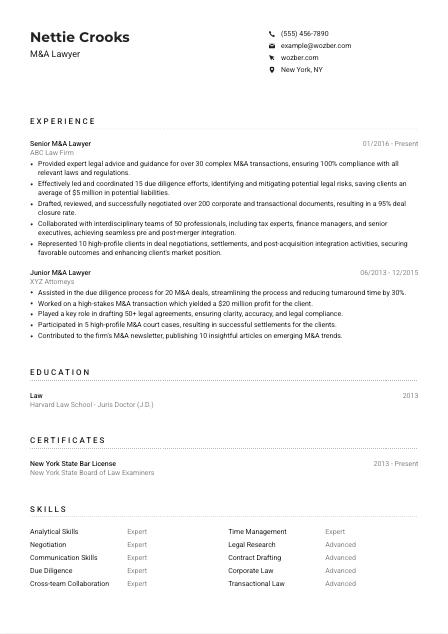
Each bullet should connect legal work to a deal-related result. Instead of vague statements about supporting transactions, show what you handled and what changed because of it. The sample resume does this well with bullets on leading 15 due diligence efforts, negotiating more than 200 transactional documents, and securing a 95% deal closure rate. Those details tell a hiring team far more than generic claims about being detail-oriented.
Use metrics that fit M&A work naturally: number of deals, size or complexity of transaction portfolio, turnaround improvements in diligence, liabilities identified, closure rates, or client outcomes from negotiation. Numbers work best when they clarify legal scope, as in the example's "$5 million in potential liabilities" avoided through risk identification.
Cut or shrink work that does not strengthen your transactional profile. General legal tasks, unrelated disputes, or broad firm contributions should only stay if they support the target role, such as securities exposure, contract drafting depth, or post-acquisition integration work. If you have mixed experience, lead with the bullets that show M&A execution first.
Your experience section should show where you have worked, what kinds of deals you handled, and how your legal work affected risk, execution, and outcomes. When that story is concrete, employers can quickly picture you in the role.
Legal hiring still treats education as a qualification checkpoint, especially when the posting explicitly requires a J.D. For an M&A Lawyer, this section should confirm that you meet the academic foundation for practice without distracting from the transaction experience that usually carries more weight later in your career.
Make sure your Juris Doctor is listed clearly and matches the posting's requirement for a J.D. from an accredited law school. This is a threshold credential, so do not bury it under unrelated education or additional coursework.
Present degree, field, school, and graduation year in a clean structure that can be read quickly by both people and applicant tracking systems. Legal resumes benefit from simple formatting because hiring teams are usually checking this section for qualification confirmation, not narrative.
If your law school work included corporate law, securities regulation, transactional drafting, or negotiation coursework, mention it when it strengthens your M&A positioning. The sample already covers the main requirement with a Harvard Law School J.D., so additional academic detail would only be useful if it sharpened the transactional focus.
Law review, honors, transactional moot court, or academic distinctions can still help, especially if you are earlier in your career or applying to firms that pay close attention to academic pedigree. Keep these additions selective and directly tied to legal credibility.
For candidates with 5+ years in M&A, extensive academic detail becomes less important than deal experience. Still, continuing legal education in securities, corporate governance, or advanced negotiation can be worth listing when it reinforces the practice area you are targeting.
This section needs to confirm that you have the formal legal education required for practice and, where useful, show early signs of transactional focus. Keep it clear, concise, and aligned with the level of the role.
For lawyers, certificates are less about collecting badges and more about proving current authorization to practice. In M&A hiring, bar status is the credential that must be easy to find, while any additional training should support your ability to handle corporate transactions, negotiations, and regulatory complexity.
List your active bar membership clearly, including the jurisdiction and current status if relevant. In this case, a New York State Bar license is essential because the role is based in New York. That credential should be immediately visible and never left for the reader to infer.
If you have certificates or continuing education tied to securities law, contract negotiation, financial statement analysis, or corporate governance, include them when they deepen your M&A profile. Do not add generic courses that do not strengthen your transaction practice.
Include issue dates or active date ranges when they help confirm that your license or training is current. For legal roles, this matters because employers need confidence that your admission is in good standing and your recent education reflects current practice standards.
Review this section regularly, especially if you add another bar admission, complete CLE tied to deal work, or gain a specialist credential that supports corporate transactions. A current credentials section tells employers you stay engaged with the legal standards shaping your practice area.
When licenses and relevant training are presented clearly, the employer does not have to search for proof that you can practice and advise on the work in front of them. That clarity matters in legal hiring.
A skills section for an M&A Lawyer should read like a transaction practice profile, not a generic list of strengths. Focus on the legal knowledge, negotiation ability, and cross-functional working style that actually show up in deal execution, document review, diligence, and client advisory work.
Pull the hard and soft skills directly from the posting before adding your own. Here, that includes corporate, securities, and contract law alongside analytical ability, negotiation, and communication. Those are central to M&A practice, so they should appear in the section if they reflect your actual experience.
Choose skills you can support elsewhere in the resume through deal work, drafting history, or client-facing outcomes. The sample list works because items like Due Diligence, Contract Drafting, Corporate Law, and Negotiation all connect back to measurable work in the experience section.
Avoid long inventories of every legal and interpersonal skill you have. A focused list is easier to scan and gives a clearer picture of your practice area. Group toward the capabilities most relevant to M&A, especially drafting, diligence, negotiation, legal research, and cross-functional collaboration with finance and executive teams.
Every skill listed should feel consistent with your work history and the kind of transaction matters you want to handle next. If a skill cannot be supported by your experience, it does not belong here.
Language ability can matter in M&A work when clients, counterparties, or cross-border teams operate across jurisdictions. Even when a role only requires English, this section helps confirm communication readiness for drafting, negotiation, and advisory work where precision matters.
If the posting names a required language, list it clearly with an honest proficiency level. For this role, English is essential, so it should appear first and be described in a way that reflects your drafting and client communication ability.
Lead with the language you use in legal analysis, contract review, negotiation calls, and written advice. For many U.S. M&A roles, that will be English, and placing it first keeps the section aligned with the employer's immediate requirement.
Additional languages can strengthen your profile if they help with international clients, cross-border transactions, or multilingual stakeholder communication. In the sample resume, Spanish adds useful breadth, especially for firms or companies with international transaction exposure.
Stick to plain terms such as Native, Fluent, Intermediate, or Basic. Legal work depends on precision, so vague descriptions can create the wrong expectation about your ability to review documents or negotiate in another language.
If you are applying to firms with cross-border M&A activity, a second language may deserve more visibility because it can support diligence review, client communication, or coordination across jurisdictions. If not, keep the section brief and factual.
This section should clarify how you operate in practice, especially in drafting and client-facing settings. Keep it accurate so employers can judge where language skills add value in your transaction work.
The summary should quickly establish your level of M&A experience and the kind of legal work you handle. This is where you set the reader's expectations for transaction depth, legal scope, and client value before they move into the detailed deal history below.
Before writing, identify the themes the employer cares about most. In this posting, those are complex transactions, due diligence leadership, document negotiation, compliance, and collaboration with finance and executive stakeholders. Your summary should reflect that mix rather than introducing yourself in generic legal terms.
Start with a direct line that names your specialization and seniority, such as an M&A Lawyer with 8+ years in transactional practice. That immediately places you in the correct part of the legal market and helps separate you from candidates coming from broader commercial or litigation backgrounds.
Mention the work you are strongest in, supported by concise facts. The sample summary does this effectively by referencing complex M&A transactions, due diligence leadership, legal compliance, document negotiation, and multidisciplinary collaboration. A short summary can still show substantial transaction credibility if each phrase earns its place.
Aim for 3 to 5 lines with specific language and no filler. Partners, recruiters, and legal hiring managers often decide very quickly whether your background matches the mandate, so your opening paragraph should deliver practice area, level, and transaction value without delay.
A well-written summary makes the rest of the resume easier to read because it tells the employer what kind of M&A lawyer they are about to review. Keep it focused on practice area, deal exposure, and the kind of legal judgment you bring to transactions.
A strong M&A Lawyer resume makes three things easy to confirm: you have the legal credentials to practice, you have handled meaningful transaction work, and you can manage risk while moving deals forward. Keep updating it as your deal sheet, drafting scope, and negotiation record grow.
Wozber's free resume builder and ATS resume scanner can help you tighten role-specific language, improve ATS optimization, and present your background in an ATS-compliant resume that surfaces the transaction experience employers need to see. The final result should make your readiness for complex M&A work clear within the first read.




