



Use Wozber and land your dream job
Create Resume
No registration required
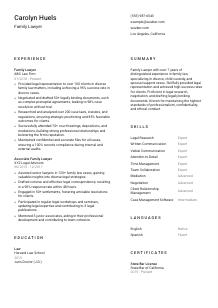
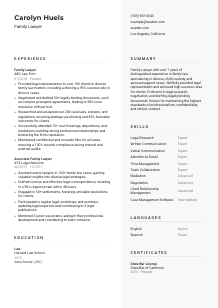
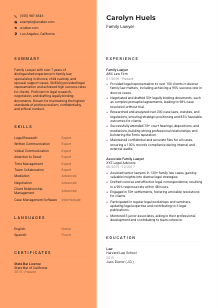
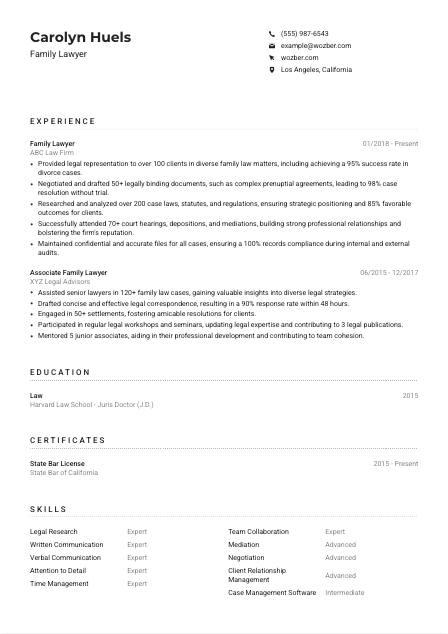
Defending clans, but your resume isn't making a strong case? Check out this Family Lawyer resume example, created with Wozber free resume builder. It shows how to clearly present your legal expertise to match matrimonial mandates, paving the way for a professional profile as solid and harmonious as the families you represent!
Family law resumes are reviewed through the lens of high-stakes client work. Hiring partners want to see whether you can manage divorce, custody, support, and settlement matters with sound judgment, careful drafting, and steady courtroom or mediation presence. Your resume should make that practice history visible fast, especially where you have carried a caseload, negotiated agreements, and handled sensitive records without errors.
A targeted resume changes how quickly your background reads as relevant family law practice instead of general litigation or broad legal support. Wozber's free resume builder helps organize that experience in an ATS-friendly resume format, so terms like custody, spousal support, mediation, and settlement agreement appear where both screening systems and legal hiring teams expect them. That makes it easier to see your actual depth in family law work.
In legal hiring, the top of the resume needs to confirm professional identity and practical eligibility without delay. For a Family Lawyer, that means clear contact details, a precise title, and any location information the posting specifically asks for.
Use your full name as the most prominent text on the resume, in a clean professional font. Law firms scan quickly, and your header should look polished and easy to reference during interviews, call-backs, and file sharing.
Place "Family Lawyer" directly under your name if that is the role you are pursuing. This removes ambiguity, especially if your background also includes broader civil litigation, associate work, or general counsel support.
Include a reliable phone number and a professional email address. If you have a LinkedIn profile or professional website with publications, speaking engagements, or practice information, include it only if it is current and aligned with your legal profile.
If a firm wants someone based in a specific market, show that clearly. In this example, listing "Los Angeles, California" immediately answers a stated requirement and avoids questions about relocation or bar eligibility by jurisdiction.
A website can strengthen your resume when it includes attorney bio content, articles on custody or support issues, or other relevant professional material. Skip anything that looks personal, outdated, or unrelated to client-facing legal work.
This section should confirm who you are, what role you practice, and whether you meet practical requirements to be contacted and considered right away.




This is the section most likely to decide whether your resume moves forward. For family law roles, employers look for matter types, level of responsibility, written work, negotiation results, and the settings where you represented clients, from mediation rooms to court hearings.
Mark the core work named in the job ad before you edit anything. Here, the clearest priorities are divorce, child custody, spousal support, legal drafting, research, negotiation, mediation, and court appearances. Your experience bullets should reflect those same practice areas where they match your background.
List positions in reverse chronological order and make the family law track obvious. Titles, firms, and dates should show progression from associate support work into independent representation, larger caseload ownership, or more complex family matters.
Do not stop at "represented clients" or "drafted legal documents." Show the scope and result. The sample does this well with points like representing more than 100 clients and resolving 98 percent of matters without trial through negotiated documents. That tells a hiring partner far more than a generic task list.
Numbers work best when they reflect real legal performance. Caseload volume, hearing count, settlement rate, audit compliance, turnaround speed, and favorable outcome rates all help define your impact. In family law, those metrics should support a picture of reliable advocacy and strong matter management, not read like inflated sales claims.
Each bullet should reinforce your readiness for the matters this firm handles. If you have broader legal experience, trim or reframe it so the emphasis stays on client representation in divorce, custody, visitation, support, agreements, and related research or negotiation work.
The experience section should leave no doubt that you have handled family law matters with enough depth to contribute quickly, whether that means advising clients, drafting agreements, or appearing in court.
For attorneys, education is straightforward but non-negotiable. A Family Lawyer resume needs to show the law degree clearly and in a format that makes bar-related eligibility easy to understand alongside your practice history.
If the posting asks for a Juris Doctor, make sure that appears exactly and clearly in your education section. This is one of the first qualification checks, so do not bury it behind abbreviations or incomplete entries.
List the degree, field of study, law school, and graduation year in a simple structure. Legal hiring teams do not need decoration here. They need quick confirmation that your academic foundation supports licensed practice.
Write "Juris Doctor (J.D.)" in full if that is what you earned. The sample resume handles this directly, which helps both ATS parsing and human review when the posting uses the same language.
If you are early in practice, relevant coursework, clinics, law review work, or family law externships can help show direction. With 5+ years of experience, those details usually matter less than your litigation, negotiation, and client counseling record.
Academic honors, scholarships, or notable legal writing can be worth listing when they strengthen your credibility without crowding the page. Keep the emphasis on distinctions that still support your professional profile as a practicing attorney.
Your education section should confirm legal training in seconds, then get out of the way so the reader can focus on your family law experience and bar status.
In legal resumes, this section often carries more weight as a licensing checkpoint than as a place for extra credentials. For family law, start with bar admission, then add only certifications that deepen your practice profile.
If bar membership is required, place your State Bar license here clearly, including the issuing body and active dates if relevant. In this example, the California bar license directly supports eligibility for practice in the target jurisdiction.
Mediation, collaborative law, or family law specialization credentials can strengthen your resume when they reflect actual practice. Choose certifications that support the kind of work the firm handles, rather than listing every continuing education item you've completed.
Include dates for active licenses, recent certifications, or credentials with renewal cycles. That helps employers see that your qualifications are current, especially in areas tied to mediation procedures or state-specific practice rules.
Family law changes through case law, statutes, and court expectations. Ongoing certifications or advanced training in negotiation, custody matters, or alternative dispute resolution can reinforce your commitment to the field and sharpen your value to a firm.
The most important credential here is the one that confirms you can represent clients lawfully in the relevant jurisdiction. Any added certification should strengthen that picture, not distract from it.
This section should read like a concise map of your legal tools. For a Family Lawyer, that usually means a mix of drafting, research, negotiation, mediation, client communication, and disciplined case management.
Start with the abilities the role depends on every day. In this posting, written and verbal communication, attention to detail, negotiation, mediation, and legal research all deserve a place because they connect directly to hearings, agreements, and client advice.
List both hard and interpersonal skills, but keep them grounded in practice. Legal research, drafting, and case management software belong beside negotiation, mediation, and client relationship management because family law involves both legal precision and emotionally charged communication.
Put the most role-specific skills first. If the job centers on divorce and custody matters, skills tied to advocacy, settlement work, and document drafting should appear before broader strengths like teamwork or time management. The sample resume gets this mostly right by foregrounding research, communication, and mediation-related strengths.
A well-built skills section should sound consistent with the motions you draft, the clients you counsel, and the negotiations or hearings you handle in family law practice.
Language ability matters in family law because the work depends on precise communication with clients, opposing counsel, mediators, and the court. List languages in a way that supports the practical demands of your practice.
If the posting specifies English proficiency, include English clearly and at the appropriate level. For a lawyer, that signals readiness for drafting, oral advocacy, client counseling, and fast-moving case communication.
Lead with the language you will use for pleadings, hearings, negotiations, and correspondence. In this example, English should sit at the top because it is explicitly required for the role.
Additional languages can be a real advantage in family law, especially in communities where clients may need clearer access to legal guidance during emotionally difficult matters. Spanish, for example, can strengthen client communication in many jurisdictions without being a universal requirement.
Use clear levels such as "Native," "Fluent," or "Intermediate." Law firms need an honest sense of whether you can manage intake conversations, draft correspondence, or conduct nuanced legal discussions in that language.
If your market includes multilingual households or a diverse local population, language skills can become a practical business and service advantage. Frame them as support for client communication, not as decorative extras.
For family law, language skills matter most when they improve client trust, reduce communication friction, and support accurate legal work from intake through resolution.
The summary should give a law firm an immediate sense of your level, focus, and results. For a Family Lawyer, that usually means years in practice, matter types handled, and the strengths that shape client outcomes.
Before writing, identify the few points the firm is most likely to care about first. In this case, experience level, family law concentration, negotiation strength, drafting ability, and courtroom or mediation exposure all belong near the top of your thinking.
Start with a direct description such as "Family Lawyer with 7+ years of experience." That instantly places you at the right level and works well when the posting asks for a minimum of 5 years in family law practice.
Use the next sentence or two to name your primary family law work, such as divorce, custody, visitation, or support matters, then add strengths like negotiated settlements, legal research, or agreement drafting. The sample summary is effective because it ties years of practice to specific matter focus and professional strengths.
Stay within 3 to 5 lines and avoid broad claims that are not supported elsewhere in the resume. A good summary should sound like the top line of your actual practice record, not a generic professional bio.
When your summary is focused, the rest of the resume reads in the right context. The reader should immediately understand your family law depth, your typical case mix, and the value you bring to client matters.
Your resume should now present the essentials a family law employer needs to see quickly: licensed practice, relevant case experience, strong drafting and negotiation work, and the ability to manage sensitive client matters with care. Keep every section anchored in actual legal work and measurable outcomes where they add meaning.
Wozber can help you shape that content into an ATS-compliant resume with cleaner structure, stronger role alignment, and targeted wording through its ATS resume scanner and AI resume builder features. The final result should make your readiness for divorce, custody, support, and settlement matters easy to recognize.




