



Use Wozber and land your dream job
Create Resume
No registration required
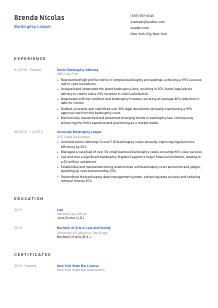
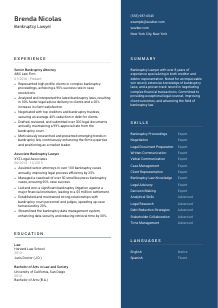
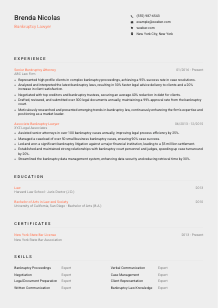
Navigating distressed finances, but your resume feels chaptered out? Check out this Bankruptcy Lawyer resume example, built with Wozber free resume builder. It shows how to showcase your legal acumen to match job requirements, ensuring your career always stands on solid financial ground!
Bankruptcy law is reviewed through the quality of your judgment under financial pressure. Firms want to see whether you can guide individuals or businesses through Chapter 7, Chapter 11, and Chapter 13 matters, draft filings that hold up in court, and negotiate with creditors or trustees without losing sight of the client's broader position. Your resume should make that practice visible through case scope, document work, and the results you secured.
A tailored resume also clears up an early screening question in bankruptcy hiring: are you a general litigator with some insolvency exposure, or a lawyer who regularly handles petitions, schedules, plans, negotiations, and bankruptcy strategy? Wozber's free resume builder helps organize that distinction in an ATS-friendly resume format, so the right terms and casework stand out quickly and hiring teams can see your bankruptcy depth from the first read.
This section is simple, but in legal hiring it still carries screening weight. A bankruptcy firm expects accurate contact information, a clear professional title, and any location detail the posting specifically asks for. Present the basics cleanly so nothing distracts from your bar status, case experience, and legal judgment.
Your name should be the most visible element on the resume, set in a clean professional style. Law firms move quickly between resumes, writing samples, and attorney profiles, so make it easy to identify you at a glance and consistent with your LinkedIn or firm bio if you have one.
Place "Bankruptcy Lawyer" immediately below your name if that is the role you are pursuing. This helps frame the rest of the resume around bankruptcy proceedings, client representation, and court-facing work, while also aligning naturally with ATS searches built around the exact job title.
List a phone number and a professional email address you check regularly. In legal recruiting, small errors create unnecessary doubt, especially for roles that depend on precision in filings, deadlines, and client communication. Double-check every character before sending the resume.
If the employer specifies a location requirement, address it plainly in this section. Here, New York City, New York is part of the stated criteria, so showing that detail upfront removes an avoidable question about local availability, court access, or relocation timing.
A LinkedIn profile, attorney bio, or personal site can help if it includes bankruptcy-specific content such as representative matters, publications, speaking engagements, or bar information. Keep it current. A link only helps when it reinforces your bankruptcy practice and professional credibility.
Personal details do not need flair. They need to confirm who you are, how to reach you, and whether you meet practical requirements such as location. Once that is clear, the reader can focus on your bankruptcy record.




This is where bankruptcy hiring decisions start to take shape. Firms look for matter type, client mix, drafting responsibility, negotiation exposure, courtroom activity, and outcomes. Your experience section should show how you practiced bankruptcy law, not just where you worked.
Start by marking the responsibilities that define the role: handling Chapter 7, Chapter 11, and Chapter 13 proceedings, interpreting bankruptcy law, advising clients, negotiating with creditors and trustees, and preparing petitions, schedules, and plans. Those points should guide which bullets stay, which get rewritten, and which matter types you bring to the front.
List your most recent role first and keep each entry easy to scan with firm name, title, and dates. For bankruptcy lawyers, chronology matters because seniority often maps to matter complexity, client autonomy, and courtroom responsibility. If you have both debtor and creditor-side work, make that visible in the role descriptions or bullets.
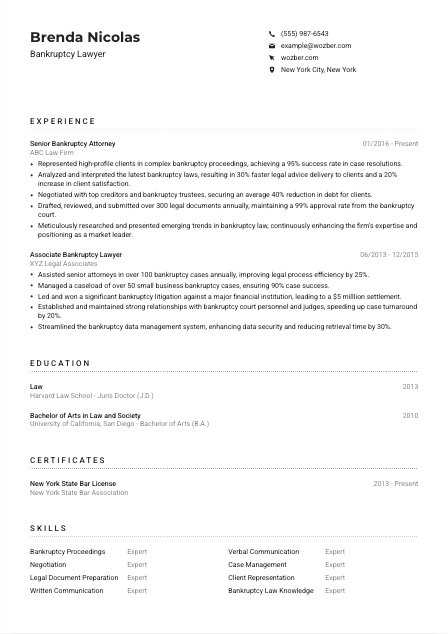
Each bullet should show a specific piece of bankruptcy practice: representing clients in proceedings, drafting filings, negotiating restructurings or settlements, researching case law, or advising on strategic options. The sample resume does this well with points on complex proceedings, creditor negotiations, and high-volume document drafting rather than vague statements about legal support.
Numbers work best when they reflect how bankruptcy work is actually measured. Case success rates, number of filings handled, debt reduced, approval rates for court submissions, turnaround time, size of settlement, or annual caseload all give hiring teams a clearer read on your performance. Examples like a 95% case resolution rate, 40% average debt reduction, or 300 plus documents prepared annually add real weight because they connect legal work to results.
Prioritize bullets tied directly to insolvency matters over general legal tasks that could belong to any attorney. Research, drafting, negotiation, and client counseling only help when they are anchored in bankruptcy practice. If a bullet does not clarify your work with debtors, creditors, trustees, plans, filings, or court outcomes, rewrite it or remove it.
By the end of your experience section, a firm should understand the bankruptcy matters you handled, the level of responsibility you carried, and the results you produced. That is what separates specialized bankruptcy practice from general legal experience.
For a bankruptcy lawyer, education is a qualification check before it becomes a differentiator. The J.D. is essential, and the rest of this section should support a straightforward read on your legal training and progression into practice.
A Juris Doctor from an accredited law school is a stated requirement, so it should appear clearly and without extra digging. Include the law school name, degree, and graduation year. If your school carries weight in the market, the name will speak for itself without additional explanation.
Use a standard format for each education entry: school, degree, field of study if useful, and graduation year. Legal hiring teams do not need a long academic narrative here. They need a fast confirmation that your credentials line up with bar admission and practice requirements.
If you took bankruptcy, secured transactions, creditors' rights, corporate reorganization, or related coursework, mention it when it adds value, especially earlier in your career. The sample resume keeps the education section concise, which works well for an experienced attorney whose main proof now sits in practice history.
Moot court, law review, clinics, judicial internships, or externships can help when they relate to insolvency, commercial law, or litigation. This is most useful for newer lawyers or candidates with limited post-bar bankruptcy experience. For a lawyer with 5+ years in practice, these details should stay selective.
Bar admission usually belongs in Certificates or Licenses, but for legal resumes it can be referenced near education if that improves flow. Since this role requires admission to the state bar and good standing, make sure that information appears clearly somewhere on the resume and is easy to find.
Your education section should confirm the legal credentials behind your practice without crowding out stronger proof from your case history. For an experienced bankruptcy lawyer, clarity matters more than detail.
In bankruptcy law, bar admission is mandatory and any specialty credential can strengthen your positioning. This section should separate required licensure from optional distinctions and show that your qualifications are current.
Admission to the relevant state bar belongs at the top because it is not optional. Include the licensing body and active dates or status. For this opening, New York State bar admission is a direct requirement, so it should be unmistakable on the page.
Add credentials that deepen your authority in insolvency, restructuring, or related financial law. A certification such as Certified Specialist in Bankruptcy Law can strengthen your profile because it points to focused expertise, while unrelated credentials may dilute the section.
Dates matter in legal credentials. They show when a license was obtained, whether a certification is active, and how current your professional standing is. That is especially useful in a field shaped by evolving case law, statutory updates, and procedural changes.
Bankruptcy practice changes with legislation, court interpretation, and market conditions. If you pursue advanced certifications, specialist recognition, or sustained continuing legal education in insolvency topics, this section can quietly reinforce that you stay current rather than relying on old experience alone.
At minimum, this section should confirm that you are licensed and in active standing. At best, it also shows that your bankruptcy knowledge has been sharpened through recognized specialization and continued development.
A bankruptcy lawyer's skills section should read like the toolkit behind actual matters, filings, negotiations, and client advice. Keep it focused on legal capabilities that connect directly to the work described elsewhere on the resume.
Start with the competencies named in the job ad, then add closely related legal skills you can support with experience. Here that includes analytical ability, legal research, negotiation, written communication, verbal communication, and collaboration with clients and stakeholders, alongside the bankruptcy-specific work itself.
Put the most role-relevant skills near the top. Bankruptcy proceedings, legal document preparation, client representation, case strategy, creditor negotiations, and bankruptcy law knowledge belong ahead of broad entries like time management. The sample resume handles this well by leading with bankruptcy-centered skills before softer supporting traits.
Avoid turning the section into a generic inventory of lawyer attributes. Every skill should connect back to a filing, negotiation, client advisory task, or court process you have actually handled. A shorter list of well-supported skills is far more convincing than a long set of vague claims.
When this section is tailored well, it reads like the working vocabulary of someone who handles insolvency matters regularly. That is the standard to aim for.
Language ability matters differently in legal roles than in many other professions. Clear English is essential for drafting filings, advising clients, negotiating with opposing counsel, and speaking effectively in court or with trustees. Any additional language should be presented as an added client-service advantage, not filler.
If the posting calls for strong English communication, list English at the top with an honest proficiency level. For bankruptcy work, this is about more than conversation. It supports document drafting, statutory interpretation, negotiation, and precise client counseling.
Additional languages can be valuable in bankruptcy practice, especially when working with individual filers, closely held businesses, or diverse urban client bases. Spanish, for example, may help with intake, expectation setting, and trust during financially sensitive matters, but it should remain secondary to the required English strength.
Terms such as "Native," "Fluent," "Intermediate," and "Basic" give a realistic picture of how well you can work in each language. Legal employers need accuracy here because drafting, negotiation, and client communication leave little room for overstated proficiency.
If you speak more than one language, frame that as a service advantage. It can help you explain bankruptcy options more clearly, gather facts more efficiently, and build rapport with clients under stress. Keep the claim grounded in communication value rather than broad cultural statements.
Do not overbuild this section if language is not central to the target role. For this posting, strong English is the main requirement, so satisfy that first. Any additional language should support your application without distracting from your bankruptcy experience and bar credentials.
For a bankruptcy lawyer, language listings should clarify communication capacity, not decorate the resume. Lead with English proficiency and add other languages only when they strengthen client-facing practice.
The summary is your opening argument. In a few lines, it should tell the reader what kind of bankruptcy lawyer you are, how much experience you bring, and which parts of the practice you handle best.
Before writing the summary, identify the few elements the employer needs to see first. For this role, that includes years of bankruptcy experience, creditor and debtor representation, legal analysis, negotiation strength, and the ability to manage filings and advice across multiple bankruptcy chapters.
Your first line should state your title and level clearly. A summary such as "Bankruptcy Lawyer with 8+ years of experience in creditor and debtor representation" works because it immediately sets scope, specialization, and seniority without wasting space.
Choose proof points that reflect how you practice. That might be success in complex proceedings, strong outcomes in creditor negotiations, command of bankruptcy law, or a high volume of accurate filings. The sample summary uses this approach by combining years of experience with representation breadth, legal knowledge, and negotiation track record.
Aim for a short paragraph that can be read in seconds. Avoid sweeping claims or generic statements about passion. Bankruptcy hiring teams respond better to concise language about case experience, client outcomes, and legal strengths they will also see supported in the experience section.
When it works, the summary tells the reader they are looking at a bankruptcy specialist with the right level of practice, judgment, and client-facing capability. That makes the rest of the resume easier to trust.
Your resume should now show the essentials a bankruptcy employer needs to confirm quickly: J.D. credentials, active bar admission, years of bankruptcy practice, exposure to creditor and debtor matters, strength in filings and negotiation, and outcomes that hold up under scrutiny. Keep the wording specific to your actual matters, especially where Chapter 7, Chapter 11, or Chapter 13 work is part of your background.
Use Wozber to turn that experience into an ATS-compliant resume with clean structure, job-aligned phrasing, and faster tailoring through its ATS resume scanner and AI resume builder tools. The final result should make one thing easy to judge: you can step into bankruptcy matters and handle the legal work with confidence from day one.