



Use Wozber and land your dream job
Create Resume
No registration required
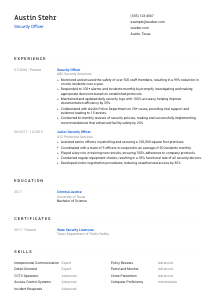
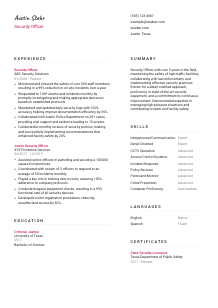
Shielding sites, but your resume feels exposed? Lock into this Security Officer resume example, built with Wozber free resume builder. Learn how to present your vigilance and protocol expertise to match job requirements, making your career defense impenetrable and your job hunt risk-free!
Security Officer hiring often turns on practical trust. Can you patrol consistently, respond fast under pressure, document incidents accurately, and handle people calmly when a situation escalates? A resume for this work needs to show those operating habits clearly, not just list general traits like vigilance or responsibility.
When your resume mirrors the language of patrol work, incident response, access control, reporting, and policy compliance, it becomes easier for a hiring team to separate hands-on security experience from broader customer-facing or facilities roles. Wozber's free resume builder helps you shape that into an ATS-compliant resume, so the screening process picks up the right terminology and the reader quickly sees whether you can protect people, property, and procedures.
Security work starts with reliability and clear identification. Your Personal Details section should present you as easy to contact, easy to place, and ready for the assignment without adding anything unrelated to the job.
Place your full name at the top in a clean, readable font. Keep it slightly larger than the rest of the text so it anchors the page immediately, much like a clear ID on a shift roster or incident report.
Add "Security Officer" directly under your name if that is the role you are applying for. Matching the job title helps frame the rest of your resume around patrol duties, incident response, documentation, and site safety instead of leaving the reader to infer your direction.
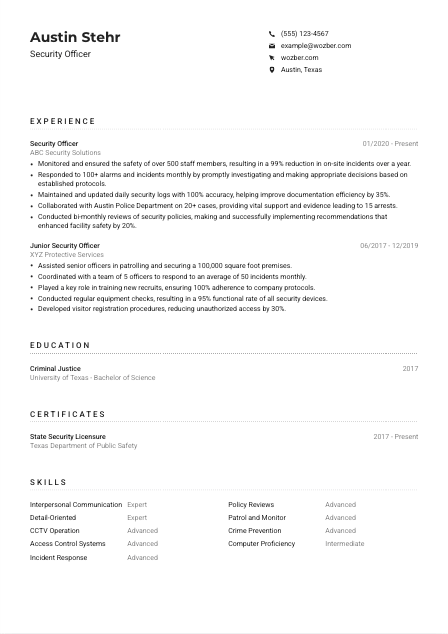
List a phone number you answer reliably and a professional email address. If the employer wants someone based in Austin or open to relocating there, showing "Austin, Texas" in this section, as the example resume does, removes a basic logistics question before it slows your application down.
If you have a LinkedIn profile or similar page, include it only if it supports your resume with matching roles, dates, certifications, or training. For security positions, consistency matters. Your public profile should reinforce your work history, not create questions about gaps or titles.
Do not include age, marital status, gender, photo, or other personal information unless a local application standard requires it. Security hiring decisions are better supported by licensure, incident-handling experience, report accuracy, and equipment familiarity.
This section should answer the first practical questions fast: who you are, how to reach you, and whether you are available for the post. Wozber's free resume builder keeps that information clean in an ATS-friendly resume format so the rest of your qualifications can do the heavier lifting.




For Security Officers, experience is where employers look for judgment, consistency, and control. Hiring teams want to see the environments you have protected, the incidents you have handled, the systems you have used, and the results of your actions when the pressure was real.
Pull the main responsibilities from the posting and map them to your background. If the role involves patrols, alarm response, CCTV monitoring, access control, daily logs, and coordination with law enforcement, make sure your bullets show those exact functions where you have performed them. The example resume does this well by covering alarms, policy reviews, safety monitoring, and police collaboration rather than staying vague.
List your most recent position first, then work backward. For each entry, include job title, employer, and dates. Security careers are often judged by scope, so make the setting clear through your bullet points: facility size, foot traffic, team size, number of incidents, or the type of site you secured.
Do not stop at "patrolled property" or "responded to incidents." Show what your actions changed. For example, reducing on-site incidents, improving visitor control, supporting arrests, or tightening documentation processes tells the reader how you operate on post and what kind of results follow from your presence.
Metrics make field performance easier to judge. Strong examples include response volume, incident reduction, documentation accuracy, number of officers coordinated, premises size, or equipment uptime. In the sample, "100+ alarms and incidents monthly" and "100% accuracy" work because they reflect normal security performance measures rather than generic business metrics.
Keep older or unrelated roles brief unless they add something useful such as de-escalation, public-facing communication, emergency response, or procedural compliance. The goal is to keep attention on your ability to protect people and property, follow protocol, write clean reports, and make sound decisions quickly.
Your experience section should let a hiring manager picture you on patrol, at a monitor station, or responding to an incident without guessing how hands-on you really are. Wozber's ATS optimization tools can help you align those bullets with the language used in the job description while keeping them natural and specific.
Education usually plays a supporting role in Security Officer hiring, but it still adds context. It can reinforce your understanding of criminal justice, public safety, report writing, or legal procedure, especially when paired with real field experience.
Start with your highest or most relevant education. A degree in Criminal Justice, Homeland Security, Public Safety, or a related field can strengthen your background, particularly when the role includes incident reporting, policy review, or coordination with law enforcement. The sample degree in Criminal Justice is a solid example of relevant alignment.
List the degree, field of study, school, and graduation year. Keep the format clean and easy to scan. Unless you are early in your career, this section does not need long descriptions if your work history already shows strong patrol and response experience.
If a job posting specifies a diploma, degree, or training level, make sure that credential is easy to spot. Many Security Officer roles prioritize experience and licensure first, but an education requirement should never be buried below less relevant details.
If you are newer to the field, selected coursework can help connect your education to the job. Courses in criminal law, emergency management, surveillance operations, or security management can add useful context when your hands-on experience is still growing.
Honors, projects, or leadership roles are worth mentioning if they relate to security, public safety, or procedure-heavy environments. Keep them concise. A security employer will care more about practical relevance than about a long list of campus activities.
Education should complement your field record, not compete with it. When presented cleanly, it adds another layer to your profile, especially for roles that value criminal justice knowledge, procedural discipline, or formal training.
In security hiring, certifications often move from helpful to essential very quickly. They show that you meet regulatory requirements, understand operational standards, and are ready to work within the rules that govern the site and the state.
If the posting requires a state-specific security license or says you must be willing to obtain one, place that credential at the top of this section. It is a hiring gate, not a bonus item. The example resume handles this correctly by listing Texas state security licensure clearly.
After licensure, add certifications that support the actual work, such as first aid, CPR, de-escalation, emergency response, or specialized training for access control or surveillance environments. Lead with the credentials that make sense for the post you want.
Security credentials often need renewal, and employers notice that. Add issue dates, expiration dates, or renewal ranges where relevant so the reader can quickly tell whether your certification is current and usable.
If you are missing a preferred credential, start working toward it before you apply when possible. Ongoing training in report writing, crisis response, defensive tactics, or site-specific systems shows that you take compliance and readiness seriously.
This section should remove doubt about whether you are cleared, qualified, and current for the work. A clearly listed license or certification can save your resume from being filtered out early, especially in regulated security environments.
A Security Officer skills section should read like the profile of someone who can monitor, assess, communicate, and respond. The best lists balance equipment knowledge with on-the-ground judgment and the people skills needed for visitors, staff, and law enforcement interaction.
Review the posting for both named and implied skills. Here, that includes CCTV, access control systems, basic computer use, written and verbal communication, quick decision-making, and attention to detail. Those are the terms most likely to matter in both ATS screening and human review.
List the hard skills that support daily operations, such as surveillance monitoring, access control, incident response, patrol procedures, and log documentation, alongside the soft skills that affect performance under pressure, such as de-escalation, interpersonal communication, and situational awareness. The sample resume gets this balance right with CCTV operation, policy reviews, and interpersonal communication in one profile.
Put the skills most central to the target role first. If the employer emphasizes equipment use and incident response, those should appear before broader traits. Keep the list focused enough that every item strengthens your case for handling the site safely and following protocol accurately.
Every skill listed here should connect to something you can actually do on post, in a control room, or during an incident. Wozber's ATS-friendly resume templates help keep that section structured so the right capabilities stand out without clutter.
Clear communication matters in security. Whether you are writing an incident log, giving directions during an emergency, or speaking with visitors and law enforcement, language ability can affect both safety and service on site.
If the job requires reading and writing in English, make that visible. Mark English at the appropriate level, such as "Native" or "Fluent," so there is no uncertainty around report writing, policy reading, or incident communication.
Additional languages can strengthen your profile, especially in public-facing environments, large facilities, residential properties, hospitals, campuses, or diverse urban sites. They are not always required, but they can improve day-to-day communication and incident handling.
Use honest ratings such as Fluent, Intermediate, or Basic. Security roles rely on precision, and overstating language ability can create problems in emergencies, witness interactions, or written documentation.
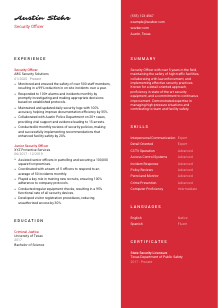
Language value depends on the site. In some settings, a second language helps with visitor screening, tenant interaction, or community-facing duties. In the example resume, Spanish is a useful addition because it can support communication in a large and diverse metro area, though it is not a universal requirement for every Security Officer role.
Present language skills as part of your ability to maintain order, provide clear instructions, and reduce misunderstandings. In security work, better communication can directly support smoother access control, faster incident response, and calmer public interactions.
If a language helps you document accurately or communicate effectively with the people on site, it belongs here. That extra capability can make your resume stronger when the role involves regular public contact or multilingual environments.
The summary needs to give a quick, credible picture of the kind of officer you are. In a few lines, it should cover your experience level, your operating strengths, and the kind of environments or responsibilities you are equipped to handle.
Start with a direct statement that identifies you as a Security Officer and gives your experience level. If you have worked in high-traffic, commercial, residential, healthcare, or public-sector settings, mention the environment if it supports the target job.
Follow with two or three specifics that connect to the employer's needs, such as incident response, alarm investigation, patrol coverage, report accuracy, law enforcement coordination, or surveillance system use. The sample summary works because it mentions high-traffic facilities, law enforcement collaboration, and security equipment instead of relying on vague claims about dedication.
Aim for three to five lines. Avoid generic adjectives unless they are backed by field context. "Detail-oriented" carries more weight when paired with accurate logs, policy review, or fast decisions in high-pressure situations.
A well-written summary should make the employer expect a disciplined, observant, and capable officer before they even reach your experience bullets. Wozber's free resume builder, together with its ATS resume scanner, can help you tighten that language so your resume stays aligned with the job and ready for screening.
A Security Officer resume works best when every section supports the same message: you can protect the site, follow protocol, communicate clearly, and respond well when something goes wrong. That means using specific experience, current credentials, relevant equipment skills, and concise reporting language throughout.
Use Wozber to organize that information into an ATS-friendly resume that matches the posting without sounding forced. The finished resume should make one thing easy to judge: whether you can step onto the property and handle the responsibilities of the role from day one.




