



Use Wozber and land your dream job
Create Resume
No registration required
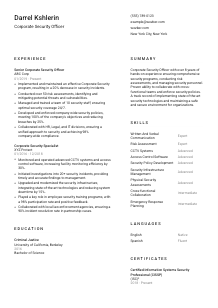
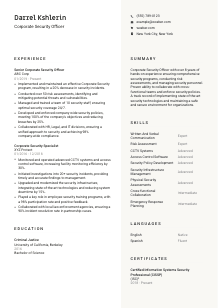
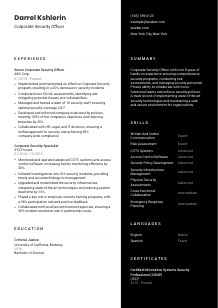
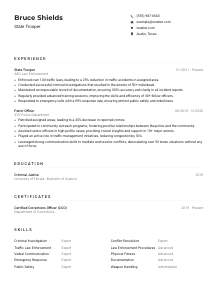
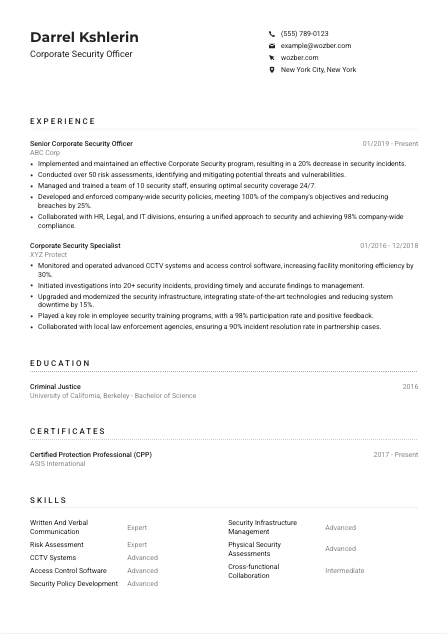
Enforcing order but your resume seems chaotic? Check out this Corporate Security Officer resume example, created with Wozber free resume builder. Learn how to align your defense tactics with job demands, making your career path secure and obstacle-free!
Corporate security resumes are read through an operational lens. Hiring teams want to see whether you can reduce incidents, run reliable protection programs, investigate threats, and coordinate with departments that influence policy, compliance, and response. If your resume stays vague, it can blur the difference between general guard work and corporate-level security leadership.
The first pass often depends on whether your resume makes core security work easy to trace, from risk assessments and access control oversight to policy enforcement and cross-functional coordination. Wozber's free resume builder helps organize that experience into an ATS-compliant resume, so the screening process can quickly surface your background in protecting people, property, and business operations.
This section needs to establish professional credibility quickly. For a Corporate Security Officer, that means clear contact information, the target title, and any location detail that directly affects eligibility, without clutter that distracts from your operational background.
Use your full name in a clean, readable style that matches the rest of the resume. Corporate security hiring tends to favor polished, business-ready presentation over decorative formatting, especially when the role works closely with HR, Legal, and executive stakeholders. Wozber's ATS-friendly resume templates help keep this section consistent and easy to parse.
Place "Corporate Security Officer" directly under your name when that is the role you are pursuing. This immediately aligns your resume with the opening and helps distinguish you from candidates coming from broader physical security or loss prevention backgrounds.
Add a reliable phone number and a professional email address. If the posting includes a location requirement, include your city and state as well. In the example, listing New York City, New York directly addresses the employer's stated location need, which is useful when geographic availability is part of the screen.
Add LinkedIn or a professional website only if it supports your candidacy with relevant security leadership, certifications, project history, or publications. A profile that reinforces investigations, policy development, training oversight, or security program management can strengthen the hiring read. If you include a link, make sure the content matches your resume.
Do not include age, marital status, photo, or other unrelated personal information. Corporate security resumes need to stay focused on operational trust, communication, and program ownership, not details that do nothing to support your ability to run assessments, supervise staff, or enforce procedures.
Your personal details should confirm that you are reachable, professional, and aligned with the basic requirements of the opening. When this section is clean, the reader can move straight to the security experience that matters most.




For this role, experience carries the most weight. Employers want more than a list of patrol duties or incident response tasks. They look for proof that you can build security coverage, assess risk, run investigations, manage personnel, and work across departments to protect assets in a corporate setting.
Mark the work that appears repeatedly in the posting, then mirror that language where it matches your background. Here, the priorities are clear: maintaining a corporate security program, conducting risk assessments and investigations, overseeing staff and vendors, developing policies, and collaborating with HR, Legal, and IT. Your bullets should speak to those functions directly.
List your most recent position first and include job title, company, and dates for each role. That structure helps hiring teams track your progression from hands-on security operations into broader program responsibility, which is often a key distinction in corporate security hiring.
Each bullet should show what you owned, how you executed it, and what changed because of your work. Good examples for this field include reducing incidents, improving monitoring coverage, closing vulnerabilities, standardizing procedures, or increasing compliance. The sample resume does this well by tying security program implementation to a 20% drop in incidents and policy enforcement to a 25% reduction in breaches.
Numbers are especially persuasive in this profession because they show scale and operational impact. Include metrics such as number of risk assessments completed, size of the team managed, incident reduction, coverage hours, compliance rates, training participation, or system downtime reduction. These are the kinds of measures that make your work legible to both hiring managers and ATS filters.
Keep the section centered on responsibilities and wins that match the target role. A hiring team for a Corporate Security Officer is more interested in investigations, policy enforcement, vendor coordination, CCTV and access control oversight, and cross-functional response than in unrelated duties or one-off achievements with no bearing on security operations.
Your experience section should make it easy to see the environments you have protected, the programs you have run, and the outcomes you delivered. Wozber's ATS optimization tools can help you align that record with the language of the opening so your most relevant work is visible early.
Education matters here because many corporate security roles ask for formal grounding in criminal justice, security management, or a related discipline. Present it clearly, especially when the degree is a stated requirement rather than a nice-to-have.
If the posting asks for a bachelor's degree in Criminal Justice, Security Management, or a related field, make that information easy to find. Place your degree, field, school, and graduation year in a straightforward format. In the example, "Bachelor of Science in Criminal Justice" directly matches the requirement.
Use a consistent order such as degree, field of study, institution, and graduation date. Corporate hiring often involves both recruiters and operational leaders reviewing the same resume, so readability matters just as much as ATS-friendly structure.
If your degree lines up closely with the posting, let that work for you. A directly related field supports your credibility in risk analysis, investigations, security planning, and policy development. If your degree is adjacent rather than exact, make sure the rest of the resume strengthens that connection through experience and certifications.
You do not need to turn this into a transcript. Include relevant coursework, honors, or academic projects only if they add useful context, such as studies in criminal justice, emergency management, threat assessment, or organizational security. This is especially helpful earlier in your career.
Clubs, associations, or university activities are worth listing only when they reinforce your security profile. For example, participation in criminal justice associations, emergency preparedness groups, or campus safety initiatives can support your story if you have limited professional experience.
This section does not need much space, but it does need precision. When your degree is presented clearly and aligns with the posting, it supports the broader case that you are prepared for corporate security work and can meet baseline screening requirements.
Certifications carry real weight in corporate security because they show specialized knowledge and continued engagement with professional standards. When a posting names credentials such as CPP or CISSP, that preference deserves direct attention on the resume.
Put the most relevant credentials first, especially when the job description calls them out. In this case, CPP and CISSP are preferred, so candidates who hold either one should make it easy to spot. The example resume benefits from listing both prominently.
Choose certifications that support corporate security, investigations, physical security operations, compliance, or related risk management work. A short list of respected, relevant credentials is stronger than a long list of marginal training items. If you use Wozber's ATS resume scanner, it can help highlight where named certifications should appear for stronger alignment.
Show when the certification was earned and whether it is current if that matters. Active status is especially useful for credentials that require renewal because it tells the employer your knowledge is up to date and still maintained.
Corporate security changes with new threat patterns, technology platforms, and compliance expectations. If you have renewed major certifications or completed relevant advanced training, that signals continued investment in the field and helps support senior-level candidacy.
Well-chosen certifications sharpen your credibility, especially when they match the posting's preferred qualifications. They should read as current, relevant proof of the security standards and technical awareness you bring to the role.
A Corporate Security Officer needs a practical mix of operational, technical, and communication skills. The best skill sections reflect how the job is actually done, from monitoring systems and assessing threats to writing policies and coordinating with internal teams and external vendors.
Start with the requirements that are stated outright, then add the capabilities the job clearly depends on. Here that includes CCTV systems, access control software, risk assessments, investigations, written and verbal communication, policy development, and cross-functional collaboration with groups such as HR, Legal, and IT.
List the skills most relevant to the position first rather than trying to capture everything you can do. For this kind of opening, security program management, physical security assessments, incident investigation, policy enforcement, and system monitoring should usually outrank broad workplace strengths. The sample skill list is strongest where it stays tied to the employer's requirements.
Group technical and functional skills in a way that reads quickly. You might separate tools and systems from leadership or communication capabilities, or keep a single list ordered by relevance. Either approach works if the section remains clear, ATS-friendly, and grounded in real security work rather than generic traits.
This section should sound like someone who has run security programs, worked with surveillance and access systems, and coordinated responses across a business. Use terms you can back up elsewhere in the resume, and let Wozber's ATS resume scanner help surface any missing language from the job description.
Language ability is not always a deciding factor in security hiring, but clear communication is. When a posting specifies professional English, meet that requirement directly. Any additional language can be valuable if it supports employee communication, incident response, or work across diverse teams.
If the employer specifies that English must be used effectively in a professional setting, list it clearly and give an accurate proficiency level. This removes any ambiguity around one of the stated requirements.
Include additional languages when they are genuinely useful in the workplace. In some corporate environments, that can support communication with employees, visitors, vendors, or external partners during routine operations and incident response.
Choose levels such as native, fluent, intermediate, or basic and keep them accurate. Security work often depends on precise communication in reports, interviews, and escalations, so overstating language ability can create real problems later.
If you are applying to a multinational company, a large urban employer, or a site with a diverse workforce, additional languages may deserve more visibility. They are not a substitute for security credentials, but they can strengthen your practical value in day-to-day coordination.
Keep this section in proportion. For most Corporate Security Officer resumes, languages are a secondary asset behind experience, systems knowledge, investigations, and policy work. Include them to round out the picture, not to carry the application.
Presented well, language skills add useful context without distracting from your core qualifications. The main point is simple: the employer should be able to see at a glance that you can communicate effectively in the environments the role requires.
The summary should establish your level, focus, and strongest qualifications in a few lines. For a Corporate Security Officer, that usually means years of experience, the type of environments you have protected, and the core areas where you deliver results, such as risk assessment, investigations, policy development, or team leadership.
Start from the responsibilities that define corporate security rather than from vague claims about professionalism. Protecting personnel and assets, managing security programs, assessing threats, and coordinating response across the organization are stronger anchors than generic adjectives.
Lead with your professional identity and years of relevant experience. A line such as "Corporate Security Officer with 8+ years of experience in corporate environments" gives immediate context and helps the reader place the rest of your resume.
Use the next sentence or two to highlight the capabilities that best match the job. That may include risk assessments, investigations, CCTV and access control oversight, policy enforcement, or staff leadership. The sample summary works because it combines years of experience with concrete focus areas instead of broad claims alone.
Aim for 3 to 5 lines and make each one count. Do not try to restate the full resume. Give enough detail to position yourself for the role, then let the experience section carry the proof. Wozber's free resume builder can help shape this into an ATS-compliant resume summary that reflects the language of the posting without sounding forced.
A focused summary helps the reader understand, within seconds, whether your background is rooted in corporate security operations or something adjacent. When it is tailored well, the rest of the resume reads with much clearer context.
A Corporate Security Officer resume should show that you can protect people and assets, run assessments and investigations, work with surveillance and access systems, and coordinate security standards across a business. When each section supports that story, the application reads as deliberate rather than generic.
Use Wozber to build, tailor, and refine your ATS-compliant resume so the requirements, keywords, and security outcomes in the posting connect cleanly to your actual experience. The final result should make it easy to judge your readiness to lead corporate security operations from day one.




