



Use Wozber and land your dream job
Create Resume
No registration required
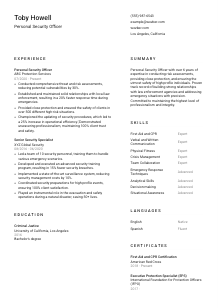
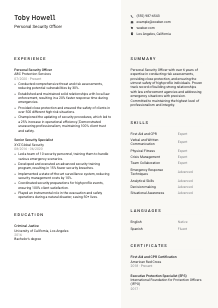
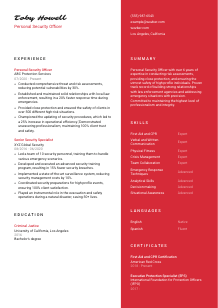
Safeguarding VIPs, but your resume feels undercover? Check out this Personal Security Officer resume example, created with Wozber free resume builder. It shows how you can present your protection prowess to match an organization's expectations, guiding your security career into the limelight it deserves!
Close protection work is judged in motion. Hiring teams want to see whether you can read risk early, stay composed around principals, and adjust protective coverage without disrupting the client's day. Your resume needs to make that operational judgment visible through threat assessment work, emergency response capability, law enforcement coordination, and the professional discretion that keeps trust intact.
A tailored resume changes how quickly that picture comes into focus. When the wording reflects the posting's language around close protection, risk assessment, first aid, and communication, Wozber's free resume builder helps you shape an ATS-compliant resume that surfaces the right experience first. That makes it easier for a hiring team to distinguish executive protection depth from broader security work.
Personal details matter more in security roles than they do in many other professions. This section should show that you are reachable, professional, and, when relevant, already positioned to meet practical requirements such as location. Keep it clean and factual.
Use your full name at the top in the most prominent text on the page. For a Personal Security Officer, that simple choice supports the overall impression of clarity, control, and professionalism that the rest of the resume needs to reinforce.
Place "Personal Security Officer" directly under your name when that is the role you are pursuing. Mirroring the posted title helps with ATS alignment and immediately frames your background around close protection rather than general guard, patrol, or facility security work.
Security hiring often moves quickly, especially when schedules, travel, or principal availability are involved. Use a phone number you answer reliably and a professional email address based on your name.
If the posting requires local availability, state your city and state clearly. In this example, Los Angeles, California belongs in the header because the employer specifically asked for candidates located there. Only do this when location is relevant to the opening.
Include LinkedIn or a professional site only if it supports your application with consistent information, certifications, or career history. For protection roles, that profile should reflect the same discretion as your resume. Keep sensitive client details, routes, or assignment specifics off public pages.
This section should tell the employer you are accessible, polished, and already aligned with the practical basics of the assignment. That is the right opening for a protection resume.




Experience carries the most weight on a Personal Security Officer resume because the work is built on judgment under pressure, not just training. Focus on assignments that show protective coverage, risk reduction, emergency response, and coordination with others responsible for safety.
Start by isolating the work this employer needs done day to day. Here, the priority areas are threat and risk assessments, close protection, coordination with law enforcement or security teams, emergency response, and updating procedures. Those should guide which roles and bullets rise to the top.
List your jobs from most recent to oldest, but give the most space to positions that reflect protection work around individuals, executives, families, or high-risk movement. If your background includes military or law enforcement service, frame the parts that transfer directly to personal security rather than listing broad duty history.
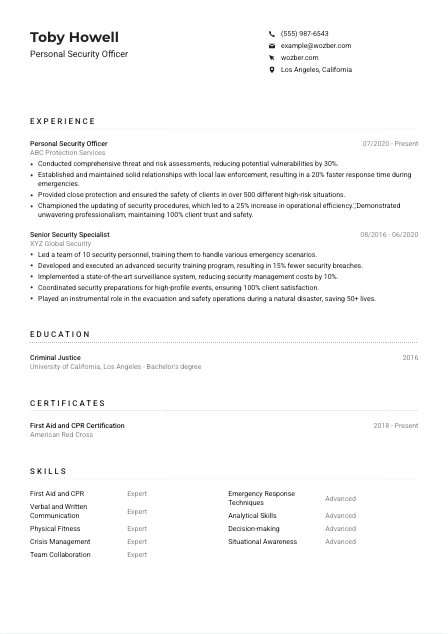
Each bullet should show what you handled and what changed because of your work. "Conducted threat and risk assessments" becomes stronger when paired with an outcome such as reduced vulnerabilities, faster incident response, or safer movement planning. The sample resume does this well by tying assessments to a 30% reduction in exposure and law enforcement relationships to faster emergency response.
Use numbers that make sense for security operations. That can include incident reduction, response-time improvement, number of high-risk assignments completed, personnel led, breaches prevented, training completion rates, or operational efficiency gains. Metrics like "500 high-risk situations" or "25% increase in operational efficiency" give hiring teams a clearer read on scope and reliability.
A Personal Security Officer resume does not need every security duty you have ever performed. Prioritize assignments involving principal safety, route planning, advance work, emergency action, surveillance awareness, or confidential client support. Leave out older or unrelated work unless it adds something concrete to your candidacy, such as command experience or crisis leadership.
The strongest experience sections show calm execution, sound judgment, and measurable risk reduction. When those points are easy to spot, your background reads like protection experience rather than generic security service.
Education will not outweigh real protection experience, but it still helps position your background. For this field, list formal education clearly and let it support your operational training, legal awareness, and understanding of security practice.
This opening requires a high school diploma or equivalent, with a bachelor's degree preferred. If you have a degree in criminal justice, security studies, public safety, or a related field, place it clearly so the preference is easy to identify during screening.
Use a simple structure: degree, field of study, school, and graduation year. That is enough for most Personal Security Officer applications and keeps the resume focused on the experience and certifications that usually matter more.
A relevant degree supports your resume when it connects naturally to the role. The example lists a bachelor's degree in Criminal Justice, which fits well because it complements work involving threat assessment, legal awareness, and coordination with law enforcement. If your degree is in another field, list it honestly and let your experience carry more of the case.
Most experienced candidates do not need a course list. Include it only if it highlights material such as emergency management, criminal law, defensive tactics, or risk analysis that directly supports close protection work, especially early in your career.
Academic honors, academy training, or relevant extracurricular leadership can stay if they reinforce discipline, judgment, or public safety focus. Skip anything that adds length without improving the employer's understanding of your readiness for protection assignments.
This section should confirm baseline qualifications and, when applicable, show training that complements protection work. Let it support your case without crowding out the experience that proves you can do the job.
Certifications matter in personal security because they show current operational readiness. First aid, CPR, protective services training, and other role-specific credentials help employers gauge whether you can respond effectively when conditions shift fast.
List the credentials that connect directly to the assignment. For this role, first aid and CPR belong near the top because the posting explicitly asks for them. Protective services credentials such as executive protection training can further strengthen your case when they are current and credible.
Choose certifications that support the employer's stated needs or the realities of close protection work. Medical response, defensive driving, protective intelligence, emergency management, or executive protection training are usually more valuable than broad, unrelated certificates.
Include issue dates and, when relevant, renewal or validity periods. In protection hiring, an expired CPR card is not a minor detail. Clear dates show that your qualifications are current and usable in the field.
Protection work changes with environment, travel patterns, client profile, and threat level. Keeping certifications active and adding new training over time signals professional discipline. The example's active First Aid and CPR certification and Executive Protection Specialist credential show the kind of upkeep employers like to see.
Your certificates should show that you can respond, protect, and stay current with accepted practice. In close protection, that practical credibility matters.
A Personal Security Officer skills section should read like the toolkit behind your field performance. Keep it focused on judgment, response capability, situational control, and communication, not a long list of generic personality traits.
Read the posting closely and extract the abilities it emphasizes. This one calls out analytical thinking, decision-making, emergency response techniques, first aid, CPR, and strong verbal and written communication. Those terms belong in your skills section when they accurately describe your background.
Protection work depends on more than physical presence. Include tactical skills such as crisis management, situational awareness, emergency response, and risk assessment, alongside communication, discretion, team coordination, and calm decision-making. That combination reflects how the work is actually performed around principals, assistants, drivers, and law enforcement contacts.
Do not overload the section with every capability you have developed. A shorter, role-aligned list is more credible and easier for both ATS systems and hiring managers to read. The sample resume stays on track with skills like Crisis Management, Situational Awareness, and First Aid and CPR, all of which support the responsibilities in the posting.
This section should reinforce the kind of protection professional you are: alert, reliable under pressure, and equipped to manage real-world security decisions.
Language ability can matter in protection roles when it improves coordination, de-escalation, travel support, or communication with a client's broader team. List languages accurately and keep the emphasis on real working proficiency.
If the posting requires spoken and written English, list English first with an honest proficiency level. That is especially important in a role where reports, incident communication, and coordination with law enforcement may all depend on clear English.
Include additional languages when they would be useful in client environments, travel contexts, family support, or coordination with local contacts. Spanish, for example, may be valuable in many protection settings, but it should be listed because you can genuinely use it, not because it seems broadly impressive.
Stick with straightforward levels such as Native, Fluent, Intermediate, or Basic. Protection work leaves little room for ambiguity, and your language section should reflect that same precision.
If a second language has helped with site coordination, event movement, client communication, or emergency response, that context can strengthen its value. Keep the note brief and grounded in actual work rather than general cultural interest.
If you have supported principals during international travel or worked regularly in multilingual environments, that can be worth noting elsewhere in the resume, usually in experience bullets. Use it only when it adds substance to your protection background.
For security work, language fluency is useful when it improves coordination and control. List only what you can use confidently in the environments you expect to work in.
The summary should establish your protection background quickly and with specifics. In a few lines, show the kind of environment you have worked in, the protective functions you handle well, and the scale or outcomes that make your experience credible.
Open with your years of experience and the protection functions most relevant to the job. For this position, that means close protection, threat and risk assessment, emergency response, and coordination with external security partners.
State the operating strengths that hiring teams expect from a Personal Security Officer, such as calm decision-making, discretion, strong communication, and the ability to protect high-profile individuals in changing environments. Keep the tone factual, not dramatic.
A summary becomes more convincing when it points to real performance. The sample resume does this by referencing six years of experience, risk assessments, close protection work, and trusted coordination with law enforcement. You can also mention measurable outcomes if they are brief and relevant, such as reducing vulnerabilities or managing large numbers of high-risk assignments.
Aim for three to five lines with no filler. A hiring manager should be able to read the section in seconds and understand your level, your specialty, and the kind of protective work you are ready to handle.
Your summary should tell the employer, quickly and credibly, that you understand protection work and have already performed it under pressure. That sets the right frame for everything that follows.
A Personal Security Officer resume should make risk judgment, close protection experience, emergency response capability, and professional discretion easy to recognize. When each section is tailored to the assignment, the hiring team can see whether your background matches the level of trust and composure the role requires.
Use Wozber's free resume builder to organize that experience in an ATS-friendly resume format, refine role-specific language with AI support, and check alignment with an ATS resume scanner. The end result should give employers a clear read on how you protect people, manage pressure, and contribute to a secure environment from day one.




