



Use Wozber and land your dream job
Create Resume
No registration required
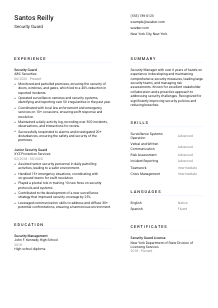
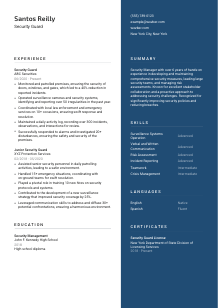
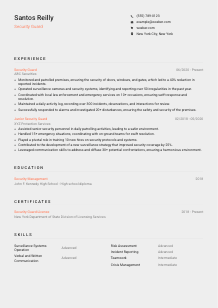
Standing watch, but your resume seems off-duty? Check out this Security Guard resume example, created with Wozber free resume builder. It shows how to present your vigilance and dedication in line with job specifications, keeping your career path as secure as the sites you safeguard!
Security Guard hiring moves quickly when a resume shows the basics that matter on the ground: patrol coverage, incident response, accurate reporting, and the ability to stay alert without constant supervision. Many applicants stay too general. They say they are dependable or watchful, but never show how they handled alarms, monitored entry points, documented incidents, or worked with law enforcement and emergency personnel.
Once your resume is tailored to the post, hiring teams can tell whether you have actually done the work or only worked near it. Wozber's free resume builder helps you align your wording with the job ad in an ATS-friendly resume format, so duties like surveillance monitoring, patrols, and daily activity logs are easy to match to your background. That clarity matters when the employer needs someone who can step into a shift and protect the site from day one.
For security roles, the top of the resume needs to be clean, direct, and easy to verify. This section does not need personality or filler. It needs to confirm who you are, how to reach you, and whether you meet any practical requirement the employer has stated, including location when that is relevant.
Place your full name at the top in the clearest text on the page. Hiring teams often review many similar applications for guard posts, and a clean header makes it easier to track your file, license details, and interview communication without confusion.
Add "Security Guard" under your name if that is the role you are pursuing. This helps immediately position your resume for patrol, access control, surveillance, and incident response work instead of leaving the reviewer to guess whether your background fits frontline site security.
Include a working phone number and a professional email address you check regularly. Security hiring can move fast when a site needs coverage, so missed calls or an outdated email can cost you an interview. Review every digit and character before sending.
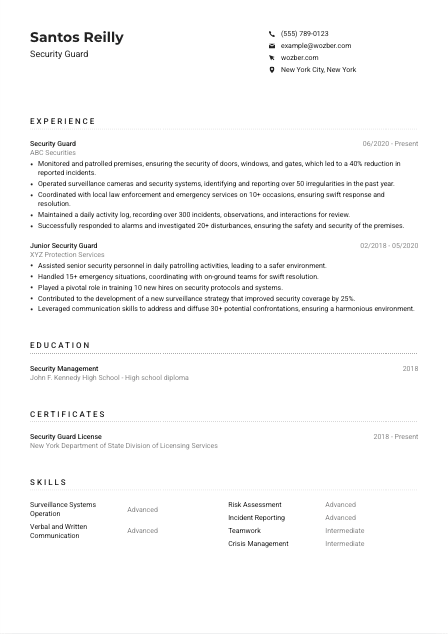
If the posting names a location requirement, include your city and state. In the example here, listing New York City, New York directly supports a stated requirement and removes uncertainty about local availability, commute, and scheduling. Use this tactic when location is part of the screening criteria, not as a default for every application.
A LinkedIn profile or professional website can support your application if it reflects the same security background shown on your resume. Keep it consistent with your work history, licenses, and certifications. If the profile is sparse or outdated, leave it off rather than create doubt.
At the top of a Security Guard resume, clarity matters more than style. A clean header, the right job title, and location details when requested make the application easier to process and move forward.




This is the section hiring managers read most closely for Security Guard roles. They want to see proof that you have monitored sites, responded under pressure, documented incidents, and followed procedure during routine patrols and unexpected disturbances. Broad claims about being alert or responsible do not carry much weight without duties, outcomes, and context.
Read the posting closely and mark the operational duties it names. For this role, that includes patrolling premises, checking doors and gates, responding to alarms, operating surveillance systems, maintaining daily logs, and coordinating with law enforcement when needed. Rewrite your experience bullets so those exact responsibilities appear naturally where they match your real work.
Start with your most recent security position and work backward. This format lets hiring teams quickly see your current site responsibilities, the environments you have worked in, and how your duties expanded over time. A move from junior guard support to independent patrol and incident handling is useful progression to make visible.
Each bullet should show what you were responsible for and what happened as a result. Good security bullets mention patrol frequency, alarm response, incident documentation, surveillance monitoring, or emergency coordination. The example resume does this well with details such as reducing reported incidents by 40 percent and responding to more than 20 disturbances.
Quantify your experience with measures that make sense for the job. That can include incident reduction, number of disturbances investigated, logs maintained, irregularities identified through CCTV, or emergency responses handled. Metrics like these show scale and consistency better than generic statements about keeping people safe.
If a past role does not support your case for patrol, monitoring, reporting, de-escalation, or emergency response, shorten it or leave it out. Keep the section focused on work that shows situational awareness, procedural discipline, and the ability to operate independently or with a team during a shift.
A Security Guard resume becomes much stronger when the experience section reads like actual site coverage and incident handling, not a list of soft traits. Use clear bullets, relevant terminology, and measurable results, then refine the wording in Wozber's ATS-friendly resume template so the right duties stand out fast.
Education is usually a straightforward check in Security Guard hiring, but it still matters because it confirms baseline eligibility. Most employers are not looking for a long academic story here. They want to see that you meet the stated requirement and, if relevant, any coursework that supports security operations or public safety work.
If the posting asks for a high school diploma or equivalent, make sure that appears plainly in your education section. Do not bury it. In this example, listing a high school diploma directly answers one of the employer's minimum requirements.
Present your education with the school name, credential, field if relevant, and graduation year or date. Clean formatting helps the employer confirm eligibility quickly, especially when they are reviewing experience, licenses, and shift-readiness at the same time.
If you studied security management, criminal justice, public safety, or a related area, include that field. It can strengthen your profile, especially earlier in your career. In the sample resume, the security-related field adds useful context even though the diploma itself is the main requirement.
Courses in surveillance systems, emergency response, conflict de-escalation, or report writing can be worth mentioning if you are light on direct experience. For an experienced Security Guard, keep this brief unless the employer is clearly asking for specialized knowledge.
Awards, honors, or relevant extracurricular activities can help if they show reliability, leadership, discipline, or public safety involvement. Early-career applicants benefit most from this. If you already have several years of site security experience, keep the emphasis on work history and certifications instead.
For most Security Guard roles, education should confirm the required credential without taking space away from patrol, reporting, and incident response experience. Include relevant details when they strengthen the case, then move on.
In security hiring, certifications are often a compliance checkpoint before anything else. If the role requires a valid guard license or state credential, put it in plain sight and make the status easy to understand. This section can move your resume forward quickly when it answers a mandatory requirement without extra digging.
List the certification or license the employer asked for first. Here, a valid Security Guard license is a stated requirement, so it should appear prominently. This is the kind of detail that can determine whether your application moves past the first review.
Put the most relevant certifications first, especially anything connected to site security, emergency response, safety procedures, or state compliance. Hiring teams care most about credentials that support patrol work, incident handling, and lawful operation on site.
Name the issuing organization and show the dates clearly, particularly if the credential must remain current. The sample resume handles this well by naming the New York licensing authority and showing that the license is active. That level of detail reduces follow-up questions.
If you have renewed your license or completed recent training in areas such as emergency procedures, first aid, or conflict management, include it. Security work depends on current compliance and up-to-date procedures, so recent credentials reinforce professional reliability.
For Security Guard applications, a visible and current license can be one of the fastest ways to clear an early screening hurdle. Make the credential easy to spot, easy to read, and easy to verify.
The skills section should reflect how Security Guard work is actually carried out. That means operational abilities, communication, and judgment under pressure, not a padded list of vague strengths. Choose skills that connect directly to the post, the site environment, and the reporting or monitoring tools you have used.
Start with the job ad and identify the skills behind the responsibilities. For this kind of post, that includes surveillance system operation, incident reporting, verbal and written communication, risk assessment, teamwork, and independent judgment during patrols or alarm response.
Keep the list close to the employer's language where it reflects your experience. If the role emphasizes daily activity logs and irregularity reporting, skills like incident reporting and written communication belong near the top. If it involves CCTV monitoring, include surveillance systems operation rather than a generic term like technology.
Choose the skills you can support in your experience section. The sample resume works because the skills connect back to real bullets about monitoring premises, coordinating with emergency services, and documenting hundreds of incidents. That consistency matters more than listing every capability you have ever used.
A tight, relevant skills section helps hiring teams connect your resume to the post quickly, especially in ATS review. Wozber's ATS-friendly resume format can help you keep the wording aligned so the most important security capabilities are easy to spot.
Security work depends on clear communication during routine patrols, incident reporting, visitor interaction, and emergencies. If the employer states a language requirement, reflect it directly. Additional languages can also add value in public-facing sites, residential buildings, retail environments, and diverse urban settings.
If the posting requires clear English, list English prominently and label your proficiency honestly. For Security Guard work, this matters for writing incident reports, communicating over radio or phone, giving directions, and speaking with supervisors or emergency responders.
Include additional languages when they are genuinely useful for the public, tenants, visitors, or staff you may interact with. In some locations, bilingual ability can help with de-escalation, access questions, or basic incident communication. In the example resume, Spanish adds practical value for a city-facing role.
Terms like "Native," "Fluent," "Intermediate," and "Basic" are enough. Avoid overstating your ability. In security work, inaccurate language claims can create real problems during emergencies or written reporting.
A hospital, office tower, school, retail site, or residential property can call for different communication demands. If a language helps you handle visitors, residents, vendors, or tense interactions more effectively, it is worth listing. Keep the emphasis on practical communication, not just cultural interest.
Additional language ability is not always a hiring requirement, but it can support service, safety, and conflict reduction. Present it as a useful job skill that improves communication on site, especially in high-traffic or community-facing environments.
For a Security Guard, language skills matter when they help you document incidents clearly, respond effectively, and communicate with the people on site. List them accurately and keep the focus on real working use.
Your summary should quickly tell the employer what kind of Security Guard you are, how much experience you bring, and which parts of the job you handle well. This section works best when it is brief and specific. Avoid broad security language that suggests a different level of role than the one you are applying for.
Review the posting before writing your summary. If the job centers on patrols, surveillance, alarm response, and reporting, your summary should reflect that operational scope. Do not drift into executive security strategy or team leadership language unless that matches your target role.
Lead with a direct line such as "Security Guard with 6+ years of experience in site patrol, surveillance monitoring, and incident response." This immediately places you in the right lane and gives the employer a clear frame for the rest of the resume.
Follow with specifics that connect to the job, such as reducing incidents, maintaining detailed activity logs, handling disturbances, or coordinating with emergency services. The example resume has strong material for this, but its summary should be brought closer to frontline guard work rather than "Security Manager" positioning.
Aim for three to five lines. That is enough to establish your background, key capabilities, and a notable result without repeating the entire experience section. A concise summary works especially well when every sentence reflects the duties named in the posting.
A focused summary helps the employer understand your security background before they reach the bullet points. Use Wozber's AI resume builder and ATS resume scanner to align the language with the job description, surface missing terms, and make your Security Guard experience easier to judge quickly.
A Security Guard resume works when it shows steady judgment, procedural discipline, and clear experience with patrols, alarms, surveillance, and incident reporting. Keep every section tied to the actual post, especially the required license, communication ability, and day-to-day site responsibilities.
Use Wozber to tighten the language, improve ATS optimization, and present your background in an ATS-compliant resume that reflects real guard work. When the hiring team opens your application, they should be able to see right away that you can monitor the premises, document what happens, and respond when something goes wrong.




