



Use Wozber and land your dream job
Create Resume
No registration required
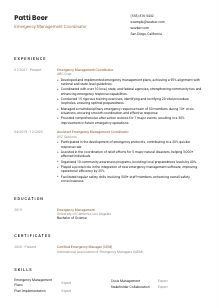
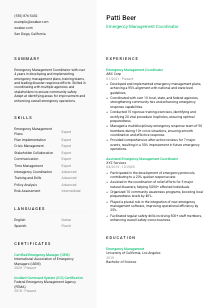
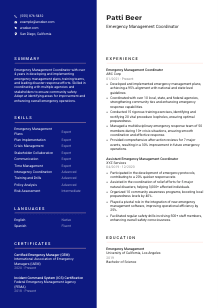
Navigating crises, but uncertain about your resume? Check out this Emergency Management Coordinator resume example, created with Wozber free resume builder. Learn how to match your disaster-response expertise to job specifics, ensuring your career stays as well-prepared as your emergency plans!
Emergency management work gets judged in real time. Plans have to hold up under pressure, drills have to expose weaknesses before an incident does, and coordination has to work across agencies that use different systems, protocols, and chains of command. Your resume should make that operational credibility visible from the first screen, especially your planning scope, response leadership, and ability to improve preparedness after reviews and exercises.
When that experience is tailored well, hiring teams can quickly distinguish someone who has supported emergency operations from someone who has actually built plans, run drills, coordinated responders, and improved procedures after an event. Wozber's free resume builder helps you align that record in an ATS-friendly resume format, so federal, state, and local coordination work reads clearly and the resume surfaces the standards this role is hired on.
This section is simple, but it still carries practical value. For an Emergency Management Coordinator, clear contact details, a precise title, and any location alignment remove avoidable friction before the reader gets to your plans, drills, and response record.
Use your full name as the most visible text on the resume so the document feels formal and easy to reference in interview scheduling, stakeholder review, or internal hiring discussions. Keep the presentation clean and professional. You do not need design flourishes here. In a field built on clear communication and usable documentation, straightforward formatting already works in your favor.
Place "Emergency Management Coordinator" directly beneath your name when that is the role you are pursuing. This immediately frames your background around emergency planning, interagency coordination, drills, and response operations instead of leaving the reader to infer your direction from later sections. If your current title differs slightly, your headline can still reflect the target role as long as the experience below supports it.
List a reliable phone number and a professional email address that you check regularly. Emergency management hiring often moves through several reviewers, and missed outreach can slow an application unnecessarily. If you include a website or LinkedIn profile, make sure it reflects relevant work such as incident response leadership, preparedness initiatives, FEMA or ICS training, or public safety partnerships rather than a generic online presence.
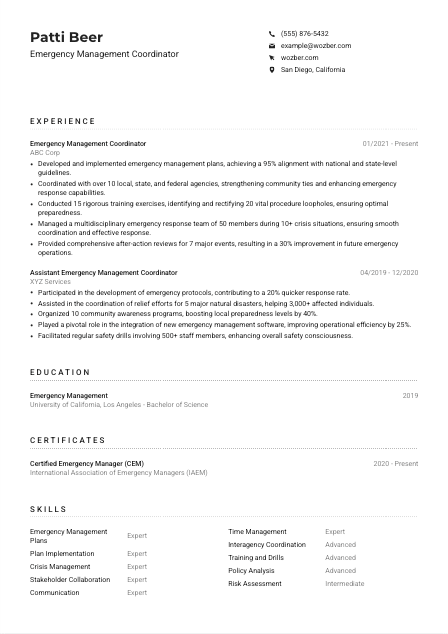
If the employer specifies a location requirement, handle it directly in this section. Here, the posting asks for San Diego, California, or willingness to relocate, so including San Diego in the sample resume helps remove an obvious screening question. Use this approach when geography affects deployment, coordination with local agencies, or on-site response expectations, but do not overstate location as a universal hiring factor for every emergency management opening.
Include links that strengthen your case for operational credibility. A polished LinkedIn profile can support your resume if it reflects certifications, emergency preparedness work, cross-agency projects, or training leadership. Skip anything outdated or unrelated. Every item in this section should support the impression that you are organized, reachable, and already operating at coordinator level.
Personal details do not need to do heavy storytelling, but they should remove doubt fast. When your title, contact information, and any required location details are easy to scan, the reader can move straight to the part that matters most in this field: how you plan, coordinate, and respond.




This is where an Emergency Management Coordinator resume earns attention. Hiring teams look for more than participation in emergency operations. They want to see who developed plans, led training, coordinated agencies, managed teams during incidents, and turned after-action findings into better procedures.
Read the job description line by line and pull out the working responsibilities behind it. For this role, those include plan development, alignment with national and state guidance, multi-agency coordination, drills, incident team management, and after-action review. Then match each one to a specific example from your background. If a posting emphasizes coordination with local, state, and federal partners, your resume should not just mention collaboration. It should show which agencies or stakeholder groups you worked with and what that coordination improved.
Use reverse-chronological order and give the most space to positions tied closely to emergency operations, business continuity, disaster response, public safety, or preparedness planning. Progression matters here. Moving from an assistant or support role into direct coordination or leadership helps the employer see increased responsibility in planning, training, and incident management. The sample resume does this well by moving from Assistant Emergency Management Coordinator into Emergency Management Coordinator with stronger ownership in the newer role.
Emergency management resumes get stronger when each bullet shows what changed because of your work. Replace broad descriptions like "responsible for emergency plans" with statements that show implementation, compliance, scale, or response improvement. For example, the sample bullet about developing emergency management plans and reaching 95% alignment with national and state-level guidelines works because it connects planning work to a clear operating standard. Use the same approach for drills, coordination, public education, and response leadership.
Numbers are especially useful in this field because they show scale and cadence. Include the number of drills run, agencies coordinated, staff trained, incidents managed, community members served, or procedural gaps corrected. Metrics like faster response times, stronger compliance alignment, improved preparedness scores, or better after-action outcomes help a hiring manager picture your range. In the example, figures such as 15 training exercises, 10+ crisis situations, and a 30% improvement in future operations give the work practical weight.
Choose accomplishments that reflect the real center of the job: preparedness systems, incident coordination, stakeholder communication, and procedural improvement. Leave out unrelated achievements that do not support those themes. Even if you worked in a broader operations or administrative role, pull forward the parts involving emergency plans, crisis response, public safety training, risk assessment, compliance, or cross-functional coordination. That focus helps your resume read as emergency management experience rather than general program support.
A strong experience section shows a full emergency management cycle. It should be easy to see where you built plans, tested them through exercises, coordinated during events, and improved procedures afterward. When those pieces are backed by metrics and role-specific language, the resume reads well to both human reviewers and ATS optimization tools.
Education matters here because the role often sits at the intersection of policy, public administration, preparedness, and field operations. Your degree should be presented in a way that quickly confirms you meet the baseline requirement and supports the kind of work shown in your experience.
If the posting asks for a bachelor's degree in Emergency Management, Public Administration, or a related field, make that easy to find. List the degree, field, school, and graduation year clearly. In this case, a Bachelor of Science in Emergency Management aligns directly with the employer's requirement, so it deserves a clean, prominent entry without extra wording around it.
Keep the format simple so the information is readable by both ATS systems and human reviewers. Degree first, then field, school, and date is usually enough. Emergency management hiring rarely depends on decorative academic presentation. It depends on whether your education supports work in planning, policy, coordination, and response environments.
A degree specifically tied to emergency management should be stated exactly, because it reinforces the professional direction of your resume. If your degree is in a related area such as public administration, homeland security, environmental health, or criminal justice, you can still present it confidently, especially when the rest of the resume shows emergency planning or response experience. The key is to make the connection obvious rather than leaving it implied.
Early-career candidates can strengthen this section with relevant coursework, capstone projects, or academic exercises tied to incident command, hazard mitigation, continuity planning, risk assessment, public communication, or disaster recovery. For more experienced candidates, those details usually matter less than field results, so include them only if they directly reinforce a target requirement.
Memberships, honors, or university leadership can help if they connect to emergency preparedness, public service, crisis communication, or community resilience. Keep the threshold high. This role is hired on applied judgment and coordination ability, so academic extras should support that story rather than distract from it.
Your education section should answer the degree requirement quickly and without clutter. Once that box is clearly checked, the rest of the resume can do the heavier work of showing how you operate in drills, incidents, and cross-agency planning.
Certifications carry real weight in emergency management because they point to recognized training standards, current practice, and commitment to the discipline. They are especially useful when the employer names a preferred credential or when your work depends on incident command, regulatory alignment, or formal preparedness frameworks.
Read the posting for named credentials and list those first when you have them. Here, Certified Emergency Manager, or CEM, is highly preferred, so placing it at the top makes sense. That immediately strengthens your positioning for roles that involve plan oversight, multi-agency coordination, and leadership during high-pressure incidents.
List certifications that directly support emergency management work rather than broad professional development courses. CEM, FEMA training, ICS credentials, continuity certifications, hazard-specific training, public information coursework, and disaster recovery programs usually carry more value here than generic management certificates. The sample's ICS certification is a solid example because it supports command structure awareness and incident coordination.
Dates matter when a credential requires renewal or when current training reflects active professional engagement. In emergency management, stale certifications can raise questions if they relate to response systems, regulatory guidance, or command protocols. Showing valid date ranges helps the reviewer understand that your knowledge is current and maintained.
Emergency management standards, systems, and agency expectations change over time. Continue adding training that supports the kinds of incidents and responsibilities you handle, whether that means exercises, ICS refreshers, hazard-specific response, mass care, mitigation planning, or continuity operations. This section should reflect an active practitioner, not someone relying only on past qualifications.
Well-chosen certifications tell the reader you speak the language of the field and stay current with formal frameworks that shape planning and response work. If you are using Wozber's ATS resume scanner, make sure named credentials from the posting appear in the right form so they are easy to identify.
Emergency Management Coordinator roles require a mix of operational knowledge and people-facing judgment. The skills section should reflect that balance clearly, with enough specificity to support the work in your experience rather than reading like a generic list of strengths.
Job descriptions often spell out the exact skill categories the employer wants to see. Here, that includes knowledge of emergency management regulations and procedures, collaboration with multiple agencies, communication, plan development, drills, and response coordination. Mirror that language where it matches your background so the connection is immediate for both ATS screening and human review.
Do not separate operational skills from interpersonal ones as if one matters more. Emergency management depends on both. Include hard skills such as emergency planning, risk assessment, policy analysis, incident coordination, training exercises, and after-action review alongside communication, stakeholder management, and team leadership. The sample skills list works because it balances planning and crisis-management capabilities with collaboration and communication.
A shorter list with real backing is stronger than a long inventory of vague abilities. Every skill should connect to something visible elsewhere in the resume, whether that is developing plans, running drills, improving response procedures, managing a multidisciplinary team, or coordinating across agencies. If you cannot point to a bullet, certification, or project that supports the skill, reconsider including it.
This section should sound like it belongs to someone who has operated in preparedness and response environments. When the skills mirror the posting and match the experience section, hiring teams can quickly connect your terminology to real planning and incident work. Wozber's free resume builder can help organize that language into an ATS-compliant resume without flattening the specifics.
Language ability matters in emergency management because instructions, coordination updates, and public communication often need to be understood quickly and accurately. This section should stay concise, but it can still support your application when the posting names a required language or when multilingual communication is relevant to the communities you serve.
When the employer specifies a language requirement, lead with it. This posting asks for advanced English proficiency, so English should appear first with an accurate level. That simple move confirms a core requirement tied to reporting, interagency communication, public guidance, and documentation during incident response.
Choose standard terms such as native, fluent, advanced, intermediate, or basic. Emergency management work depends on clarity, so avoid creative or vague labels. A hiring manager should be able to tell quickly whether you can lead briefings, write reports, support training, or communicate with affected communities in that language.
Extra languages can add value when the role involves community outreach, public education, shelter operations, or coordination in diverse service areas. The sample resume includes Spanish, which could be relevant in many public-facing emergency management settings. Treat that as a useful illustration, not a universal requirement. Include additional languages when they strengthen your actual operating range.
Overstating language ability is risky in any role, and especially so where instructions, incident communication, and stakeholder updates need precision. If you can converse but not brief, write, or translate confidently in a professional setting, choose a lower level. Accuracy protects your credibility.
If your target role supports a region with multilingual communities or requires regular coordination across diverse organizations, language skills can reinforce your readiness for outreach and response. Keep the section practical. The point is to show communication range where it has operational value, not to turn language ability into a separate story line.
For this profession, language skills are most useful when they support briefings, public communication, documentation, or community coordination. Keep the section honest and specific so the reader understands how you can communicate when conditions are demanding.
The summary is your fastest chance to frame the kind of emergency management professional you are. It should give a hiring manager a clear read on your level, your area of ownership, and the kinds of planning or response outcomes you can deliver.
Start by identifying the few responsibilities that define the target job most clearly. For this role, that means emergency management plans, multi-agency coordination, training exercises, team leadership during incidents, and after-action improvement. Your summary should reflect the parts of that work where you have the strongest track record instead of trying to mention every possible competency.
A direct opening works best here. State your professional identity and the amount of experience you bring, such as more than 4 years in emergency management, preparedness, response coordination, or related operations. The sample summary does this effectively by immediately establishing role relevance and years in the field.
Choose strengths that are central to the job and supported by the resume below. Good options include developing emergency plans, coordinating agencies, leading drills, improving response procedures, or managing incident teams. If possible, hint at scale or outcomes, such as improved preparedness, stronger alignment with guidelines, or more effective future operations. This makes the summary feel earned rather than generic.
Aim for three to five lines that read cleanly in one pass. Avoid soft claims that could fit any role. In emergency management, specific language such as preparedness planning, interagency coordination, crisis response, or after-action review says much more than broad claims about being organized or passionate. A compact summary with the right terminology sets up the rest of the resume well.
Your summary should make one thing clear before the hiring manager reaches your experience section: you already understand the planning, coordination, and response demands of the job. When it is tailored tightly and presented in Wozber's ATS-friendly resume template, the rest of the document has a clear frame to build on.
A well-tailored Emergency Management Coordinator resume shows more than interest in the field. It shows that you can build plans against formal guidance, coordinate agencies and community partners, run exercises that expose gaps, lead teams during incidents, and improve operations after review.
Use Wozber to organize those details in an ATS-friendly resume format, strengthen alignment with the posting through the ATS resume scanner, and keep your language close to the operational realities of the job. The final resume should make it easy to judge your preparedness to coordinate when conditions are unstable and decisions matter.