



Use Wozber and land your dream job
Create Resume
No registration required
Steering web ventures, but your resume feels like a 404? Check out this Web Project Manager resume example, made with Wozber free resume builder, to learn how to map your digital dexterity to match job criteria. As systematic as your site architecture, you'll build a career that's always live and loading!
Web project management sits at the intersection of delivery, coordination, and technical judgment. Hiring teams want to see whether you can keep web builds moving across developers, designers, stakeholders, and vendors while protecting scope, timeline, budget, and release quality. Your resume should make that operating range visible fast.
For this role, the first screen often separates general project coordinators from managers who have actually run web projects end to end. Using Wozber's free resume builder helps you tailor that story into an ATS-compliant resume by matching the language of the posting and surfacing the web delivery work, reporting cadence, and tool use that matter most. That makes it easier to show that you can lead a project from kickoff through launch.
This section is brief, but it answers practical questions before a hiring manager reaches your experience. For a Web Project Manager, that means presenting clear contact details, the exact target title, and any location information the employer has explicitly requested.
Use your full name as the visual anchor of the resume. Keep it easy to read and slightly more prominent than the rest of the page so the document feels organized from the first line, which matters in a role built around structure and coordination.
Place "Web Project Manager" directly under your name when that matches the role you are pursuing. This immediately frames your background around web delivery rather than broader project support, digital marketing coordination, or product operations.
List a phone number and professional email address that you actively monitor. If you include a website or LinkedIn profile, make sure it supports your resume with relevant project work, portfolio context, or leadership history rather than outdated or generic content.
If the employer specifies a location, include your city and state so they can quickly confirm you meet that requirement. In the provided example, listing San Francisco, California directly supports the posting's location filter and avoids unnecessary uncertainty early in review.
A portfolio, LinkedIn profile, or personal site can strengthen your application when it shows web project scope, launches, stakeholder work, or platform experience. Keep the information consistent with your resume so your project history, titles, and dates align across every source.
Your personal details should remove friction, not add it. When the basics are accurate and aligned with the posting, hiring teams can move straight to evaluating your web delivery experience and project leadership.




This is the section that carries the most weight for a Web Project Manager. Employers are looking for proof that you can define scope, coordinate cross-functional work, manage timelines and risks, and keep web projects on track through launch and post-launch follow-up.
Read the posting like a project brief. Mark the responsibilities that define success, such as owning the full web project life cycle, coordinating internal and external resources, reporting risks, and keeping delivery on time and within budget. Those themes should shape which achievements you choose and how you phrase them.
List positions in reverse chronological order, but give the strongest detail to roles tied to web development, digital delivery, or cross-functional project ownership. If you have older experience in adjacent areas, compress it so your resume stays focused on the work most relevant to web planning, execution, and stakeholder management.
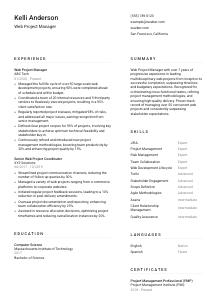
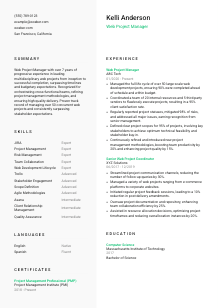
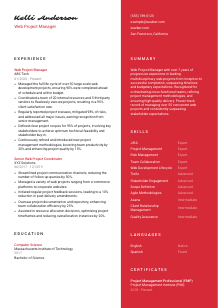
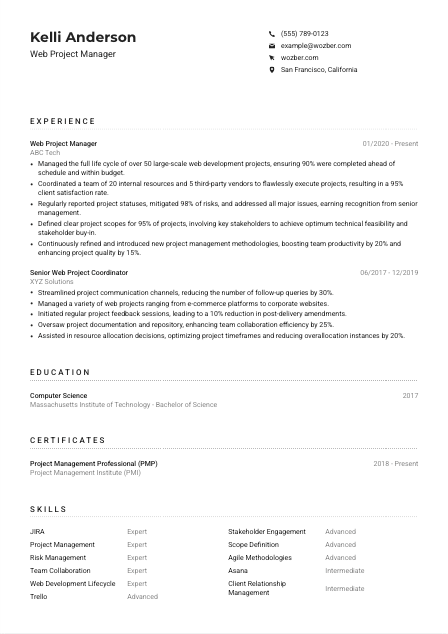
Each bullet should show what you managed and what changed because of your work. Instead of saying you were responsible for project coordination, show the scale, workflow, and result. The example resume does this well with achievements like managing more than 50 large-scale web development projects and defining scope clearly enough to improve stakeholder buy-in and technical feasibility.
Web project management is measured through schedule adherence, budget control, client or stakeholder satisfaction, productivity, issue resolution, and process improvement. Numbers like 90% of projects delivered ahead of schedule, a 95% satisfaction rate, or a 20% productivity gain give hiring teams a more concrete picture of how you run delivery.
Keep the emphasis on project leadership, resource coordination, vendor management, reporting, Agile execution, and process improvement. Early technical roles can stay if they help explain your understanding of development workflows, but your strongest content should show you operating as the person who keeps web projects moving from kickoff to completion.
Your experience section should read like a record of shipped work. When the bullets show scope, tools, collaboration surfaces, and measurable delivery results, your resume starts to look like someone who can step into active web projects and run them with control.
Education usually will not outweigh delivery experience at this level, but it still matters in web project management because it helps explain your familiarity with technical teams, web workflows, and the language of implementation. Keep it clear and relevant to the role.
If the posting asks for a bachelor's degree in Computer Science, Information Systems, or a related field, reflect that clearly. A degree in one of these areas signals that you can work effectively with developers, understand technical constraints, and participate meaningfully in scope and feasibility discussions.
Include your degree, field of study, school, and graduation year or date. Hiring managers should be able to scan this section in seconds without hunting for the credential that supports your project management background.
When your degree aligns directly with the requirement, use the full, accurate title. In the example, "Bachelor of Science in Computer Science" works well because it matches the academic preference in the posting and reinforces technical fluency for web delivery work.
Relevant coursework can help if you are early in your career or transitioning into web project management from another path. Classes in software development, systems analysis, UX, databases, or project management can provide useful context, but experienced candidates usually do not need this extra detail.
Honors, leadership roles, or major academic projects belong here only when they add something meaningful, such as team leadership, product delivery, or technical project work. For a candidate with 5+ years of experience, this section should stay concise and support the bigger story told in experience.
Keep education straightforward and relevant. For a Web Project Manager, it should confirm that you have the academic grounding to work comfortably with technical teams and web project requirements.
Certifications matter most when they reinforce how you run projects. In web project management, the right credential can support your knowledge of delivery frameworks, stakeholder communication, risk handling, and structured execution across multidisciplinary teams.
If the employer mentions PMP or CSM, put those certifications in this section if you hold them. They are familiar hiring signals for project structure, Agile process knowledge, and professional commitment, especially when a role combines traditional planning with iterative web delivery.
Choose certifications that support project leadership, Agile practices, Scrum facilitation, digital delivery, or process improvement. A short list of relevant credentials is stronger than a long list of loosely connected courses.
Add the year earned and, when relevant, show that the certification remains active. In project environments where methodologies and tooling evolve, current credentials help show that your framework knowledge has stayed current alongside your practical experience.
If you are pursuing additional certification, focus on areas that improve how you manage web teams and releases, such as Agile delivery, Scrum, stakeholder communication, or digital product workflows. Ongoing development matters most when it connects directly to better execution on live projects.
Certifications should reinforce the way you manage work, not decorate the page. For this role, the best ones support credible delivery leadership across timelines, teams, and evolving web requirements.
A Web Project Manager's skills section should reflect the tools, methods, and collaboration strengths that keep digital projects moving. Focus on the capabilities that shape scope, execution, reporting, and team coordination rather than listing every platform you have touched.
Start with the job description and pull out the competencies that define day-to-day work. In this case, that includes project management platforms, multidisciplinary coordination, communication, and full life cycle ownership. Align your wording with the posting where it matches your real experience so both reviewers and ATS tools can read the connection clearly.
Name the systems and working styles you use to run web projects, such as JIRA, Trello, Asana, Agile methodologies, risk management, scope definition, stakeholder engagement, and quality assurance. The sample resume handles this well by combining tool proficiency with operational skills like web development lifecycle knowledge and team collaboration.
Group or order skills so the most relevant ones appear first. A focused skills section helps employers quickly understand whether you can manage planning, communication, execution, and issue tracking in a live web environment. Leave out generic filler and keep only the abilities you would be expected to use on the job.
Your skills section should make your operating toolkit obvious. When it shows the right project platforms, delivery methods, and coordination strengths, hiring teams can quickly picture how you would run their web projects.
Language skills matter in web project management because the role depends on clear updates, expectation setting, issue escalation, and cross-team communication. Include them when they support the job requirements or your ability to work across client, vendor, or distributed team settings.
If the posting specifies English communication skills, list English first with an accurate proficiency level. That directly addresses a stated requirement and supports the reporting, stakeholder management, and meeting facilitation expected in the role.
Additional languages can be useful when you coordinate with international vendors, support global clients, or work across distributed teams. Include them if they are genuine strengths and relevant to the environments in which you manage projects.
Choose straightforward descriptors such as Native, Fluent, Professional, Conversational, or Basic. In a role built on communication, inaccurate language claims can quickly create problems once interviews move into stakeholder scenarios or reporting discussions.
If your work has involved offshore development teams, multilingual stakeholders, or international website launches, language capability can become more meaningful. In that context, even one additional fluent language may support smoother coordination and fewer communication gaps.
Languages can help differentiate you, but they should support the main story of project delivery, web coordination, and execution. Keep this section concise unless multilingual communication is central to the role you are targeting.
For a Web Project Manager, languages are most useful when they strengthen collaboration and reporting across teams. Include them clearly, keep the proficiency honest, and let them support your broader delivery profile.
Your summary should quickly establish the level of web project work you handle, the delivery environment you operate in, and the results you tend to produce. A few lines are enough if they are specific about project scope, team coordination, tools, and outcomes.
Start with your title and years of experience in web project management or closely related delivery work. This immediately tells the reader whether you match the seniority of the role and whether your background belongs in web projects rather than general operations or marketing execution.
Mention the type of projects, teams, and delivery responsibilities you handle. Strong summaries often reference multidisciplinary web projects, lifecycle ownership, stakeholder coordination, vendor management, or timeline and budget accountability because those are central to the job.
Include only the most relevant specifics, such as JIRA, Agile methodologies, risk management, or process improvement. The example summary works because it blends scale, leadership, and outcomes instead of turning into a long keyword list.
Aim for a short paragraph that sounds like an experienced project lead, not a biography. A concise summary with 2 to 4 targeted sentences is enough to show your delivery track record and set up the details that follow in your experience section.
A well-written summary quickly tells the reader that you understand web delivery and have already managed the moving parts that come with it. Once that picture is clear, the rest of the resume can back it up with project metrics, tools, and launch results.
A Web Project Manager resume should leave little doubt about your ability to scope work, coordinate teams, manage risk, and deliver web projects on schedule. Review each section to make sure the language reflects actual project work, the metrics sound native to delivery performance, and the most relevant tools and methodologies appear where employers expect to find them.
Use Wozber to turn that experience into a sharper final draft with ATS-friendly resume templates, AI-assisted tailoring, and an ATS resume scanner that helps align your wording with the posting. The finished resume should make one thing easy to judge: you can take a web project from kickoff to launch with control.




