



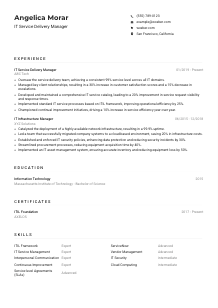
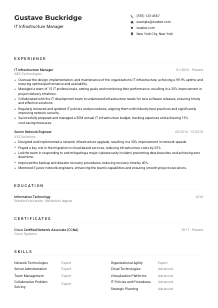
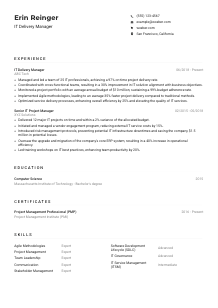
Use Wozber and land your dream job
Create Resume
No registration required
Overseeing IT services, but your resume feels offline? Log into this IT Service Manager resume example, created with Wozber free resume builder. Learn how to bring together your tech leadership and job requirements, keeping your career running on the latest upgrades and top performance!
IT Service Managers sit at the point where user support, operational discipline, and business continuity meet. Hiring teams want to see whether you have actually run a service desk, improved incident response, maintained service levels, and kept internal users productive when systems, devices, or workflows break. Your resume should make that operating range visible early, not bury it under generic IT management language.
A tailored resume changes how quickly your background reads against IT service requirements such as ITIL practice, SLA ownership, ITSM tooling, and team leadership. Wozber's free resume builder helps you shape that experience into an ATS-compliant resume with the right terminology and structure, so the hiring team can quickly connect your service metrics, platform knowledge, and management scope to the role in front of them.
This section is short, but it still does real work in an IT Service Manager application. It confirms role alignment, contact accuracy, and any location requirement before a reviewer even gets to your service delivery history.
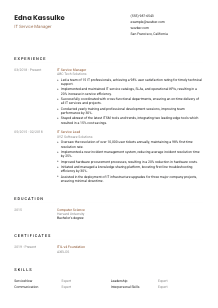
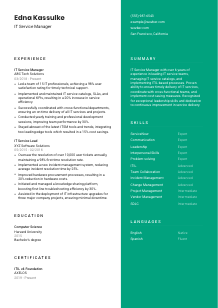
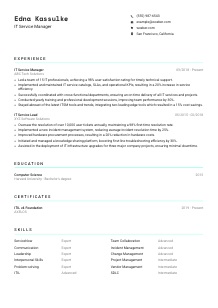
Use your full name as the most visible text on the page. Keep the formatting clean and easy to scan so the focus stays on your experience managing service operations, support teams, and IT processes rather than on design choices.
Place "IT Service Manager" directly under your name if that is the role you are applying for. Matching the target title helps position your background around service desk leadership, SLA ownership, and ITSM process management from the first line.
List a phone number and professional email address that are current and easy to verify. If a hiring manager wants to discuss your experience with incident management, service improvement, or cross-functional coordination, there should be no friction in reaching you.
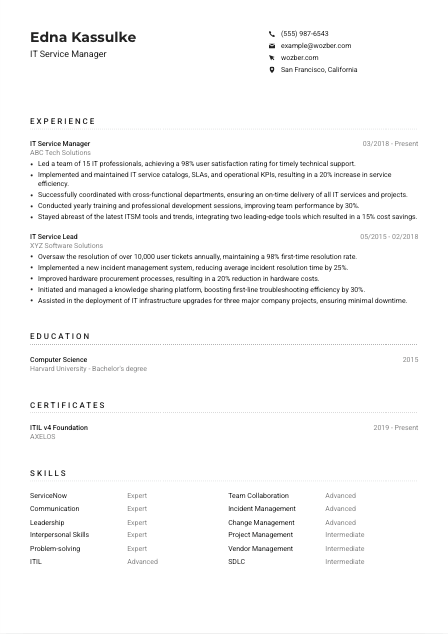
If the role specifies a location, include it clearly. In this example, listing San Francisco, California immediately answers a stated requirement and removes doubt about local eligibility or relocation timing.
Include LinkedIn or a professional website if it supports your IT leadership story. Make sure it reflects the same titles, dates, certifications, and service management accomplishments shown on the resume, especially if you highlight tools such as ServiceNow or frameworks such as ITIL.
Personal details should quickly establish that you are reachable, professionally presented, and aligned with the basics of the opening. For an IT Service Manager, that means no ambiguity around title, contact information, or location requirements.




Experience carries the most weight for IT Service Manager hiring because it shows how you operated under real support volumes, service targets, and team demands. Focus on the parts of your work history that show leadership, process control, tool usage, and measurable service outcomes.
Read the posting for the service delivery responsibilities that matter most, then mirror those themes in your bullets. Here, that means leading a service desk team, maintaining service catalogs and SLAs, working across departments, and improving operations through ITSM best practices. Your past roles should be framed around those same responsibilities when they reflect your actual work.
List roles in reverse chronological order and make the progression easy to follow. Titles such as IT Service Lead, Service Desk Manager, or IT Operations Manager can all support the move into IT Service Manager if the bullets show growing ownership over support delivery, escalation handling, reporting, and team management.
Generic statements like "managed support operations" are too thin for this level. Show what changed under your leadership. The sample resume does this well by pairing responsibilities with outcomes such as a 20% increase in service efficiency after improving service catalogs, SLAs, and KPIs, which tells a hiring team exactly how the work translated into better operations.
Quantify the performance indicators that matter in IT support environments. Useful measures include ticket volume, first-contact resolution, user satisfaction, incident resolution time, downtime reduction, SLA attainment, training impact, and cost savings. For example, leading a team of 15 with a 98% user satisfaction rating says much more than simply claiming strong leadership.
Prioritize achievements that support an IT Service Manager brief. Incident management improvements, service desk leadership, ITSM platform implementation, knowledge base adoption, vendor coordination, and cross-functional project delivery all belong here. Less relevant work can stay brief unless it directly supports your ability to run reliable IT services at scale.
Your experience section should make it easy to picture you running service operations, guiding a support team, and improving delivery against defined standards. The more clearly you connect your work to SLAs, KPIs, ITSM workflows, and user outcomes, the stronger your case becomes.
Education is usually straightforward for an experienced IT Service Manager, but it still matters when the posting calls for a specific degree background. Present it clearly so the reviewer can confirm the academic requirement without hunting for it.
If the role asks for a Bachelor's degree in Computer Science, Information Technology, or a related field, list your degree in a way that makes that match obvious. In the example, "Bachelor's degree" in "Computer Science" immediately supports the requirement.
Include degree, field of study, school, and graduation year or date in a simple structure. For ATS optimization, avoid burying education details in dense formatting or unconventional layouts that can make degree information harder to parse.
When a posting is specific about academic background, wording matters. If your field is Computer Science, Information Systems, Information Technology, or a closely related discipline, name it clearly instead of relying on abbreviations or incomplete descriptions.
Early-career candidates can use relevant coursework, capstone projects, or systems-focused academic work to reinforce technical credibility. For more established service managers, education usually stays concise unless a project strongly supports your background in infrastructure, support systems, or process improvement.
Honors, technical societies, or leadership activities are worth mentioning only if they add meaningful context. For this profession, academic extras should support technical grounding or leadership potential, not distract from your service management record.
Education should confirm that you meet the baseline academic expectation and let the reader move back to your operating experience. Keep it clean, accurate, and easy to match against the posted requirement.
Certifications carry real weight in IT service management because they show process knowledge that goes beyond day-to-day support experience. For roles built around ITIL practices, service improvement, and operational consistency, the right credentials strengthen your positioning fast.
Put the certifications most relevant to service management at the top, especially when the posting names one directly. Here, ITIL v4 or higher is a stated requirement, so an ITIL v4 Foundation credential should be highly visible rather than buried after unrelated training.
Choose certificates that strengthen your case for managing IT services, support processes, governance, or quality standards. Alongside ITIL, credentials tied to IT service management or ISO/IEC 20000 can help if they are relevant to the target role, as shown in the example resume.
Listing certification dates helps a hiring manager gauge how current your framework knowledge is. In ITSM work, where process maturity, tooling, and best practices evolve, recent certification can support your credibility in improvement-focused environments.
Ongoing learning matters in service management, especially if your environment includes platform upgrades, automation, service reporting, or change governance. Add new certifications when they genuinely reflect your working capability and the kind of service organization you want to lead.
Relevant certifications strengthen the process side of your resume. They show that your approach to incident handling, service levels, and continual improvement is grounded in recognized ITSM practice, not only in informal experience.
The skills section should read like the toolkit of someone who can run support operations, coach a team, and improve service performance. A scattered list weakens the message. A focused list tells the hiring team what systems, methods, and leadership strengths you bring into the service function.
Start with the requirements and responsibilities that define the job. In this case, that includes ITSM tools such as ServiceNow or Remedy, ITIL knowledge, communication, leadership, and the ability to work across teams. Those are the skills that should anchor your list if they reflect your experience.
An IT Service Manager needs more than platform knowledge. Balance technical skills such as ServiceNow, incident management, change management, and KPI tracking with management capabilities such as team leadership, stakeholder communication, training, and vendor coordination. The sample resume handles this balance well by mixing ITSM and leadership skills instead of treating them as separate profiles.
Put the most relevant and role-defining skills first. For this kind of opening, ITSM platforms, ITIL, service operations, incident response, SLA management, and leadership usually deserve more space than broader secondary skills. This makes the section easier to scan and improves ATS alignment with the language used in the posting.
Your skills section should quickly show that you can manage the mechanics and the people side of IT service delivery. If the top of the list reflects the tools, frameworks, and leadership demands of the role, the section is doing its job.
Language ability may look secondary on a technical resume, but in IT service management it affects user support, stakeholder communication, documentation, and team leadership. Present it with the same honesty and clarity you would use for any operational qualification.
If the posting specifies English fluency, list English prominently with an accurate proficiency level such as "Native" or "Fluent." For a manager overseeing support communications, escalations, and internal coordination, this is a practical requirement, not a minor detail.
Place the required language at the top of the section so reviewers and ATS systems can find it immediately. That simple placement helps avoid unnecessary friction in roles where written updates, stakeholder meetings, and service documentation all depend on strong English communication.
Additional languages can strengthen your profile in organizations with multilingual users, distributed teams, or global support structures. They are a bonus, not a substitute for core service management ability, so keep the emphasis proportionate.
Choose levels you can defend in real work settings, especially if the job involves live support conversations, training sessions, or written communication with executives and end users. Inflated language claims can create immediate credibility issues.
When extra languages matter, they usually matter because they support smoother user interactions, clearer documentation, or collaboration across regions. That context is more useful than treating language ability as a generic advantage.
Language details should confirm that you can communicate effectively in the operating environment of the role. For IT Service Manager positions, that usually means clear English first, with any additional languages adding situational value.
The summary is where you establish your operating profile in a few lines. For an IT Service Manager, that means quickly connecting your years of experience to service delivery leadership, ITSM process knowledge, and measurable improvements in support performance.
Use the posting to decide which themes belong in the opening lines. For this job, the important points are leading IT service teams, working with ITSM tools, managing service standards, and driving improvement. Your summary should reflect that scope instead of opening with broad statements about being results-driven or passionate about technology.
State your title or close equivalent, your experience level, and your area of focus. A line such as "IT Service Manager with 6+ years of experience leading service desk operations and ITIL-based process improvement" gives the reader immediate context and positions you in the right lane.
Mention one or two specific achievements or operating strengths that support your case. The example summary works because it ties leadership and ITIL-based service management to outcomes such as timely service delivery and cost-saving improvements, rather than staying at the level of personality traits.
Aim for a short paragraph that can be read in seconds. Three to five lines is enough to establish your service management background, platform familiarity, leadership scope, and improvement mindset without repeating the bullet points that belong in your experience section.
Your summary should quickly establish that you can run IT services with structure, lead a support function, and improve delivery in measurable ways. When that message is clear from the start, the rest of the resume has a strong frame to build on.
A well-tailored IT Service Manager resume makes your service delivery record easy to follow. Team leadership, SLA ownership, ITSM platform experience, ITIL knowledge, and measurable support results should all appear where a hiring team expects to find them.
Use Wozber's AI resume builder to tighten wording, align your resume with the job description, and strengthen ATS optimization without losing the specifics of your real work. That combination helps turn your background into an ATS-friendly resume format that clearly supports the role.
When the document is finished, it should leave little doubt that you can manage the service desk, improve operational performance, and lead IT support with consistency.




