



Use Wozber and land your dream job
Create Resume
No registration required
Blueprinting systems, but your resume feels disconnected? Bring your enterprise ingenuity forward with this Enterprise Architect resume example, created with Wozber free resume builder. Learn how to align your strategic vision with job requisites, paving a career path as integrated and dynamic as the organizations you design!

Enterprise Architects are expected to connect technology decisions to business direction, not simply document current-state systems. Hiring teams look for people who can shape target architecture, guide integration choices, and keep standards consistent across platforms, teams, and long planning cycles. Your resume needs to make that strategic influence visible, along with the scale of environments and decisions you have owned.
The fastest way to lose traction is to sound like a general infrastructure lead or solution architect when the role calls for enterprise-wide architecture governance. Using Wozber's free resume builder helps you shape an ATS-compliant resume around the language of the posting, so frameworks, architecture leadership, and cross-functional decision-making surface quickly. That makes it easier for reviewers to see whether you can steer architecture across the business, not just deliver one system well.
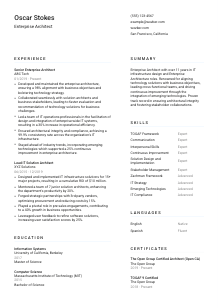
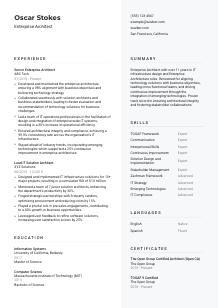
For an Enterprise Architect, the header does more than identify you. It sets a professional tone immediately and removes friction around role match, seniority, and practical requirements such as location and communication channels.
Use your full name in the largest text on the page so it is easy to find in a resume database or PDF review. Senior architecture roles are often reviewed by recruiters, technology leaders, and business stakeholders, so your name should anchor the document cleanly and professionally.
Place "Enterprise Architect" directly under your name when that is the role you are pursuing. This helps position you correctly from the first line and prevents your resume from reading like a solution architect, infrastructure manager, or IT strategist profile when the opening is specifically enterprise architecture focused.
Include a reliable phone number and a professional email address. Senior roles often involve several interview rounds and stakeholder scheduling, so accuracy matters. A simple format like firstname.lastname@email.com keeps the header credible and easy to parse in an ATS.
If the job requires a specific location, show it clearly in your header. In the example, "San Francisco, California" directly answers a stated requirement and removes doubt about local availability. If a posting does not mention location constraints, your city and state are usually enough.
Include LinkedIn, a professional website, or a portfolio page only if it supports your case with architecture-relevant content such as transformation programs, speaking engagements, published thought leadership, or major platform initiatives. Keep the information consistent with your resume so reviewers see one coherent profile.
This section should answer basic questions immediately: who you are, what role you are targeting, how to reach you, and whether you meet practical requirements. Once that is clear, the reader can focus on your architecture work.




This is the section where Enterprise Architect candidates separate themselves from adjacent profiles. Hiring teams want to see enterprise-wide decision-making, architecture governance, integration leadership, and measurable business outcomes, not just technical delivery tasks.
Read the job description for the operating themes behind the title. Here, the employer emphasizes enterprise architecture alignment, collaboration with solution architects and operations, technology recommendations, integration leadership, and compliance. Build your bullets around those same themes using your own work, so the reader sees a clear match between your background and the architecture function they need.
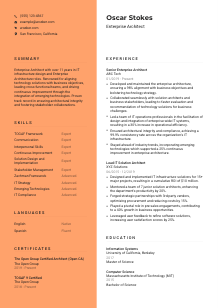
List roles in reverse chronological order and make the progression obvious. Enterprise architecture hiring often looks for a path from hands-on design or solution architecture into broader governance and strategy. The sample resume does this well by moving from Lead IT Solution Architect into Senior Enterprise Architect, which helps explain readiness for enterprise-level ownership.
Quantify outcomes in ways that make sense for the role: business alignment, operating efficiency, compliance rates, platform consistency, cost reduction, implementation scale, or ROI. Metrics such as "98% alignment with business objectives," "30% increase in operational efficiency," or "$10 million ROI" work because they connect architecture decisions to business and operating results.
If you have worked with TOGAF, Zachman, capability mapping, target-state roadmaps, governance boards, integration standards, or architecture review processes, include them in context. For ATS optimization and human review alike, it helps when these terms appear inside real accomplishments rather than as isolated keywords. The same goes for cloud platforms, ERP environments, integration patterns, or compliance frameworks when they are relevant to your actual work.
Every bullet should strengthen your case for architecture leadership across the organization. Remove items that are too operational, too narrow, or disconnected from strategy unless they explain an important step in your progression. Keep the focus on architecture decisions, stakeholder influence, system integration, governance, and technology direction.
After this section, a reviewer should understand the scale of environments you have shaped, the architecture standards you have enforced, and the business outcomes your decisions supported. That is the core of enterprise architecture credibility.
Education is usually a supporting section at this level, but it still matters. For Enterprise Architect roles, it confirms the technical and analytical base behind your architecture decisions and helps satisfy degree requirements quickly.
If the posting asks for a Bachelor's degree in Computer Science, Information Systems, or a related field, list the degree exactly and avoid vague abbreviations. In the example, a Bachelor of Science in Computer Science clearly satisfies that requirement and immediately answers a screening question.
If you have a master's degree, include it because it can strengthen your profile for strategy-heavy architecture roles. A Master of Science in Information Systems, for instance, reinforces expertise in enterprise systems, information flow, and technology planning without needing extra explanation.
Degrees are most useful here when the field supports enterprise architecture work. Computer Science, Information Systems, Software Engineering, and similar disciplines map naturally to infrastructure design, systems integration, and architecture planning. Make sure the field name is visible, not buried.
Most experienced Enterprise Architects do not need to list courses. Include them only if they sharpen your positioning, such as distributed systems, systems design, cybersecurity architecture, or enterprise integration, especially if you are earlier in your career or pivoting from a related path.
Honors, thesis topics, or leadership roles can stay if they point toward architecture-relevant strengths such as systems thinking, research depth, or technical leadership. If they do not add that kind of value, keep the section concise and let your experience carry more weight.
This section should confirm that you meet the academic baseline and, where applicable, show extra depth in systems or information architecture. At senior level, clarity matters more than detail.
In enterprise architecture, certifications are often a practical shorthand for framework knowledge and professional discipline. They become especially valuable when a posting names TOGAF, Open CA, or another architecture standard directly.
When the job description names certifications such as "TOGAF 9 Certified" or "The Open Group Certified Architect (Open CA)," lead with those credentials. That immediately shows alignment with the employer's preferred framework language and architecture maturity expectations.
List certifications that strengthen your case for enterprise architecture work, especially those connected to architecture frameworks, governance, cloud platforms, security architecture, or large-scale transformation. In the example, TOGAF and Open CA are strong because they directly support the responsibilities in the posting.
Dates help reviewers understand whether your certification is current and relevant. This matters when employers want recent framework knowledge or active standing. Keep the format simple and consistent so the section is easy to scan.
Enterprise Architects are expected to stay current on architecture methods and emerging technologies. If you are renewing a credential or adding a newer one in cloud, security, or digital transformation, include it to show that your architecture practice is still evolving with the market.
A concise certification section can reinforce that you know the formal architecture methods behind the role, especially when the employer wants structure, governance discipline, and enterprise-level consistency.
Enterprise Architect skills should read like the toolkit of someone who shapes technology direction across the business. That means balancing architecture frameworks and systems thinking with stakeholder management, governance, and communication.
Pull out the capabilities that define the role. In this description, that includes architecture frameworks, IT infrastructure design, cross-functional collaboration, stakeholder communication, enterprise-wide integration, and continuous improvement. Those are the terms that should guide what stays in your skills list.
A useful Enterprise Architect skills section usually mixes framework expertise with broader execution skills. TOGAF, Zachman, enterprise integration, architecture governance, and IT strategy can sit alongside stakeholder management, communication, and facilitation because all of them affect how architecture gets approved and implemented.
Do not turn this section into a complete inventory of your career. Choose the skills that support the target role most directly and that you can back up in your experience section. The sample skills list works because it highlights architecture frameworks, compliance, strategy, emerging technologies, and communication rather than unrelated technical tools.
When this section is tailored well, it quickly tells the reader whether your background fits enterprise architecture governance, cross-functional planning, and technology strategy. Keep it focused enough that every skill feels earned.
Language ability matters differently depending on the organization. For Enterprise Architects, it can affect stakeholder workshops, executive presentations, vendor discussions, and collaboration across regions or business units.
If the posting requires fluency in English, place English at the top of the section and state your level clearly. That gives the employer a direct answer on an explicit requirement and is especially important for roles involving presentations, architecture reviews, and cross-functional communication.
Additional languages can strengthen your profile when the company operates across markets or works with distributed teams, vendors, or regional technology groups. They are not required for every Enterprise Architect role, but they can add practical value in global environments.
Choose labels such as "Native," "Fluent," or "Intermediate" carefully. Enterprise Architects often need to explain tradeoffs, challenge requirements, and present future-state designs, so overstating language ability can create problems later in stakeholder conversations.
Some architecture roles are mainly local and internal. Others involve multinational programs, offshore delivery teams, or global platform rollouts. If your language skills have helped in those settings, they are worth showing because they support smoother coordination and decision-making.
A second or third language is most compelling when it improves your ability to run workshops, support regional rollouts, or work across international teams. In the example, Spanish adds extra breadth, while English remains the required language to foreground.
This section does not need to be long. It should simply make clear whether you can communicate at the level the architecture role demands, especially in stakeholder-facing environments.
Your summary should establish the kind of Enterprise Architect you are in a few lines. It needs to show strategic range, architecture depth, and the kind of business outcomes your decisions influence.
Start by identifying the few themes that define the opening. Here, those are enterprise architecture alignment, infrastructure design background, cross-functional collaboration, and architecture integrity. Build the summary around two or three of those themes rather than trying to cover your entire career.
Open with your years of experience and the architecture domain you work in. A line such as "Enterprise Architect with 11+ years in IT infrastructure design and enterprise architecture" quickly frames your level and gives the reader a clear professional identity.
Use the next sentence to show how you work, not only what you know. Mention strengths like aligning technology with business objectives, leading cross-functional architecture decisions, or improving architectural consistency across systems. The sample summary does this effectively by combining strategic alignment, stakeholder collaboration, and continuous improvement.
Stay within 3 to 5 lines and avoid generic claims like "results-driven" or "dynamic leader." Use language you can support elsewhere in the resume through metrics, frameworks, or transformation examples. A concise summary with real architecture substance will do more than a paragraph full of broad promises.
By the time someone finishes these opening lines, they should already understand your architecture scope, your business orientation, and the kind of enterprise environment you are prepared to lead.
A well-tailored Enterprise Architect resume shows more than technical breadth. It makes your governance approach, business alignment, framework fluency, and cross-functional influence easy to see across every section.
Use Wozber's free resume builder, ATS-friendly resume templates, and ATS resume scanner to align your language with the posting, strengthen ATS optimization, and surface the architecture experience that matters most. The finished resume should make one point clear quickly: you can guide enterprise-wide technology decisions with structure, credibility, and business purpose.




