



Use Wozber and land your dream job
Create Resume
No registration required
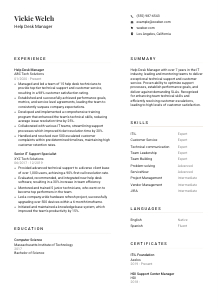
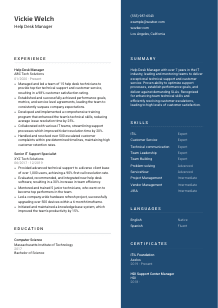
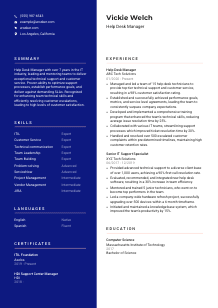
Troubleshooting tickets, but your resume is calling for tech support? Check out this Help Desk Manager resume example, created with Wozber free resume builder. Learn how to align your management mastery with job specifics, ensuring your career journey always comes with a smooth resolution!
Help Desk Manager hiring turns quickly on operational proof. Teams depend on this role to keep ticket flow under control, maintain service quality when escalations spike, and coach technicians without letting SLAs slip. Your resume needs to show that you can run support operations, improve resolution performance, and handle difficult customer issues with the judgment expected from a service desk leader.
That becomes much easier to read when your resume is tailored to the language of the posting. Wozber's free resume builder helps you shape an ATS-compliant resume around the requirements that matter most for help desk leadership, from ITIL process knowledge to training, escalation handling, and service metrics. The result should make it obvious that you can lead a support team and improve day-to-day service delivery.
For a Help Desk Manager, the header should read like someone ready to step into operational ownership. Keep it clean, professional, and aligned with the job so hiring teams can confirm core basics fast and move on to your service desk experience.
Place your name at the top in a clear, professional format. Help desk leadership roles are practical and fast-moving, so avoid decorative styling. A simple presentation keeps the focus on your management experience, SLA ownership, and support background.
Add "Help Desk Manager" directly below your name when that is the role you are pursuing. Matching the target title helps frame the rest of the resume around team leadership, escalation management, and service desk performance instead of general IT support work.
List a reliable phone number and a professional email address. Accuracy matters here more than polish. If a hiring manager wants to move quickly after seeing relevant experience in support operations or technician leadership, your contact details should never slow that down.
Some help desk manager openings have an on-site or location-specific requirement. In the example posting, Los Angeles, California is explicitly required, so listing city and state removes an immediate point of doubt. Treat this as tailoring to the opening, not a universal rule for every application.
Include LinkedIn or a professional website if it supports your candidacy with IT leadership history, certifications, or project context. Make sure it lines up with the resume. If your profile mentions service desk tools, knowledge base work, hardware rollouts, or support team management, that consistency helps.
Your personal details should answer the basics immediately: who you are, what role you are targeting, how to reach you, and whether you meet any location requirement in the posting. Keep it simple so the hiring team gets to your support leadership experience without friction.




This section carries the most weight for a Help Desk Manager. Hiring teams look for signs that you have led technicians, improved service outcomes, and handled the operational side of support, not just solved tickets yourself. Your bullets should show ownership of team performance, process improvement, and escalations.
Read the job description closely and mark the responsibilities that define the role. For this kind of opening, that usually means leading technicians, setting performance goals, tracking SLAs, improving support processes, and managing escalated complaints. Those priorities should shape which achievements you choose and how you phrase them.
List jobs in reverse chronological order with title, company, and dates. For service desk leadership roles, that structure helps reviewers quickly spot progression from hands-on support into supervision, team management, or broader operational ownership. If you moved from senior support into management, make that upward path easy to follow.
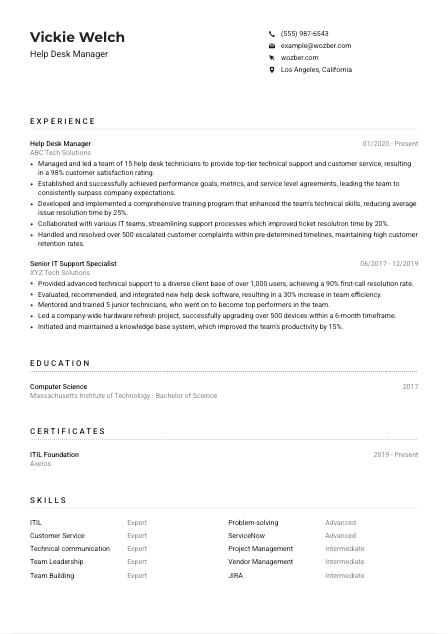
Write accomplishment bullets around team leadership, service quality, and process improvement. Good help desk manager bullets mention metrics such as customer satisfaction, first-call resolution, ticket resolution time, backlog reduction, training impact, or team size. The example resume does this well by pairing leadership actions with outcomes like a 98% customer satisfaction rating and a 25% reduction in average resolution time.
Quantified details help hiring teams understand your operating scope. Include the number of technicians you managed, user population supported, volume of escalations handled, percentage improvements, or project timelines. Metrics like "managed a team of 15," "resolved 500+ escalations," or "improved ticket resolution time by 20%" say far more than broad claims about leadership.
Prioritize experience that shows you can lead a support function. Technical achievements still matter, but they should connect to manager-level responsibilities such as workflow improvement, technician coaching, software implementation, reporting, or cross-team collaboration. Leave out bullets that are impressive but unrelated to service delivery, customer support performance, or team leadership.
By the end of this section, a reviewer should understand the size of the support environment you handled, how you improved service desk performance, and how you led people through day-to-day operational demands. That is the core of the role.
Education will rarely outweigh proven help desk leadership, but it still matters when the posting asks for a specific degree. Present it clearly so the reviewer can confirm your academic background and move on to the experience that shows how you run support operations.
If the posting asks for a bachelor's degree in Computer Science, Information Technology, or a related field, list that information plainly. The example resume does this with a Bachelor of Science in Computer Science, which aligns neatly with the requirement.
Present degree, field of study, school, and graduation year in a consistent order. Help desk manager resumes are usually reviewed for operational depth first, so your education section should be quick to process and free of extra formatting noise.
When your degree directly supports the role, do not bury the field of study. A line such as "Bachelor of Science, Computer Science" makes the connection immediate. That is especially useful when the employer is screening for a formal technical foundation alongside leadership experience.
Most mid-level and senior help desk manager candidates do not need a course list. Include coursework only when it adds something meaningful, such as IT service management, systems administration, networking, or leadership training that helps explain your support background.
Academic honors, leadership activities, or relevant extracurriculars can stay if they reinforce your technical credibility or leadership path, especially earlier in your career. Once you have several years of support management experience, keep this section brief and let your service desk results do the heavier lifting.
This section should confirm that you meet the stated degree requirement and have a solid technical foundation. For a Help Desk Manager, that is usually enough. The operational proof belongs in your experience section.
Certifications carry real weight in help desk leadership when they connect to service management standards, support center operations, or the technology stack your team supports. They show that your approach is grounded in recognized practices, not only experience gained on the job.
Put the most relevant certifications first, especially when the employer names them. In this example, ITIL Foundation and HDI Support Center Manager are strong matches because they support process discipline, service desk operations, and team leadership. If you hold a Microsoft desktop administration certification, that can also be useful where endpoint support is part of the environment.
Choose certifications that reinforce your value as a support leader. Prioritize service management, desktop support, customer support operations, and management-related credentials over unrelated technical badges. A shorter, focused list usually works better than a long catalog.
Include completion dates and, when relevant, active status. This helps show whether your knowledge of ITIL practices or support center management is current. In roles where process design and SLA reporting matter, recency can strengthen your profile.
Support operations change with tooling, security requirements, device management, and service expectations. Continuing to earn relevant certifications signals that you stay current on how modern service desks are run, trained, and measured.
For a Help Desk Manager, certifications work best when they support the story already told by your experience: you understand service desk frameworks, you can improve support processes, and you bring structure to customer-facing IT operations.
A Help Desk Manager needs a skills section that reflects both operational command and people leadership. Hiring teams want to see the mix that keeps a support function running well: service management knowledge, communication under pressure, and the ability to guide technicians toward better performance.
Use the posting to identify the exact language the employer uses. For this role, terms like ITIL, customer service, problem-solving, technical communication, service desk processes, and team leadership belong near the top because they reflect how the job is actually performed and evaluated.
Your list should show that you can manage both the support environment and the people working in it. Include tools or operational knowledge such as ServiceNow, JIRA, ticketing workflows, knowledge base management, and SLA tracking, along with leadership skills like coaching, training, escalation handling, and cross-team collaboration.
Do not turn the skills section into an inventory of everything you have used. Prioritize the capabilities that support help desk leadership. The example resume stays close to that mark with ITIL, customer service, technical communication, team leadership, ServiceNow, and JIRA, giving a clear picture of both support operations and management scope.
A hiring manager should be able to glance at this section and see that you understand service desk operations, can communicate with users and technical teams, and know how to lead people against service targets. If those points are clear, the section is doing its job.
Language fluency matters in help desk management because the work depends on clear communication with users, technicians, and other IT teams. Document it plainly, especially when the posting specifies a required language for written updates, escalations, and customer-facing conversations.
If the role requires strong spoken and written English, list English first and indicate your level clearly. That matters in help desk leadership because managers handle escalated complaints, write internal updates, and communicate process changes across teams.
Additional languages can be valuable in user-facing support settings, especially in large or diverse organizations. They are not mandatory unless the posting says so, but they can strengthen your profile when the help desk serves multilingual users or customers.
Stick with standard labels such as Native, Fluent, Intermediate, or Basic. Those labels are easy to understand and set realistic expectations for calls, documentation, training, or customer communication.
If you speak more than one language, think about whether that skill helps in your target environment. For some help desk teams, it improves communication with employees, vendors, or customer groups across regions. For others, it is simply a useful extra.
Be precise about your proficiency. Overstating language ability can create problems fast in support leadership roles where escalations, written communication, and stakeholder updates need clarity and confidence.
For a Help Desk Manager, language skills are not decorative. They affect customer communication, technician guidance, and escalation handling. List them honestly and in a way that matches the communication demands of the job.
Your summary should quickly establish how you lead a help desk, what kind of support environment you have managed, and what results followed. This is where you position yourself as someone who can improve service quality, coach a team, and keep operations steady when issues escalate.
Before writing, identify the few themes that define the opening. For a Help Desk Manager, that usually means team leadership, support process improvement, customer service quality, SLA performance, and escalation management. Build the summary around those ideas instead of broad statements about being passionate or driven.
Lead with your title or professional identity, then mention your years in IT support and management. A line such as "Help Desk Manager with 7+ years in IT support, including team leadership and service desk operations" immediately gives the reader context.
Include one or two concrete outcomes that match how help desk leaders are measured. The example summary works because it references process optimization, performance goals, SLA delivery, and customer satisfaction. Metrics like resolution time improvement, first-call resolution, CSAT, or escalations handled make the summary stronger.
Aim for three to five lines. That is enough space to show leadership level, technical support background, and a few high-value outcomes without repeating the experience section. Every sentence should strengthen your case for running a support team.
When this section is working, the reader reaches your experience already expecting to see SLA ownership, technician leadership, process improvement, and strong customer support judgment. That is exactly the frame a Help Desk Manager resume needs.
Before sending your resume, make sure each section supports the same message: you can lead a help desk team, improve service delivery, and handle escalations with structure and accountability. Check that your experience shows measurable support outcomes, your skills reflect both service desk operations and people management, and your certifications support the processes named in the posting.
Wozber can help you tighten that alignment through ATS optimization, targeted wording, and an ATS-friendly resume format that keeps service metrics and leadership achievements easy to read. When the resume is tailored well, hiring teams can quickly see whether you are ready to manage the desk, the team, and the service standards that come with the role.




