



Use Wozber and land your dream job
Create Resume
No registration required
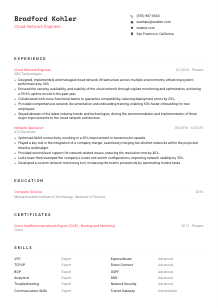
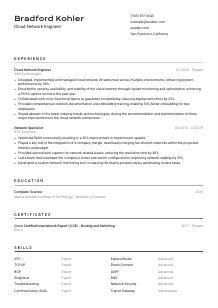
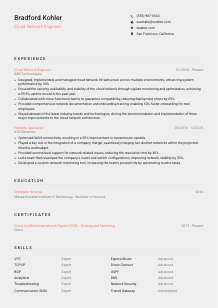
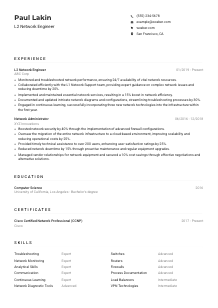
Building networks in the cloud, but your resume seems stranded on-premises? Explore this Cloud Network Engineer resume example, created with Wozber free resume builder. Learn how to present your cloud connectivity expertise to match job criteria, guiding your career path to where the sky's the only limit!
Cloud network engineering sits at the intersection of architecture, reliability, and security. Hiring teams want to see how you design connectivity between cloud and on-prem environments, keep critical services available, and solve routing or performance issues before they affect applications. Your resume should make that operating range visible through concrete infrastructure work, not broad claims about being technical or collaborative.
For this role, early screening often depends on whether your resume clearly connects your background to cloud networking terms the team already uses, from VPC design to BGP and DNS operations. Wozber's free resume builder helps you shape that language into an ATS-compliant resume, so the technical scope of your work is easier to read and your experience lands as relevant cloud network engineering rather than general network support.
This section should identify you quickly and remove friction from the first review. For a Cloud Network Engineer, that means a clean header, a role title that matches the target position, and contact details that support any stated location requirement.
Use your full name in the most prominent text, then place your target title directly below it. If you are applying for a Cloud Network Engineer position, say exactly that. It immediately frames your background around cloud connectivity, routing, and infrastructure operations instead of leaving the reviewer to infer your specialty.
Keep the title aligned with the role you want, especially when your previous positions used adjacent labels such as Network Engineer or Network Specialist. A direct title match helps when teams are screening for cloud-focused networking rather than broader infrastructure work.
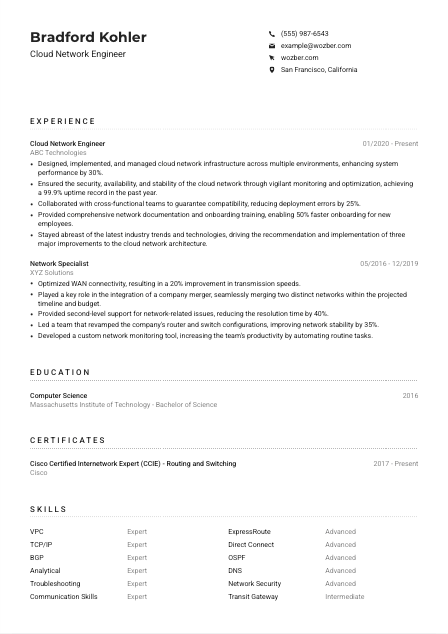
Include a reliable phone number and a professional email address. If the posting includes a location requirement, show your city and state clearly. In the provided example, listing San Francisco, California addresses a stated local requirement right away and avoids uncertainty about availability.
If you maintain a LinkedIn profile, GitHub, technical blog, or personal site, include it only when it reinforces your network engineering work. Useful additions might be architecture diagrams, automation projects, lab work, or posts on hybrid connectivity, routing design, or network security. Keep the content consistent with the resume.
Do not add age, marital status, photo, or other details unrelated to cloud networking work. Save the space for information that helps a hiring manager move faster, such as your title, location, and contact channels.
Your header should answer three questions in seconds: who you are, what role you do, and whether you meet any basic location or contact requirements.




This is where you show how you operate real cloud networks. Employers look for architecture decisions, protocol depth, uptime ownership, troubleshooting range, and the business effect of your work across production environments.
Start by identifying the work patterns in the job description. For Cloud Network Engineer roles, that usually includes designing cloud network infrastructure, managing hybrid or multi-environment connectivity, improving availability and security, supporting applications, and documenting the environment for other teams. Use those themes to choose which achievements to emphasize.
List roles in reverse chronological order, with your most recent and cloud-relevant experience first. If your background includes both traditional networking and cloud networking, keep the older roles only if they show progression in routing, WAN, support escalation, or infrastructure design that supports the cloud story.
Each bullet should show what you changed or improved in the environment. Good examples for this profession include reducing deployment errors, increasing uptime, improving network throughput, tightening security posture, or simplifying onboarding through better documentation. The sample resume does this well by tying cloud infrastructure management to a 30% performance improvement and 99.9% uptime.
Quantify results with measures that make sense for cloud networking. Uptime, latency, throughput, error reduction, incident resolution time, deployment reliability, failover performance, or onboarding speed all help a reviewer understand scale and impact. Numbers work best when they are tied to a network outcome, not added as decoration.
Trim accomplishments that do not support the target role. A cloud networking resume should stay centered on areas such as VPC architecture, routing, cloud interconnects, monitoring, network security, documentation, and cross-team support for business applications. Even if an older achievement is impressive, cut it if it pulls the reader away from your infrastructure depth.
After reading your experience section, a reviewer should understand what environments you handled, which network problems you solved, and how your work improved reliability, performance, or operational support.
Education is usually a quick verification step for experienced Cloud Network Engineers, but it still matters. Present it clearly so the reviewer can confirm the degree requirement and move on to your infrastructure experience.
If the role asks for a Bachelor's degree in Computer Science, Information Technology, or a related field, list your degree in a way that clearly matches. The example resume's Bachelor of Science in Computer Science aligns directly with that requirement and removes guesswork during screening.
List degree, field of study, school, and graduation year or date. Keep the order easy to scan so recruiters and hiring managers can verify the credential without searching through extra text.
Write the exact degree you earned rather than shortening it too much.
For early-career candidates, coursework in computer networks, distributed systems, cloud computing, security, or systems engineering can strengthen the section. For someone with 5+ years in production environments, coursework is usually secondary unless it directly supports a specialized cloud networking path.
Add academic distinctions, capstone work, or technical projects if they reinforce network engineering depth. For example, a senior project on routing optimization, network automation, or cloud architecture can help newer candidates show practical direction without crowding the section.
Education should confirm the required foundation quickly, then leave space for the operational work that carries the most weight in cloud network hiring.
Certifications can strengthen a Cloud Network Engineer resume when they reinforce routing expertise, cloud networking depth, or current platform knowledge. They are especially useful when the role involves complex hybrid connectivity or enterprise-scale architecture.
Prioritize certifications tied to networking architecture, cloud connectivity, and operational depth. In the example, CCIE Routing and Switching and a cloud network engineering credential both reinforce the kind of protocol and infrastructure knowledge the job description emphasizes.
A short list of certifications tied to BGP, OSPF, cloud interconnects, or network security is stronger than a long list of loosely related badges. Show the credentials that support the work you want to do, not every course you have completed.
Add the year earned, renewal period, or current validity where appropriate. This matters in cloud and network roles because employers often want proof that your knowledge reflects current platforms and practices rather than technologies you used years ago.
Cloud networking changes fast as providers expand their interconnect, segmentation, and security capabilities. Ongoing certification work shows that you stay current on architecture patterns and platform updates, which is especially useful for roles that expect recommendations and continuous improvement.
List certifications that make your routing knowledge, cloud platform depth, or architectural range easier to trust at a glance.
The skills section should read like the toolkit you actually use to design, connect, secure, and troubleshoot cloud networks. Keep it focused on technologies, protocols, and working strengths that belong in day-to-day network engineering.
Start with the terms the employer already uses. For this kind of role, that may include VPC, ExpressRoute, Direct Connect, Transit Gateway, TCP/IP, BGP, OSPF, DNS, monitoring, and troubleshooting. If those tools and protocols reflect your real experience, use the same wording so your resume matches the technical conversation.
Order your skills by importance to the target role. Core cloud networking services and routing protocols should usually appear before broader capabilities. In the example, VPC, TCP/IP, and BGP lead the list, which makes sense because they connect directly to cloud architecture and network operations.
Include a mix of hard skills and a few role-relevant soft skills. For Cloud Network Engineers, analytical ability, troubleshooting, and communication matter because the work often involves incident response, architecture reviews, and coordination with security, platform, and application teams. Keep the emphasis on technical substance.
A hiring manager should be able to glance at this section and quickly recognize the cloud networking services, protocols, and problem-solving strengths you bring to production environments.
Language skills are usually a supporting detail for Cloud Network Engineers, but they can matter when the posting names a required language or the role involves cross-regional teams, vendors, or documentation work.
Check the posting for any explicit language requirement and list that language first. Here, English proficiency is a stated requirement, so it should appear at the top of the section with an accurate level.
Use straightforward labels such as Native, Fluent, Intermediate, or Basic. Clear levels help employers judge whether you can handle incident calls, documentation, stakeholder training, or cross-team troubleshooting in that language.
Additional languages can be useful when working with international teams, external partners, or distributed operations. Include them when they are genuine communication strengths, not filler.
Do not overstate fluency. In technical roles, language claims can be tested quickly in meetings, documentation reviews, or troubleshooting discussions, so precision matters.
Cloud network engineering often includes documentation, training, and support for internal teams or stakeholders. If you can do that work across more than one language, it is worth showing, especially in global organizations.
List the languages that help you operate effectively in technical discussions, written documentation, and stakeholder support, with English clearly covered when required.
Your summary should give a fast, accurate read on your cloud networking background. In a few lines, show the scale of your experience, the infrastructure areas you handle, and the operational outcomes you consistently deliver.
Read the job description before you write a single line. For a Cloud Network Engineer, your summary should usually reflect cloud infrastructure design, hybrid connectivity, routing knowledge, network performance, security, and cross-team support rather than generic IT experience.
Lead with your title, years of experience, and your main area of expertise. A clear opener like the example's "Cloud Network Engineer with over 6 years of professional experience" works because it immediately sets seniority and domain focus.
Choose two or three strengths that map directly to the job, then anchor them with a result if possible. Strong options include designing cloud network infrastructure, maintaining high availability, improving performance, or driving architectural improvements. Keep the claims grounded in work you can support elsewhere in the resume.
Aim for three to five lines. That is enough room to establish your cloud networking scope, key protocols or service areas, and one or two outcomes without turning the summary into a second experience section.
A well-written summary should tell the reader, within seconds, that you are experienced in cloud network design and operations and that your work improves reliability, performance, and infrastructure support.
A Cloud Network Engineer resume should make your architecture work, protocol depth, and operational results easy to recognize from the first scan. When each section reinforces the same story, from location and title to quantified uptime, routing, connectivity, and collaboration outcomes, hiring teams can place you much faster against the role.
Wozber's AI resume builder, ATS-friendly resume templates, and ATS resume scanner can help you align your language with the posting, surface missing requirements, and organize your experience into an ATS-friendly resume format. The finished resume should make one thing clear: you can design, support, and improve cloud network environments with confidence.




