



Use Wozber and land your dream job
Create Resume
No registration required
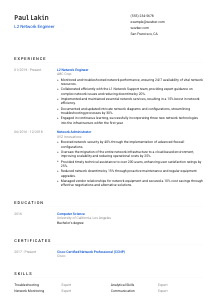
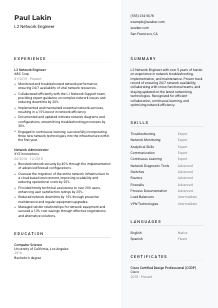
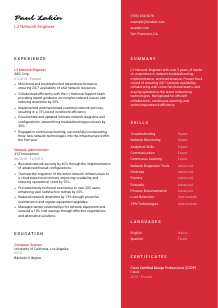
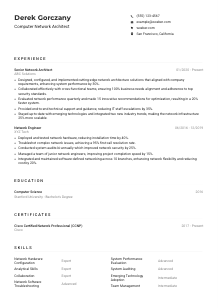
Troubleshooting LAN parties, but your resume isn't connected? Check out this L2 Network Engineer resume example, built with Wozber free resume builder. Learn how to weave your second-level savvy with job requirements, and set a career path with super-powered network speed!
L2 Network Engineer hiring usually turns on a practical question: can you stabilize production networks when performance drops, incidents escalate, or an L1 team needs a faster path to root cause. A resume for this work needs to make your troubleshooting depth, device-level experience, and operating discipline visible early, especially if you support routers, switches, firewalls, load balancers, or always-on environments.
Screening gets much easier when your resume uses the same operational language as the job description instead of broad IT wording. Wozber's free resume builder helps you shape that language into an ATS-compliant resume by aligning titles, skills, and accomplishment phrasing with the posting, so hiring teams can quickly see whether your background fits outage response, implementation work, and day-to-day network reliability.
For infrastructure roles, the header does more than identify you. It confirms basic logistics before anyone reads your incident history, certifications, or tooling experience. Keep this section clean and direct so nothing distracts from your network background.
Use your full name as the most prominent text on the page. Keep the styling professional and readable. In technical hiring, clarity wins over design flourishes, and a clean header sets the same tone you want the rest of your resume to carry.
Place "L2 Network Engineer" directly under your name when that is the role you are targeting. This removes guesswork, helps ATS matching, and immediately positions your experience around escalation support, troubleshooting, and network operations rather than general IT support or systems administration.
Use a reliable phone number and a professional email address, ideally a straightforward format such as firstname.lastname@email.com. Check every character. In roles that depend on precision, a typo in your contact details sends the wrong message before your technical experience is even reviewed.
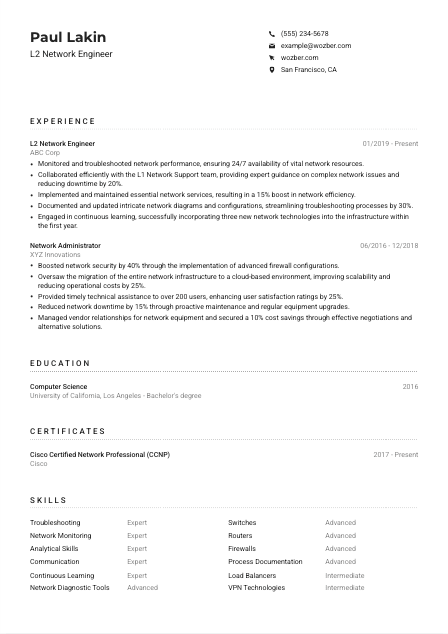
If a posting specifies location or relocation, include your city and state in the header. Here, listing "San Francisco, CA" directly answers a stated requirement and removes an avoidable question from the screening process. For other applications, tailor this detail to the employer's stated location needs rather than treating it as a universal rule.
If you include LinkedIn or a professional website, make sure it matches your resume's titles, dates, and core achievements. For network engineers, this can reinforce your certifications, infrastructure scope, or project work, but only if the profile is current and consistent.
Your personal details should confirm that you are reachable, professionally presented, and logistically aligned with the role. Once that is clear, the reader can focus on what matters most for L2 work: how you support, maintain, and improve production networks.




This is the section where L2 candidates separate themselves from generalist IT profiles. Hiring managers want to see what kinds of environments you supported, what issues you handled, which devices and services you touched, and what changed because of your work.
Read the job description closely and pull out the work patterns it emphasizes. In this case, the recurring themes are network troubleshooting, break-fix support, implementation, 24/7 availability, escalation guidance for L1, and maintenance of core infrastructure devices. Those are the themes your bullets should echo using your own real examples.
List positions in reverse chronological order and make the job titles easy to scan. If you have worked as an L2 Network Engineer, Network Administrator, NOC Engineer, or in another hands-on network operations role, make that progression obvious so the reviewer can quickly follow your technical growth.
Focus each bullet on a concrete part of the work: what you monitored, troubleshot, implemented, maintained, or documented. The example resume does this well with lines about ensuring 24/7 network availability, guiding the L1 support team on complex issues, and updating network diagrams and configurations. That kind of wording tells a hiring team you have worked in live operational environments, not just around network tasks.
Quantify results where you can support them. Downtime reduction, faster resolution, improved efficiency, stronger security posture, lower operating costs, migration scale, or user volume all fit naturally in network engineering. Results such as reducing downtime by 20% or improving troubleshooting speed through better documentation carry more weight than vague claims about making an impact.
Do not overload this section with every ticketing, support, or admin task you have ever done. Prioritize work that shows escalation handling, device configuration, monitoring tools, vendor coordination, infrastructure changes, and reliability improvements. If a bullet does not help explain how you operate as an L2 engineer, trim it or rewrite it.
A well-shaped experience section should leave no doubt about the kinds of networks you have supported and the level of responsibility you carried. When your bullets show incidents, devices, collaboration points, and measurable results, your L2 scope becomes clear fast.
Education will rarely outweigh hands-on network experience at the L2 level, but it still matters because many employers use it as an early qualification check. Present it in a way that confirms the requirement quickly and supports your technical foundation.
If the posting asks for a bachelor's degree in Computer Science, Information Technology, or a related field, make sure that information is easy to find. A listed Bachelor's degree in Computer Science, like the example resume shows, directly covers the academic requirement without extra explanation.
Keep the format simple: degree, field of study, school, and graduation year. Recruiters and hiring managers should be able to confirm your educational background in seconds without parsing dense formatting or extra text.
If your degree is in Computer Science, Information Technology, Information Systems, or another closely related discipline, name it precisely. Exact wording helps when education is part of ATS filtering and keeps your resume aligned with the job description.
Early-career candidates can benefit from including networking labs, systems courses, capstone projects, or infrastructure-focused academic work. If you already have several years of network operations experience, keep this section lean unless a project clearly strengthens your fit for routing, switching, security, or network design work.
Honors, scholarships, or technical extracurriculars are worth adding when they reinforce discipline or relevant interest, especially for candidates with lighter experience. For more established engineers, these details should stay secondary to production troubleshooting, implementation, and certification depth.
This section should quickly answer whether you meet the degree requirement and show the technical base behind your network work. Keep it concise, accurate, and easy to verify.
For L2 network roles, certifications are one of the clearest ways to show structured technical depth. They are especially useful when the job emphasizes Cisco environments, implementation work, or escalation-level troubleshooting.
When a job prefers CCNP or CCDP, list those certifications prominently if you hold them. Doing so shows immediate alignment with the employer's preferred qualification set, as the example resume does with both Cisco credentials.
Choose certifications that support the actual work of the role. Cisco, routing and switching, network design, security, cloud networking, or vendor-specific infrastructure credentials usually matter more here than broad general IT certifications that do not speak directly to network operations.
Add the year earned and, where relevant, indicate whether the certification is current. This helps hiring teams understand how recent your formal training is and whether your knowledge is being maintained alongside changes in tooling and best practices.
L2 engineers are expected to keep up with new platforms, architectures, and operational practices. If you are actively renewing certifications or building new expertise, let that support the story already told in your experience section about continuous learning and adapting to newer network technologies.
Certifications should strengthen the case that you can handle the routing, switching, troubleshooting, and design expectations tied to the role. Place the most relevant ones first and keep them current enough to matter.
A network engineer's skills section should read like an accurate map of daily work, not a generic IT list. The most useful version combines technical depth, operational tooling, and the collaboration needed when incidents move between support tiers or vendors.
Start with the language in the posting. Here, that includes network troubleshooting, break-fix, implementation, diagnostic and monitoring tools, documentation, and collaboration with internal teams and vendors. Those are better anchors than broad labels such as "IT support" or "technical knowledge."
List the infrastructure skills first, then include the communication abilities that matter in escalation-heavy environments. Skills such as switches, routers, firewalls, load balancers, network monitoring, and diagnostic tools belong alongside communication and cross-team collaboration because L2 engineers often translate complex issues for L1 teams, vendors, or non-network stakeholders.
Do not flood this section with every technology you have touched once. Group your strongest, most relevant capabilities around the role's core work. The example resume stays close to the mark by naming troubleshooting, monitoring, process documentation, core network devices, and VPN technologies without drifting into unrelated tools.
Your skills list should support the story told in your experience section. When the tools, devices, and collaboration strengths line up clearly, the hiring team can picture you handling real L2 network issues in their environment.
Language details are usually a secondary section for network engineers, but they still matter when the role explicitly mentions reading technical material in English. Vendor documentation, configuration references, incident notes, and escalation records all depend on that ability.
If the posting requires the ability to read complex texts in English, state your English proficiency directly. A simple entry such as "English - Native" or "English - Fluent" answers the requirement without overexplaining it.
Include additional languages when they are real strengths and could help in user support, vendor communication, or global team collaboration. They are a plus, but they should remain secondary to your network operations experience unless the employer specifically emphasizes multilingual work.
Choose clear levels such as Native, Fluent, Intermediate, or Basic. Straightforward ratings help set accurate expectations and keep this section consistent with the rest of your resume's factual tone.
Extra languages are most useful when the role involves cross-regional teams, external partners, or user communities that benefit from them. If that is not central to the position, keep this section brief and let your technical sections carry the application.
Language ability can add range to your profile, especially in distributed operations or multinational environments, but it should support the main case rather than replace it. For L2 network roles, troubleshooting depth and infrastructure experience still lead.
Use this section to answer explicit reading or communication requirements, then move on. The value here is clarity, especially when the posting names English proficiency as part of the baseline.
Your summary should sound like someone who has worked in live network environments, not someone reciting keywords from a posting. In a few lines, establish your level, your technical focus, and the kinds of outcomes you have delivered.
Start with your current professional identity and years of relevant experience. A line such as "L2 Network Engineer with 5+ years of hands-on experience" works because it immediately tells the reader your level and domain.
Use the summary to reflect the main demands of the role: troubleshooting, implementation, maintenance, uptime support, and collaboration during escalations. The example summary does this by referencing 24/7 availability, cross-functional collaboration, and current network technologies rather than relying on generic claims.
Mention outcomes that fit network engineering, such as reducing downtime, improving efficiency, supporting production availability, or strengthening infrastructure reliability. You do not need a long list here. One or two well-chosen results are enough to establish credibility.
Aim for three to five lines with direct language and strong nouns. Avoid soft introductions or broad statements about passion. This section works best when it reads like a concise operational profile that connects your background to the network environment you want to support.
A sharp summary tells the reader, within seconds, whether your background belongs in an L2 network shortlist. Keep it specific enough to show troubleshooting depth, infrastructure familiarity, and the kind of operational results you can deliver.
An effective L2 Network Engineer resume makes a few things easy to confirm right away: you can troubleshoot live network issues, support and implement core infrastructure, document changes cleanly, and work across support tiers when incidents escalate. Every section should help clarify that operating profile.
Wozber's free resume builder can help you turn that experience into an ATS-friendly resume format, and its ATS resume scanner can sharpen the wording around requirements, certifications, and technical terminology. The final result should make your readiness for hands-on network operations clear before the first interview.




