



Use Wozber and land your dream job
Create Resume
No registration required
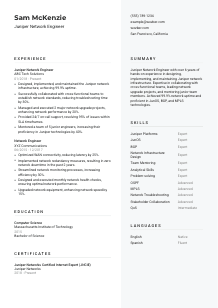
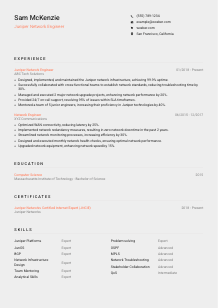
Routing packets, but your resume seems to loop? Untangle it with this Juniper Network Engineer resume example, created with Wozber free resume builder. Learn how to blend your network know-how with job demands, and steer your career on a clear path of connectivity!
Juniper Network Engineers are hired to keep critical routing, switching, and security environments stable under pressure. A resume for this work needs to show more than general network support. It should make your scope clear fast: the Juniper platforms you worked on, the protocols you managed, the reliability you maintained, and the level of troubleshooting or design ownership you carried.
Screening gets much easier when that technical scope is spelled out in the same language the role uses. Wozber's free resume builder helps you shape an ATS-compliant resume around the posting's terminology, so hiring teams can quickly see whether your background lines up with JunOS administration, BGP and OSPF routing, MPLS or QoS work, security platforms, and operational support expectations.
For infrastructure roles, the header should answer a few practical questions immediately: who you are, how to reach you, what role you target, and whether you match any location requirement. Keep it clean and factual so the reader can move straight to your network experience.
Use your full name in a slightly larger font than the rest of the resume. Skip nicknames unless they are the name you use professionally. In technical hiring, clarity matters. Your header should look as precise as a change record or network diagram label.
Place "Juniper Network Engineer" directly below your name when that is the role you are pursuing. This helps recruiters and ATS tools categorize your resume quickly and immediately frames your background around Juniper routing, switching, and network operations rather than broader infrastructure work.
Include a working phone number and a professional email address, ideally based on your name. Check them carefully. A role that involves configuration accuracy, outage response, and escalation handling benefits from small signs of precision, even in the contact section.
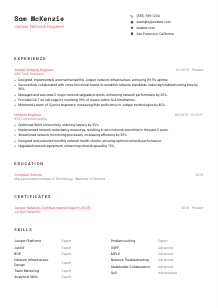
If a posting requires local presence, list your city and state. Here, San Francisco, CA is specifically requested, so including it removes an avoidable question early. Treat this as targeted tailoring to the opening, not a universal rule for every Juniper Network Engineer resume.
A current LinkedIn profile can reinforce your resume with certifications, platform depth, and project history. If you link to a personal site, make sure it supports the role with relevant content such as lab work, network architecture writeups, or professional credentials rather than unrelated material.
Your personal details should remove friction, not add it. If the title, contact information, and location are easy to confirm, the reader can focus on the Juniper experience that matters most.




This is the section network leaders study most closely. They want to know what environments you supported, which Juniper technologies you touched, how you handled availability and incidents, and whether your work improved performance, resilience, or operational efficiency.
Read the job description like a runbook. Mark the platforms, protocols, and operational demands that repeat. In this case, JunOS, BGP, OSPF, MPLS, QoS, SRX, upgrade work, troubleshooting, and on-call support all deserve space in your experience bullets if they reflect your background. This gives you the right vocabulary for tailoring without copying the posting word for word.
Use reverse chronological order and make each entry easy to scan: company, title, dates, then accomplishment bullets. For network engineering roles, your title alone is not enough. The bullets should quickly reveal whether you owned design, implementation, maintenance, incident response, or standards work across campus, data center, WAN, or security environments.
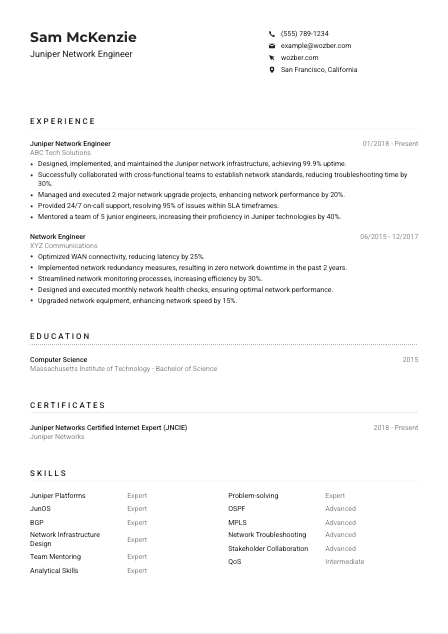
Each bullet should connect an action to a technical or business result. Instead of saying you were responsible for infrastructure, show what you improved. The sample resume does this well with points like maintaining Juniper infrastructure at 99.9% uptime and cutting troubleshooting time by 30% through cross-functional standards work. That combination of ownership and measurable result reads much stronger than a task list.
The most convincing numbers in this field are tied to uptime, latency, SLA performance, throughput, incident resolution, deployment volume, redundancy, or reduced troubleshooting time. Metrics like 95% of issues resolved within SLA or 20% performance improvement tell hiring managers how you operate in production environments and how your work affects network stability.
Cut or shorten achievements that do not support your case for this role. If you have broad networking experience, keep the details that point toward Juniper routing and switching, security platforms, protocol depth, upgrade execution, and mentoring. Even when earlier roles were more general, frame them around transferable work such as WAN optimization, redundancy design, health checks, or equipment upgrades.
After reading this section, a network manager should understand the environments you supported, the Juniper technologies you handled, and the operational results you delivered. Make those three points unmistakable.
Education is usually a quick scan in senior network hiring, but it still matters. It confirms the baseline technical foundation and helps you meet stated requirements without forcing recruiters to search for the credential.
If the posting asks for a bachelor's degree in Computer Science, Information Technology, or a related field, make that information easy to spot. A Bachelor of Science in Computer Science, like the example resume shows, directly covers the requirement and supports the technical depth expected in enterprise network engineering.
List the degree, field of study, school, and graduation year. That is usually enough. Hiring teams reviewing infrastructure resumes want to confirm the credential quickly and move back to your Juniper experience, certifications, and protocol knowledge.
If your degree is closely tied to networking, systems, computer science, or information technology, state the full field name rather than a shortened version. Specificity helps when a role requires formal technical education and when ATS parsing looks for related academic backgrounds.
Relevant coursework can help if you are earlier in your career or if your program included networking, operating systems, security, or telecommunications classes that support the role. With 5+ years of experience, this usually becomes secondary to production work on routing, switching, and security infrastructure.
Honors, capstone projects, or student lab work are worth listing only if they strengthen your case for network engineering. A routing project, network automation work, or a security lab is useful. Generic campus involvement is usually better left off once your professional experience carries the narrative.
This section should confirm the required degree without slowing the resume down. Present it clearly, then let your hands-on Juniper work and certifications carry the technical story.
Juniper certifications carry real weight because they point to platform depth, protocol knowledge, and continued investment in the technology stack. For roles centered on JunOS, routing, and security infrastructure, this section can strengthen your credibility quickly.
Lead with certifications that map directly to the employer's environment. A Juniper credential such as JNCIE is highly relevant here because it supports advanced knowledge of Juniper platforms and complex network design or troubleshooting work. If you hold multiple certs, order them by closeness to the target role.
List certifications that reinforce your ability to work on Juniper routing, switching, and security technologies. Broader networking certs can still help, but Juniper-focused credentials should take priority for a specialized engineer position like this one.
Include the year earned and, if applicable, the active period or renewal status. Certification dates matter in infrastructure hiring because they show whether your knowledge of current platform capabilities, security practices, and network standards is recent enough to trust in a production environment.
Juniper environments change through software releases, hardware refresh cycles, security updates, and new operational practices. Ongoing certification or training in areas like routing, security, or automation helps show that your knowledge has stayed current beyond past implementations.
A well-chosen certification section tells the reader that your Juniper expertise is not casual or outdated. It should support the level of engineering responsibility your experience already suggests.
For a Juniper Network Engineer, the skills section works best as a compact technical inventory. It should confirm the protocols, platforms, and operational strengths that appear in your experience rather than repeating broad buzzwords.
Start with the technologies and capabilities the job actually asks for, then keep only the ones you can support elsewhere in the resume. In this posting, that includes JunOS, BGP, OSPF, MPLS, QoS, Juniper platforms, and security exposure such as SRX. Matching the posting's language improves both ATS alignment and technical credibility.
Do not stop at protocol names. Include the practical engineering capabilities that shape day-to-day performance, such as network infrastructure design, troubleshooting, standards development, on-call support, or mentoring. The sample resume handles this well by pairing technical tools with analytical skills, problem-solving, and stakeholder collaboration.
Organize skills so a reviewer can process them in seconds. One common approach is to separate technical skills from collaboration or leadership skills, or to cluster by routing, security, and operations. Avoid long undifferentiated lists. A focused set of relevant skills usually works better than trying to name every protocol or platform you have ever touched.
Every skill here should echo your experience, summary, or certifications. When the same Juniper technologies and network responsibilities appear consistently across sections, your profile reads as focused and credible.
Communication matters in network engineering because outages, change windows, escalations, and cross-team troubleshooting all depend on precise language. The language section should stay brief, but it can still help you meet a stated requirement cleanly.
If the posting states that clear English communication is essential, list English explicitly with an honest proficiency level. Using "Native" or "Fluent" works well when accurate and immediately addresses a stated requirement.
Start with the language required for the job, then list additional languages by proficiency. This keeps the section practical and easy to scan, especially when the role includes collaboration with operations teams, vendors, or distributed support groups.
Additional languages can be useful in multinational environments or customer-facing infrastructure teams. They are a bonus, not a substitute for technical depth, so keep the emphasis where it belongs. In the example, Spanish adds range without distracting from the candidate's Juniper background.
Choose common labels such as Native, Fluent, Intermediate, or Basic. Avoid vague wording. Clear proficiency levels set accurate expectations for meetings, documentation, incident calls, and stakeholder communication.
Some network engineering jobs are almost entirely internal, while others involve vendors, field teams, or global operations centers. If your language ability genuinely supports those collaboration patterns, listing it can strengthen the resume. If not, keep the section minimal.
This section only needs to confirm that you can communicate effectively in the environments the role requires. For this posting, clear English belongs on the page and should be easy to find.
The summary sits at the top of the resume, so it needs to establish your technical identity quickly. For Juniper-focused roles, that means leading with platform depth, years of experience, and a few outcomes that show you have worked in live network environments where uptime and response time matter.
Start with the parts of the job that define the position. Here, that means Juniper network engineering rather than generic IT support. Your first line should establish your years of experience and the kind of infrastructure you have designed, implemented, or maintained.
A concise opening such as "Juniper Network Engineer with 6+ years of experience designing, implementing, and maintaining enterprise network infrastructure" works because it immediately gives the reviewer your specialty and scope. The sample summary uses this approach effectively.
Use the next lines to mention the technologies and results most relevant to the role. For this posting, that could include JunOS, BGP, MPLS, security platforms, high availability, upgrade work, or mentoring. The example summary strengthens its case by pairing protocol depth with a 99.9% uptime result.
Aim for three to five lines. That is enough space to show platform focus, experience level, and a few high-value outcomes without repeating your entire experience section. Cut generic traits unless they are tied to the actual work, such as troubleshooting complex issues or collaborating on network standards.
A strong summary tells the reader, within seconds, what kind of Juniper environment you can handle and at what level. If this section is doing its job, the rest of the resume simply backs it up.
A well-tailored Juniper Network Engineer resume should make four things easy to judge: your platform expertise, your protocol depth, your reliability under production conditions, and your ability to improve network performance. When those points are clear across the summary, experience, skills, and certifications, the resume reads like someone ready to support critical infrastructure.
Use Wozber's free resume builder to organize that experience in an ATS-friendly resume format, then refine the wording with its ATS resume scanner and AI-assisted tailoring features so the technical language matches the role naturally. The finished resume should make it easy for a hiring team to see that you can step into a Juniper environment and contribute with confidence.