



Use Wozber and land your dream job
Create Resume
No registration required
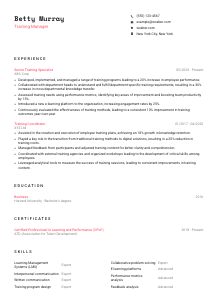
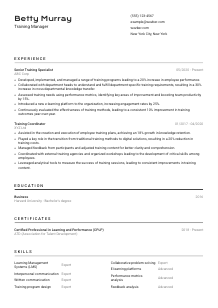
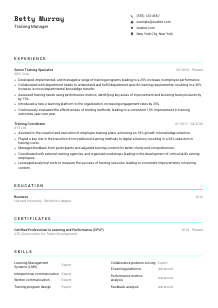
Cultivating skills, but your resume feels untrained? Explore this Training Manager resume example, created with Wozber free resume builder. Learn how to showcase your training tactics in line with job expectations, steering your career path toward peak professional development!
Training managers are usually hired to fix a business problem, not simply to deliver classes. Teams expect them to identify skill gaps, build training that people will actually use, and show whether performance, retention, compliance, or productivity improved afterward. Your resume needs to make that operating reality visible, especially through program design scope, stakeholder partnership, and the results your learning initiatives produced.
When your resume mirrors the language of the job description, reviewers can quickly separate broad L&D experience from true training leadership. Wozber's free resume builder helps you shape an ATS-compliant resume around the right terms, from LMS administration to training effectiveness reporting, so hiring teams can immediately see whether you can run programs, work across departments, and improve workforce capability at scale.
For a Training Manager, the header should answer a few practical questions right away: who you are, what role you do, and whether you meet any basic logistics in the posting. Keep it clean, professional, and easy to scan so the rest of the resume can move quickly into program leadership and learning outcomes.
Use your full name as the main header, then place "Training Manager" directly beneath it or beside it. That immediate role match matters when employers are sorting candidates with backgrounds in HR, instructional design, enablement, or broader learning and development. If your current title is slightly different, such as Senior Training Specialist, you can still headline yourself as a Training Manager when your experience clearly supports that level.
Use the exact job title from the posting when it reflects the work you do. For this opening, "Training Manager" is the clearest choice. It keeps your positioning consistent in ATS screening and helps the hiring team understand that your experience goes beyond facilitation into program ownership, training analysis, and cross-functional coordination.
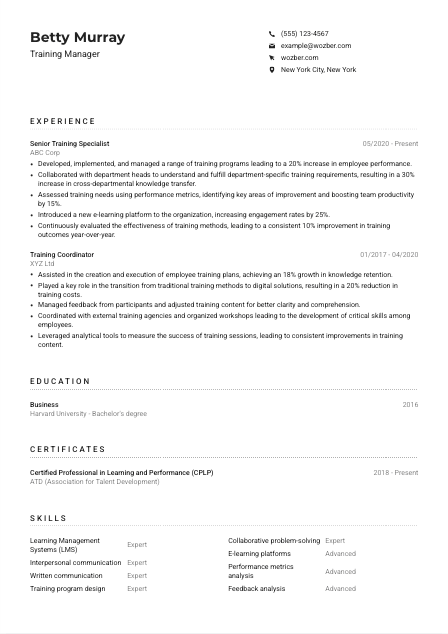
List a reliable phone number and a professional email address, ideally in a straightforward format. Add your city and state when location matters. In the example, "New York City, New York" directly supports a stated requirement, which removes uncertainty before the employer even reaches your experience section.
Some training roles are flexible, but others depend on on-site delivery, close partnership with department leaders, or local presence. When a posting specifies location, include it exactly and without extra explanation. Here, showing New York City, New York tells the employer you satisfy a concrete filter rather than leaving them to guess about relocation or commute.
A LinkedIn profile or professional website can strengthen your header when it supports your training background with useful detail. This is most helpful if it includes learning program examples, facilitation experience, LMS projects, workshop topics, or certifications. Make sure the titles, dates, and achievements match your resume so the story stays consistent.
Your personal details should remove basic questions fast: your role, your reachability, and any required location fit. That gives the employer a clear path to focus on your training results.




This is the section where Training Manager resumes usually separate themselves. Hiring teams want to see more than workshop delivery. They look for evidence that you assessed needs, designed or improved programs, worked with business leaders, used LMS or e-learning tools effectively, and tracked whether training changed performance in a measurable way.
Start by marking the responsibilities and requirements that define the role. In this job, the recurring themes are training program development, needs assessment, LMS and e-learning proficiency, collaboration with department heads, and reporting effectiveness to leadership. Those themes should appear in your experience bullets using language that matches your actual work, not generic HR wording.
List your experience in reverse chronological order and give the most space to roles where you designed, implemented, managed, or evaluated training. Titles such as Training Manager, Senior Training Specialist, Learning and Development Specialist, or Enablement Lead usually deserve the most attention when they involve program rollout, stakeholder partnership, and measurable learning outcomes.
Replace task-heavy bullets with results tied to training performance. "Developed training materials" is weak on its own. A stronger version shows scope and impact, such as building a training program that increased employee performance, shortened ramp time, improved retention, or raised engagement with digital learning. The sample resume does this well by connecting program management to a 20% increase in employee performance and a 25% engagement lift after introducing a new e-learning platform.
Numbers matter most when they reflect how training work is judged. Use metrics like completion rates, assessment scores, knowledge retention, productivity gains, adoption rates, time-to-proficiency, cost reduction, or year-over-year improvement in training outcomes. If you assessed needs through performance data, say what changed afterward. That gives the employer a clearer picture of your analytical range, not just your delivery style.
Cut accomplishments that do not strengthen your case for managing training programs. Prioritize bullets that show curriculum design, LMS administration, e-learning rollout, facilitator management, stakeholder alignment, feedback analysis, or reporting to senior leadership. Even if an achievement is impressive, it should stay off the page if it does not support your case as someone who can lead organizational learning efforts.
Your experience section should show that you can move from training needs to training outcomes with structure, data, and stakeholder trust. Wozber can help align that experience with ATS optimization so both the system and the hiring team can quickly trace your impact.
Training Manager roles do not always hinge on advanced degrees, but employers still use education as an early qualification check. Keep this section direct and make sure it clearly supports the academic background requested, especially when the posting names fields like Education, Business, or Human Resources.
Here, the employer asks for a bachelor's degree in Education, Business, Human Resources, or a related field. If you meet that requirement, state it plainly. In the example, a Bachelor's degree in Business aligns directly, which helps clear an early screening checkpoint without needing extra interpretation.
List the degree, field of study, school name, and graduation year in a simple format. That structure works well in an ATS-friendly resume format and keeps reviewers from hunting for basic qualifications. Avoid adding too much extra detail unless it strengthens your relevance for training, facilitation, adult learning, or organizational development.
If your degree maps closely to the posting, make that easy to spot. For example, "Bachelor's degree, Business" is stronger than leaving the field vague. If your degree is in a related area, keep the wording accurate and let your experience section reinforce the connection through training design, learning delivery, or workforce development work.
Most experienced training professionals do not need to expand heavily on academics, but relevant coursework can help if it covers instructional design, communication, adult learning, organizational behavior, or HR development. Use this sparingly. The material should add context, not distract from your program leadership experience.
If you completed professional development in facilitation, LMS platforms, e-learning authoring, or learning analytics, mention it where it fits best. Formal credentials belong in Certificates, while degree-related distinctions stay here. That separation keeps the resume easier to scan and makes each qualification type easier to understand.
Education should settle the formal requirement quickly and cleanly. Once that box is checked, the hiring focus shifts back to your training programs, tools, and measurable results.
Certifications carry extra weight in training and development because they show continued investment in learning science, facilitation standards, and program design. They are especially useful when a posting names a preferred credential or when you want to show depth beyond your degree.
This posting prefers certification in Training and Development, with CPLP named as an example. That gives you a clear tailoring cue. If you hold a directly relevant credential, place it prominently and use the full official name so both ATS systems and hiring managers can recognize it immediately.
List credentials that strengthen your case as someone who can design, deliver, and evaluate training programs. Relevant examples include CPLP, CPTD, instructional design certifications, facilitation credentials, or platform-specific learning technology certifications. The closer the certificate is to program leadership, the more useful it is on the page.
Certification dates help show recency, active status, or renewal maintenance. In the provided example, the CPLP entry includes a continuing date range, which suggests the credential remains current. That matters in a field where methods, digital delivery tools, and learner engagement practices keep evolving.
Training leaders are expected to stay current on e-learning methods, LMS capabilities, learning analytics, and adult learning practices. If you are actively pursuing new credentials, add completed ones first and only mention in-progress study when it is genuinely relevant to the target role.
Relevant certificates reinforce that your training knowledge is current, structured, and recognized beyond day-to-day experience. They are especially persuasive when they align with the learning frameworks or technologies named in the posting.
A Training Manager skills section works best when it balances learning technology, program design, communication, and analysis. Employers expect a mix of operational skills and people-facing strengths, because the role sits between business needs, learner engagement, and measurable performance improvement.
Read the job description for explicit requirements and implied capabilities. This one clearly asks for LMS and e-learning proficiency, strong written and verbal communication, and the ability to assess needs and improve training based on performance metrics. Those are not filler keywords. They describe the actual work the person will be doing.
Build the section around skills you have applied in training environments, not broad traits with no proof behind them. A focused list might include Learning Management Systems, training program design, instructional design, e-learning platforms, performance metrics analysis, facilitation, stakeholder collaboration, and written communication. The sample resume balances technical tools with the interpersonal side of department collaboration well.
Put the skills closest to the posting near the top. If the employer emphasizes LMS usage, communication, and program execution, those should appear before lower-priority items. Keep the list concise enough that each item feels deliberate. Your best skills section should echo the work you already proved in experience bullets.
This section should confirm the toolkit behind your achievements: the systems you use, the learning work you lead, and the communication strengths that keep training programs effective across departments.
Language matters in training roles because clarity affects adoption, comprehension, and learner confidence. If a posting names a required language, treat it as a practical qualification and make it easy to find on the resume.
This employer specifies that the candidate should be comfortable communicating in English. That is a direct requirement, so English should appear clearly in your language section if it reflects your working ability. For training roles, language proficiency affects facilitation, written materials, stakeholder communication, and reporting.
Put English first when it is the operating language of the role and label your level accurately, such as Native or Fluent. That makes it easy for reviewers to confirm you can handle workshops, training documentation, and manager communication without extra follow-up.
Extra languages can be valuable in organizations with multilingual teams, regional offices, or localized training needs. In the example, Spanish adds range, but it should remain secondary to the required English qualification unless the job specifically emphasizes multilingual delivery.
Stick with recognizable terms such as Native, Fluent, Intermediate, or Basic. Avoid vague descriptions. Training roles depend on precision, so your language ratings should set realistic expectations for facilitation, writing, and cross-functional communication.
If your language skills supported training rollouts across teams or regions, that proof usually belongs in the experience section as well. The language section itself should stay brief, but it can still support a broader story about audience reach, accessibility, or multilingual learner support.
Language details should confirm that you can communicate clearly with learners, managers, and leadership. For this kind of role, that is a practical capability, not a minor extra.
The summary should quickly establish your level, your training specialty, and the kind of outcomes you deliver. For Training Manager roles, that usually means a short introduction that connects years of experience with program design, learning technology, cross-functional partnership, and measurable workforce improvement.
Start with a concise statement of your experience in training and development, learning and development, or a closely related area. Mention your years in a natural way, such as "Training Manager with 6+ years of experience in training and development." That immediately positions you at the right level for a role asking for a minimum of five years.
Use the next sentence to name the tools or strengths the employer cares about most. For this posting, that includes training program design, LMS and e-learning platforms, and collaboration with department leaders. The sample summary handles this well by linking modern learning platforms with cross-department work rather than listing disconnected keywords.
Your summary should not stop at competence. Include the kind of outcome your work creates, such as improving employee performance, strengthening knowledge retention, increasing engagement with digital learning, or refining programs through performance analysis. That gives the employer a reason to expect results, not just activity.
Aim for three to five lines with no filler. Every sentence should earn its place by covering level, specialty, tools, or outcomes. If the summary starts repeating bullets from your experience section word for word, tighten it until it reads as a sharp professional overview rather than a duplicate.
A hiring manager should be able to read your summary and immediately understand your training scope, your operating tools, and the kind of organizational improvement your programs produce.
A Training Manager resume works when every section points to the same story: you can identify learning needs, build programs that fit the business, use LMS and e-learning tools effectively, and report measurable improvement. That is what employers need to see across your header, experience, skills, and summary.
Use Wozber to organize that story in an ATS-friendly resume template, strengthen wording with role-specific terminology, and check alignment with an ATS resume scanner before you apply. The finished resume should make one thing easy to judge: whether you can lead training programs that improve employee performance.




