



Use Wozber and land your dream job
Create Resume
No registration required
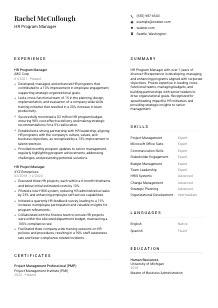
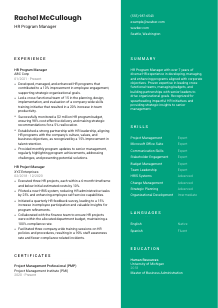
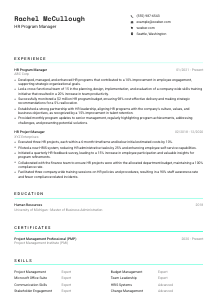
Designing HR initiatives, but your resume lacks benefits? Check out this HR Program Manager resume example, created with Wozber free resume builder. It shows how to seamlessly connect your talent in people strategy with job specifics, ensuring your career advancement package gets the highest engagement rate!
HR Program Managers sit at the point where people strategy meets delivery. Hiring teams look for candidates who can move large initiatives from planning to rollout, keep leaders informed, manage budgets responsibly, and show measurable results in areas like engagement, retention, training uptake, or HR process improvement. Your resume should make that operating range visible quickly.
When that scope is spelled out clearly, reviewers can tell whether you have led HR programs or only supported them. Wozber's free resume builder helps you shape that distinction into an ATS-compliant resume by aligning your language with the posting and keeping the structure clean enough for both screening systems and senior stakeholders to see your program ownership.
For an HR Program Manager, the top of the resume should read like a confident business document. Clean contact details, a clear title, and location information where relevant help remove friction before the reader gets to your program work, stakeholder management, and delivery track record.
Place your name prominently, then use the target title directly beneath it. If you are applying for an HR Program Manager position, say "HR Program Manager" rather than a broad label like "HR Professional" or "People Operations Leader." That immediate alignment matters when the role centers on program ownership, cross-functional execution, and strategic HR initiatives.
List a reliable phone number and a professional email address that would look appropriate in communication with executives, HR leaders, and project stakeholders. Errors here undermine the polished, organized impression expected from someone who may be responsible for program updates, budget discussions, and senior-level coordination.
Some HR roles are flexible. Others are tied to a business hub, an in-office leadership team, or a regional employee population. In the example here, Seattle, Washington is a stated requirement, so showing Seattle in the personal details immediately answers a basic screening question. If relocation is relevant, make that easy to understand rather than leaving the issue ambiguous.
If you include LinkedIn or a professional website, make sure it supports the same story as your resume. For this kind of role, that may mean reinforcing your experience with HR programs, organizational initiatives, change management, training rollouts, HRIS projects, or stakeholder-facing work. A mismatched or outdated profile weakens the consistency of your application.
Skip details such as age, marital status, gender, or other information unrelated to the role. HR leaders are especially aware of fair hiring practice, and your resume should reflect that professionalism. Keep the focus on qualifications, communication, and readiness to manage people programs at scale.
This section should answer the practical basics in seconds. Once the title, contact details, and any location requirement are clear, the reader can move straight to the work that matters most: your ability to run HR programs effectively.




This is the section that decides whether you look like an HR operator, an HR project lead, or a true program manager. Employers hiring for this work want to see initiative scope, cross-functional coordination, budget responsibility, reporting cadence, and business outcomes, not just a list of HR duties.
Read the job description for the operating demands behind the title. Here, the priorities are clear: develop and improve HR programs, lead cross-functional teams, manage budget, align with business goals, and report progress to senior management. Your experience bullets should answer those points directly, using examples from workforce planning, training, engagement, HR systems, policy rollout, organizational development, or similar workstreams you have led.
Use reverse chronological order and make each entry easy to scan: title, company, dates, then accomplishments. That simple structure helps ATS parsing and also lets a hiring manager quickly see whether your progression moved from project coordination into broader program leadership. For HR Program Manager roles, career progression often matters because it shows increasing ownership of stakeholders, budgets, and enterprise-wide initiatives.
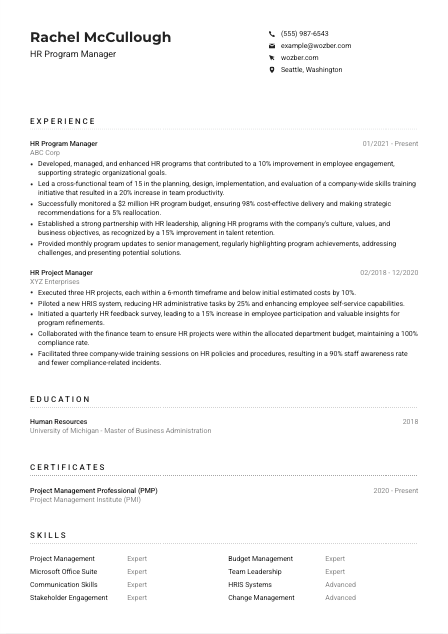
Each bullet should show what you led, how you delivered it, and what changed as a result. The example resume does this well by tying HR programs to a 10% improvement in employee engagement and a training initiative to a 20% increase in productivity. Those are much stronger than generic lines about "supporting HR initiatives" because they show scale, ownership, and business impact.
Numbers are especially useful in HR program management because they show operational range. Include metrics such as budget size, team size, adoption rate, participation rate, retention lift, engagement gains, administrative time reduced, rollout timeline, or frequency of executive reporting. Managing a $2 million budget, leading a 15-person cross-functional team, or delivering monthly updates to senior leadership gives the reader a concrete sense of your level.
Prioritize experience that shows program design, implementation, governance, stakeholder influence, or measurable HR outcomes. Leave out older or less relevant points that do not strengthen your case. For example, a resume for this role gains more from an HRIS implementation or enterprise training rollout than from unrelated achievements that do not speak to strategic HR delivery.
A hiring team should finish this section knowing what programs you owned, how broadly you worked across the organization, and what results followed. That distinction is what moves a resume from HR support to HR program leadership.
Education is usually a qualifying section for HR Program Manager roles, but it still shapes how your background is read. Degree relevance, field of study, and highest level earned help frame whether you bring formal grounding in business, people operations, or organizational management.
Check the posting for required and preferred education, then mirror that structure in your resume. In this case, a bachelor's degree in Human Resources, Business Administration, or a related field is required, and a master's degree is preferred. If you have both, list them clearly so the reader can confirm that qualification without searching.
Include degree, field of study, school, and graduation year in a consistent format. The example resume makes the fit easy to spot by listing an MBA in Human Resources and a bachelor's degree in Management. That kind of clarity works well for HR program roles because it shows both business context and people-focused study.
If your coursework, concentration, or graduate study covered areas such as organizational development, change management, business administration, labor relations, or workforce strategy, make that visible when it strengthens your case. This is especially useful when your title history is evolving from HR project work into broader program leadership.
Most experienced HR Program Managers do not need to list classes or academic projects unless those details support a gap, a pivot, or unusually relevant training. Early-career candidates can use this space to show preparation in program planning, analytics, HR systems, or employee development, but senior candidates should keep the focus on the degree itself unless there is a compelling reason to go deeper.
Include honors, leadership roles, or notable research only if they strengthen the story you are telling. For example, a graduate capstone on organizational change or employee engagement could support your positioning. Otherwise, keep the section concise and let your delivery record in the experience section carry more weight.
For this role, education should confirm that you meet the academic baseline and, where applicable, show added depth in business or HR leadership. Once that is clear, your resume should return quickly to program execution and outcomes.
Certifications matter most when they strengthen the case that you can run structured initiatives, speak the language of governance and delivery, and manage HR work with discipline. For HR Program Managers, the right credential can support both the people side and the execution side of the role.
List certifications that map directly to the job description. Here, PMP and HRMP are specifically mentioned as pluses, so they deserve space if you hold them. They support two important hiring questions at once: can you manage complex programs, and do you understand the HR context those programs sit within.
Choose certifications that relate to program execution, HR operations, organizational development, change management, or people leadership. A PMP is especially useful when the role includes timelines, resource coordination, and executive reporting. An HR-focused credential helps reinforce your grounding in the people side of policy, compliance, employee experience, and organizational priorities.
Show the certification name, issuing body, and date or active period so the credential reads as current and credible. The example resume does this cleanly with both the certification title and issuing organization, which helps the reader quickly recognize the qualification without needing extra context.
HR program work changes with new systems, workforce expectations, and operating models. If you are continuing your education through recognized certifications, that supports your credibility as someone who can lead evolving initiatives, whether the focus is HRIS adoption, manager capability building, or enterprise change programs.
The best certifications here do not decorate the resume. They reinforce that you can lead structured HR initiatives, manage complexity, and operate credibly with both HR leadership and business stakeholders.
An HR Program Manager skills section should read like an operating toolkit. Employers want to see the mix of planning, systems fluency, stakeholder influence, communication, and budget awareness needed to move initiatives across departments and keep them aligned with business goals.
Use the posting to identify the blend of capabilities the role depends on. Here, that includes HRIS systems, project management tools, Microsoft Office Suite, communication, relationship building, and stakeholder influence. Those are not filler terms. They point to the actual day-to-day work of managing timelines, reporting progress, coordinating with leaders, and keeping HR programs running smoothly.
List skills you can support with examples elsewhere in the resume. If you claim budget management, your experience section should show financial responsibility. If you list stakeholder engagement, your bullets should show partnership with HR leadership, finance, managers, or senior executives. The example resume handles this well by pairing skills like budget management and team leadership with quantified results in the experience section.
Do not overload this section with every HR or office skill you have ever used. Prioritize the capabilities most central to HR program delivery, such as project management, change management, strategic planning, communication, organizational development, HRIS fluency, and cross-functional leadership. A concise list helps both ATS optimization and human review because the most relevant terms stay visible.
Every skill listed should support the picture of someone who can plan, influence, execute, and report on HR initiatives. If a skill does not help prove that, it probably belongs elsewhere or not at all.
Language ability matters differently in HR than in many other functions. Clear communication, policy interpretation, training delivery, and employee-facing conversations all depend on it, so the languages section should support the communication demands of the role without overstating its importance.
If the posting specifies a language requirement, state your proficiency plainly. Here, the role requires the ability to articulate effectively in English, so English should be listed in a way that removes doubt, such as Native or Fluent. For a role that includes executive updates, cross-functional facilitation, and employee communication, clarity here is practical, not decorative.
Lead with the language the role depends on, then add others that may be useful in the organization. If a company serves multilingual employee populations or operates across regions, additional languages can support training, employee relations, and broader program communication. Keep the order relevant to the actual work.
A second language is worth listing when it could help you work across employee groups, regional teams, or global HR initiatives. In the example resume, Spanish complements English and can strengthen a people-facing profile, though it is not a universal requirement for every HR Program Manager opening.
Stick with clear descriptors such as Native, Fluent, Intermediate, or Basic. HR roles often involve sensitive communication, policy explanation, and facilitation, so inflated proficiency claims can create problems later. Keep the wording accurate and easy to interpret.
If your work includes cross-cultural collaboration, workforce communication, or training across diverse teams, language ability can reinforce your value. It should still remain secondary to your program leadership, stakeholder management, and delivery track record, which are the main hiring priorities in most HR Program Manager searches.
Show the language capability the role requires, then add any extra reach that genuinely supports your work with employees, leaders, or global teams. For most HR Program Manager resumes, that is enough.
The summary needs to answer a simple question fast: what kind of HR Program Manager are you? In a few lines, it should cover your level, your operating strengths, and the kinds of outcomes you have delivered, so the reader enters the rest of the resume with the right frame.
Open with your title or professional identity, then add years of experience and the area you work in most credibly. A line like "HR Program Manager with 7+ years of experience leading strategic people initiatives" sets the context immediately. The example summary does this effectively by grounding the candidate in broad HR experience and program leadership.
Choose two or three strengths that match the job, such as leading cross-functional teams, managing budgets, driving HR programs tied to business goals, or partnering with senior leaders. This section works best when it reflects the operating center of the role rather than trying to mention every HR competency you possess.
A summary becomes more persuasive when it hints at business impact. You do not need a full metric list, but brief references to stronger engagement, productivity gains, successful enterprise rollouts, or improved retention can sharpen the picture. Save the detailed proof for the experience section.
Keep the summary flexible enough to match the emphasis of each posting. One employer may care more about large-scale change programs and stakeholder influence. Another may emphasize HRIS transformation, training strategy, or budget governance. Wording that mirrors the actual posting will improve ATS alignment and make your positioning feel deliberate rather than generic.
A good summary gives the reader the right lens for everything that follows. By the time they reach your experience section, they should already expect to see strategic HR programs, measurable outcomes, and confident cross-functional leadership.
An HR Program Manager resume needs to show more than HR experience. It should make your planning range, stakeholder influence, program ownership, budget discipline, and business impact easy to read from top to bottom.
Use Wozber's free resume builder, ATS-friendly resume templates, and ATS resume scanner to align your wording with each posting, strengthen ATS optimization, and present your work in a clean structure. The finished resume should make one conclusion easy for the hiring team: you can lead HR initiatives with the scale, clarity, and follow-through the role requires.




