




Use Wozber and land your dream job
Create Resume
No registration required
Nurturing office harmony, but your resume feels off-key? Check out this HR Assistant resume example, created with Wozber free resume builder. Learn how to tune your employee-centered skills to match job melodies, composing a career that strikes all the right chords!
HR Assistant work sits close to the daily mechanics of a company. You are often the person keeping employee records accurate, moving interviews forward, answering policy and benefits questions, and making sure routine HR processes do not slip. A resume for this role needs to show dependable execution, discretion with employee information, and the ability to support recruiters, managers, and employees without creating extra follow-up.
When that experience is tailored well, hiring teams can quickly separate general administrative support from hands-on HR coordination. Wozber's free resume builder helps you shape an ATS-compliant resume around the language of the posting, so terms like HRIS, recruiting support, employee records, and performance management appear where they naturally belong. That makes it easier to see whether you can step into day-to-day HR operations with minimal ramp-up.
For an HR Assistant, the top of the resume should feel orderly and reliable. HR teams notice clean presentation because the role itself involves accuracy, follow-through, and clear communication with employees and candidates.
Use your full name in a larger, readable font so it is easy to identify at a glance. HR roles deal with records, forms, and people data every day, so even this first line should reflect a professional, organized presentation.
Place the exact title "HR Assistant" beneath your name when that is the role you are pursuing. It immediately frames your background around recruiting support, employee administration, and HR coordination instead of leaving the reader to guess whether you are applying from a broader office support track.
Keep this section practical and error-free so recruiters can move you to the next step without friction.
If the posting calls for a specific location, include it directly in your header. For this Denver-based opening, listing Denver, Colorado removes uncertainty about relocation and helps the employer see that you are positioned for on-site or local coordination needs.
If you include LinkedIn or a professional website, make sure it supports your HR story. That profile should reinforce details such as HR administration experience, recruiting coordination, HRIS exposure, certifications, or employee relations support rather than introducing unrelated roles.
Your contact section should confirm that you are easy to reach, professionally presented, and aligned with the basics of the opening. For an HR Assistant, that quiet precision already says something useful about how you work.




This section carries most of the weight for an HR Assistant application. Employers want to see how closely you have worked with recruiting workflows, employee documentation, HR systems, policy administration, and day-to-day issue resolution.
Read the job description closely and pull out the operational tasks it emphasizes. Here, that includes reviewing resumes, scheduling interviews, conducting reference checks, maintaining employee records, handling benefits or payroll questions, and supporting performance management. Then make sure your bullets show those activities through actual work performed, not generic claims about helping the HR team.
List your most recent HR or administrative role first so the employer sees your current level of exposure to HR processes right away. For support roles especially, recency matters because HR systems, compliance routines, and employee-facing procedures can change quickly.
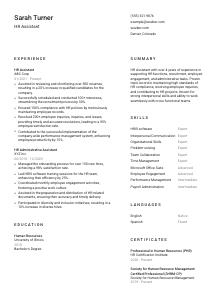
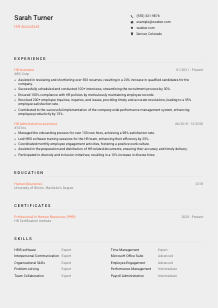
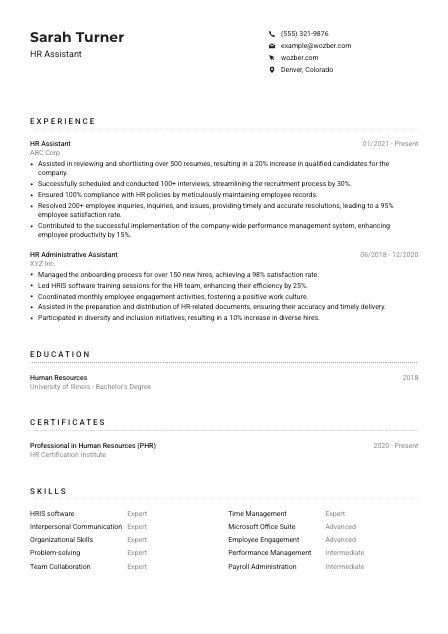
Each bullet should show what you handled and what improved because of your work. Instead of writing "responsible for interview scheduling," write the result, such as coordinating high interview volume across hiring managers or shortening recruitment turnaround time. The sample resume does this well by tying interview scheduling to a 30% streamlining of the recruitment process.
Use metrics that fit the function: resumes screened, interviews scheduled, inquiries resolved, onboarding volume, compliance rate, satisfaction scores, or process improvements. The example's details such as reviewing 500+ resumes, resolving 200+ employee inquiries, and maintaining 100% compliance are strong because they reflect how HR support work is actually measured.
Keep the focus on work that supports hiring, records management, employee service, systems, and internal coordination. If you are coming from a broader administrative background, prioritize tasks connected to confidential documentation, calendar coordination for interviews, policy communication, spreadsheet tracking, or support for HR managers. Every bullet should help the reader picture you operating inside an HR department.
A well-built experience section should make your daily contribution easy to picture. When your bullets show recruiting volume, record accuracy, employee support, and measurable process improvements, your readiness for HR Assistant work becomes much easier to judge.
Education matters here because the posting sets a clear academic baseline. It also helps explain your grounding in HR principles such as compliance, employee relations, staffing, and organizational behavior, especially earlier in your career.
If you have a bachelor's degree in Human Resources or a related field, make that easy to find. This posting specifically asks for it, so matching the wording where accurate helps both the reader and the ATS connect your background to the role's baseline requirement.
List degree, field of study, school, and graduation year in a simple structure. HR teams review high volumes of applications, and straightforward formatting helps your qualifications read quickly without distracting from the substance.
If your degree directly supports HR work, do not bury the major. "Bachelor's Degree in Human Resources" carries more value here than leading only with the institution name because it connects your academic training to recruiting, compliance, and employee administration.
Recent graduates can include coursework, honors, student HR associations, or projects tied to employment law, compensation, training, or people operations. Those extras matter most when they reinforce practical HR knowledge that your work history has not fully established yet.
If you have completed workshops, short courses, or seminars in areas like HR compliance, onboarding, HRIS use, payroll basics, or employee relations, include them when they support the target role. This is especially helpful if the posting leans on process-heavy work and your degree is older or in a related field rather than a direct HR major.
Your education section should quickly answer whether you meet the academic requirement and whether your studies connect to the work ahead. For an HR Assistant role, that means making your HR-related training visible without overcomplicating the section.
Certifications are not always mandatory for an HR Assistant, but they can sharpen your profile, especially when the employer values formal HR knowledge. They are particularly useful when they support your experience with compliance, employee relations, and core HR practices.
When a posting mentions credentials like PHR or SHRM-CP, feature them prominently if you hold them. In this opening, those certifications are listed as a plus, so including them helps position you above the baseline by showing formal investment in the profession.
Choose certifications that support the actual responsibilities of the role. HR credentials, HRIS training, payroll coursework, benefits administration certificates, or compliance-related learning will do more for this application than general business courses with weak connection to HR operations.
Add the year earned or the active date range so employers can see how current the certification is. This matters in HR because policies, employment practices, and compliance expectations evolve, and recent credentials suggest current professional knowledge.
Even if you do not hold PHR or SHRM-CP, relevant ongoing learning still helps. Courses in employee relations, recruiting operations, HR analytics, or labor law can signal that you are actively building the knowledge needed to support a busy HR team and handle employee-facing processes with confidence.
The right certifications tell an employer that your HR knowledge extends beyond routine administration. When they match the posting and are presented clearly, they strengthen your credibility without needing much space.
The best HR Assistant skills sections are practical. They should sound like the tools and interpersonal strengths someone uses while coordinating interviews, updating records, answering employee questions, and supporting policy-driven processes.
Start with the competencies the employer names directly. In this case, that includes HRIS software, Microsoft Office Suite, communication, and interpersonal ability. If those are part of your background, use the same wording so your skills section aligns naturally with both ATS screening and human review.
HR Assistant work sits between process and people. Balance technical capabilities such as HRIS, spreadsheets, document management, and payroll support with interpersonal strengths like employee communication, discretion, conflict handling, and cross-functional coordination. That mix reflects the actual rhythm of the job.
Do not turn this into a long inventory. Lead with the abilities most tied to the target work, such as recruiting coordination, employee records management, benefits or payroll issue handling, performance management support, and professional communication. The sample resume's mix of HRIS software, Microsoft Office, employee engagement, payroll administration, and problem-solving is a useful model because it stays close to real HR tasks.
A focused skills list should sound like someone who can support an HR department from day one. Lead with systems, communication, and process-related strengths that match the posting and your actual experience.
Language ability matters differently in HR than it does in many back-office jobs. HR assistants communicate with candidates, employees, and managers, so language listings should support clear workplace communication rather than simply add extra profile detail.
If the posting specifically requires English proficiency, list English at the top with an honest rating such as Native or Fluent. Since HR assistants handle interview coordination, employee questions, and policy communication, strong written and spoken English is a real operating requirement here, not a minor preference.
If you speak additional languages, include them when they can support employee communication or a diverse workforce. In some organizations, a second language can help with onboarding, benefits conversations, or employee support, though it is usually a bonus rather than a universal requirement.
Stick to recognizable terms such as Native, Fluent, Intermediate, or Basic. HR work depends on precision in communication, so inflated language claims can create immediate credibility problems if the role involves employee-facing conversations or written documentation.
For a primarily English-speaking HR Assistant opening, keep the section concise and make sure it does not distract from your recruiting, records, or HRIS experience. If the employer serves multilingual teams, then added language capability deserves more emphasis because it can directly improve employee support and workplace access.
Extra language ability can strengthen your profile when it connects to inclusion initiatives, broader employee access, or smoother communication across a diverse workforce. The value is strongest when you frame it as a support to HR service, not as a generic personal trait.
For HR Assistant applications, language skills matter most when they reinforce communication capacity inside the workplace. Keep the section honest, relevant, and tied to how you would support employees and candidates.
Your summary should quickly place you in the HR function and establish the kind of support work you can handle. This is where you connect your years of experience to the employer's immediate needs without repeating the entire resume.
Start by identifying the few responsibilities that define the opening most clearly. For this role, that means recruiting support, employee records, employee inquiries, policy compliance, and assistance with performance management. Use those themes to shape your summary so it reflects the actual job instead of sounding like a generic administrative profile.
Begin with a direct line that states your title and relevant experience, such as how many years you have supported HR operations or administrative HR functions. That gives immediate context and helps separate you from candidates whose experience is only loosely related.
Choose two or three strengths that match the role and back them with substance. You might reference hiring coordination, employee issue resolution, record accuracy, HRIS use, or support for company-wide initiatives. The sample summary works because it combines years of experience with compliance, employee support, and cross-functional teamwork rather than relying on vague enthusiasm.
Aim for 3 to 5 lines that read cleanly and carry useful detail. A concise summary is especially effective for HR support roles because it lets the employer quickly confirm your level of HR exposure before moving into the experience section for proof.
A good summary should immediately place you inside the work of an HR department. When it names your experience level and your most relevant HR strengths, the rest of the resume has a clear frame.
An effective HR Assistant resume should show that you can keep people processes moving, handle confidential information carefully, and support employees and hiring managers without losing accuracy. When each section points back to recruiting support, records management, HR systems, communication, and compliance, the application reads as job-ready rather than broadly administrative.
Use Wozber's free resume builder to organize that experience into an ATS-friendly resume template, then refine it with the ATS resume scanner so the wording reflects the posting naturally and the final document stays easy to parse. The result should make one thing clear fast: you can step into HR operations and contribute from day one.