



Use Wozber and land your dream job
Create Resume
No registration required
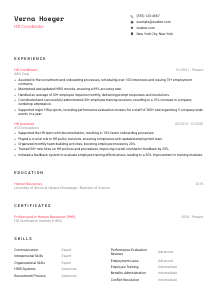
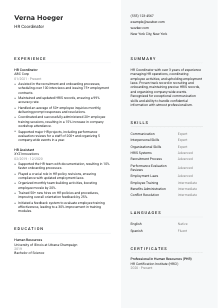
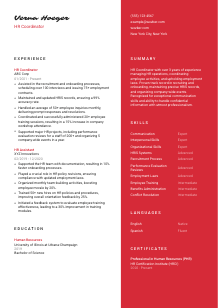
Cultivating company culture, but feeling lost in your resume maze? Navigate this HR Coordinator resume example, created with Wozber free resume builder. Learn how to match your coordination skills to the job details, signaling to employers your potential to perfect the people puzzle!
HR Coordinator hiring usually turns on operational reliability. Teams need someone who can keep recruiting and onboarding moving, maintain accurate employee records, answer policy questions with discretion, and support training or performance cycles without details slipping through the cracks. Your resume should make that steadiness visible through concrete HR work, not broad people-skills language.
A tailored resume changes how quickly that HR value is recognized. When your wording reflects the posting's terminology around HRIS, onboarding, employment law, and employee support, Wozber's free resume builder helps shape an ATS-compliant resume that reads clearly in both applicant tracking systems and human review. The result is a faster, cleaner picture of whether you can handle day-to-day HR coordination with accuracy and professionalism.
For an HR Coordinator, the top of the resume should feel orderly and professional from the first line. This section is simple, but it still carries hiring cues: whether you present yourself clearly, meet basic application requirements, and make follow-up easy for a recruiting team already working through a busy hiring process.
Use your full name as the most visible text on the page. Keep the formatting clean and professional so it matches the level of organization expected in HR work, where accuracy in records, contracts, and employee communication matters every day.
Place "HR Coordinator" directly under your name if that is the role you are pursuing. Matching the posted title helps frame your experience immediately, especially when your background includes related titles such as HR Assistant or HR Operations Coordinator.
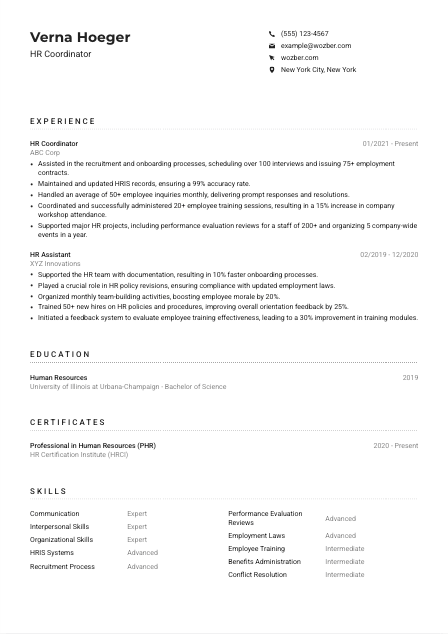
List a current phone number and a professional email address, then confirm both are error-free. If the posting includes a location requirement, include it plainly. In the example, "New York City, New York" works well because the employer specifically asks candidates to be based there.
Include LinkedIn or a relevant professional website if it reinforces your HR background with consistent titles, dates, certifications, or project work. For this type of role, a polished profile can support your resume by showing continuity across HR operations, recruiting support, training coordination, or compliance-related work.
Keep this section limited to information needed for contact and eligibility. Personal data such as age, marital status, or a full street address does not strengthen an HR application and can distract from the qualifications that matter, such as experience, education, and location alignment when required.
An HR resume should look controlled before the reader reaches the first bullet. Clear contact details, the right title, and only relevant information help present you as someone who can handle employee data and communication with care.




This section carries the most weight for an HR Coordinator because it shows how you support the day-to-day mechanics of people operations. Hiring teams look for proof that you can keep hiring workflows moving, maintain accurate records, respond to employees professionally, and contribute to recurring HR programs without losing pace or confidentiality.
Read the job description and identify the recurring HR functions behind it. For this role, that includes recruitment support, onboarding, HRIS maintenance, employee inquiries, training coordination, and broader HR projects such as performance review cycles or company events. Those workstreams should shape the bullets you choose and the language you use.
List jobs in reverse chronological order with title, employer, and dates in a consistent format. That structure matters in HR hiring because teams often want to see how recently you handled employee-facing coordination, documentation, or HR systems work, and whether your experience has progressed from support into fuller ownership.
Prioritize bullets that line up with the role's actual workload. If the job centers on recruiting and onboarding, bring those bullets higher. The sample does this well by leading with scheduling more than 100 interviews and issuing 75+ employment contracts, which immediately shows hands-on coordination rather than general administrative support.
Numbers work best when they reflect the pace, accuracy, or scale of HR activity. Useful measures include interview volume, contract count, record accuracy, employee inquiry volume, training participation, review-cycle population, or onboarding speed. A bullet like "maintained HRIS records with 99% accuracy" tells a hiring team far more than "responsible for employee data."
An effective HR Coordinator resume covers more than one corner of HR. Alongside recruiting, include work tied to policy communication, benefits questions, compliance support, training sessions, engagement activities, or performance reviews when those were part of your role. In the example, supporting evaluations for 200+ staff and organizing company-wide events broadens the picture in a way that fits many coordinator positions.
By the end of this section, the hiring team should be able to picture you keeping interviews scheduled, records current, employees informed, and recurring HR processes on track. That is the kind of practical confidence this role depends on.
Education is usually a checkpoint section for HR Coordinator hiring, but it still matters. Employers often ask for a bachelor's degree in Human Resources, Business Administration, or a related field, so this part of the resume should confirm that requirement fast and without extra clutter.
List your degree exactly and include the field of study. When the posting asks for a bachelor's degree tied to HR or business, make that connection obvious. A Bachelor of Science in Human Resources, as shown in the example, answers the requirement directly.
Use a straightforward format: degree, field, school, and graduation year or date. Clean structure helps reviewers confirm qualifications quickly, especially when they are comparing several candidates with similar levels of HR operations experience.
If your degree is closely tied to HR, name that specialization clearly. If it is in a broader field such as business administration, do not over-explain. Let the degree stand on its own unless coursework or projects directly strengthen your case for recruiting, labor law, training, or HR systems work.
Recent graduates or early-career applicants can include relevant coursework, academic honors, or student leadership tied to human resources, employee relations, or organizational behavior. If you already have solid HR experience, those extras usually matter less than your work history.
If you have completed post-degree HR training, compliance coursework, or workshops in areas like employment law, HRIS, or onboarding, those can reinforce your professional development. Full certifications usually belong in the certification section, but brief continuing education can still support your HR focus here when it adds context.
This section works best when it answers the degree requirement in seconds and supports the rest of your HR profile. Save the detail for the experience section unless your academic background is a major part of your value.
Certifications are not mandatory for every HR Coordinator opening, but they can add useful weight. In a field shaped by policy, documentation, compliance, and employee support, the right certification tells employers you have invested in the standards behind the work, not just the day-to-day tasks.
Choose certifications that reinforce your understanding of human resources work, employment regulations, or employee lifecycle processes. A credential such as the PHR is a strong example because it relates directly to core HR knowledge and supports roles involving policy guidance, compliance awareness, and operational coordination.
Only include certifications that strengthen your candidacy for HR work. One respected HR credential is more useful than a longer list of unrelated courses. Relevance matters more than volume, especially when recruiters are scanning quickly for alignment with HR operations responsibilities.
Include the date earned and, if applicable, the active period or renewal status. That helps employers understand whether the credential is current, which is particularly useful in HR where laws, policy standards, and best practices change over time.
If you are actively maintaining a certification or working toward one, present that in a clear, accurate way. Ongoing learning in topics like employment law, compliance, benefits, or HR technology can support your candidacy by showing that your knowledge is current and applied.
A well-chosen HR certification adds credibility when your resume already shows hands-on coordination work. It tells employers that your experience is backed by formal knowledge of the field's rules and practices.
The skills section should read like a concise map of how you operate in an HR environment. For an HR Coordinator, that usually means a blend of process skills, systems familiarity, policy knowledge, and employee-facing communication. Generic soft-skill lists are less useful than skills tied to actual HR tasks.
Pull skills directly from the posting when they match your background. In this case, that includes HRIS systems, recruitment and onboarding, employment laws and regulations, training coordination, and professional communication. Matching that language helps both ATS screening and recruiter review.
Place the most role-relevant skills first. For HR Coordinator roles, that often means HR operations, HRIS accuracy, employee inquiries, interview scheduling, documentation, onboarding, and policy communication ahead of broader traits like teamwork or adaptability.
Group related strengths naturally and avoid padding the section with every possible competency. The sample skill list works because it balances systems knowledge, recruiting support, performance review involvement, benefits awareness, and communication without becoming a keyword dump.
When this section is done well, a recruiter can immediately see the tools, processes, and people-facing capabilities you would bring into the role. Keep it tight, relevant, and grounded in actual HR responsibilities.
Language ability matters in HR because the job often involves interviews, onboarding materials, policy questions, and day-to-day employee communication. If a posting requires professional English, your resume should confirm that clearly. Any additional language can be valuable when it supports a diverse workforce or multilingual employee population.
If the role specifies professional English communication, list English prominently with an honest proficiency level. That answers a stated requirement and reassures the employer that you can handle employee correspondence, policy explanations, and interview scheduling professionally.
Order languages by practical workplace value. For many HR Coordinator roles in the U.S., English belongs first unless another language is equally central to the role. Clear ordering helps the reviewer understand your day-to-day communication strength at a glance.
If you speak another language, include it when you can use it in a professional setting. In some HR environments, bilingual ability helps with onboarding, training sessions, benefits questions, or employee support across a broader workforce.
Choose simple descriptions such as Native, Fluent, Advanced, or Conversational, and be accurate. HR work depends on precise communication, so overstating language ability can create problems quickly once you are in employee-facing conversations.
Extra languages are most relevant when they improve employee communication or help you work across varied teams. In the example, Spanish is a useful addition because it suggests broader communication reach, though it remains a bonus rather than a universal requirement for every HR Coordinator job.
This section is most effective when it confirms you can communicate clearly in the language the role requires and, where relevant, support a wider employee population with additional language skills.
Your summary should quickly establish what kind of HR support you provide and at what level. In a few lines, it should connect your experience to the employer's immediate needs, whether that is recruiting coordination, HRIS accuracy, employee support, training logistics, or policy-minded administrative work.
Before writing, identify the two or three responsibilities that define the opening. For this job, those are recruitment and onboarding support, HRIS record accuracy, employee inquiries, training coordination, and knowledge of employment law. Use those priorities to decide what belongs in your opening lines.
Open with your title or closest equivalent and your years of experience. A line such as "HR Coordinator with over 3 years of experience in HR operations and employee support" gives the reader immediate context and positions you within the right career stage.
Follow with two or three specifics that map directly to the role. Good summary material for an HR Coordinator includes onboarding volume, HRIS accuracy, policy communication, training administration, or support for performance review cycles. The example summary works because it mentions recruiting, HRIS precision, events, and professionalism with confidential information.
Aim for three to five lines that read cleanly and avoid broad claims. This section should sound like someone who can step into HR coordination work immediately, not like a generic statement about being passionate, hardworking, or people-oriented.
A hiring team should finish these opening lines with a clear sense of your HR scope, your level of experience, and the kind of coordination work you already handle well. That clarity sets up every section that follows.
An effective HR Coordinator resume shows more than interest in people operations. It shows that you can manage hiring logistics, keep employee records accurate, communicate policy clearly, and support recurring HR programs with discretion and follow-through.
Use Wozber's free resume builder to shape that experience into an ATS-friendly resume template, then refine the wording with ATS optimization in mind so the right HR terms, systems knowledge, and operational results are easy to spot. The final document should make one thing clear: you can be trusted with the daily coordination work that keeps HR running.




