



Use Wozber and land your dream job
Create Resume
No registration required
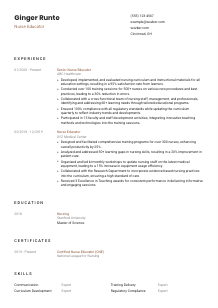
Empowering students, but your resume feels under the weather? Browse this Nurse Educator resume example, created with Wozber free resume builder. Learn how to highlight your teaching and healthcare expertise to make your career as robust as your students' immune systems!
Nurse Educators are trusted to turn clinical practice into clear instruction that improves how nurses work at the bedside. Hiring teams look for more than teaching ability alone. They want to see whether you can build relevant curriculum, lead training on changing protocols, and keep educational content aligned with patient care standards and regulatory expectations.
When that experience is tailored well, the resume quickly separates hands-on educators from candidates whose background is mostly clinical or mostly academic. Wozber's free resume builder helps you shape an ATS-compliant resume around the language employers use for curriculum development, staff training, and compliance, so your background reads clearly as nursing education leadership from the start.
In nursing education, small details carry weight because the work itself depends on accuracy, professionalism, and clear communication. Your Personal Details section should confirm that you are easy to contact, professionally presented, and available for the setting described in the posting.
Place your full name prominently at the top of the resume in a clean, readable format. For Nurse Educator roles, this section should feel polished and clinical rather than decorative. A straightforward presentation supports the impression that you can produce organized training materials, documentation, and instructional content.
Use the exact target title beneath your name when it fits your background. Listing "Nurse Educator" immediately helps position your resume in the right lane, especially when employers are sorting between bedside RNs, clinical trainers, staff development specialists, and academic educators.
Use a reliable phone number and a professional email address, ideally based on your name. In a role that depends on workshop coordination, follow-up with nursing staff, and communication with leadership, careless contact details create the wrong impression before your experience is even read.
If the employer requires local availability, include your city and state. Here, Cincinnati, OH is specifically requested, so showing it directly in this section removes an immediate screening question. If you are relocating, make that status clear instead of leaving the employer to guess.
Include a LinkedIn profile or professional website only if it supports your candidacy with aligned information. For a Nurse Educator, this might reinforce teaching experience, presentations, committee work, publications, or professional development activity. Make sure dates, titles, and credentials match the resume exactly.
This section should quietly confirm professionalism and availability. For Nurse Educator hiring, that means accurate contact details, a clear role title, and any location information the employer needs to see right away.




Experience carries the most weight when it shows how your education work changed nursing practice, onboarding quality, or compliance outcomes. Employers want to see that you have taught real clinicians, built usable learning content, and partnered with nursing leadership to close skill gaps that affect patient care.
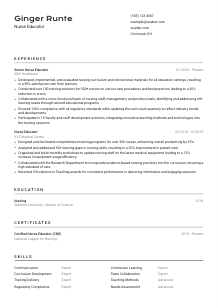
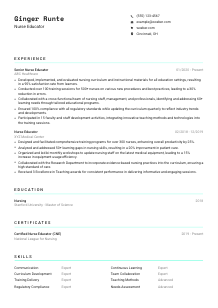
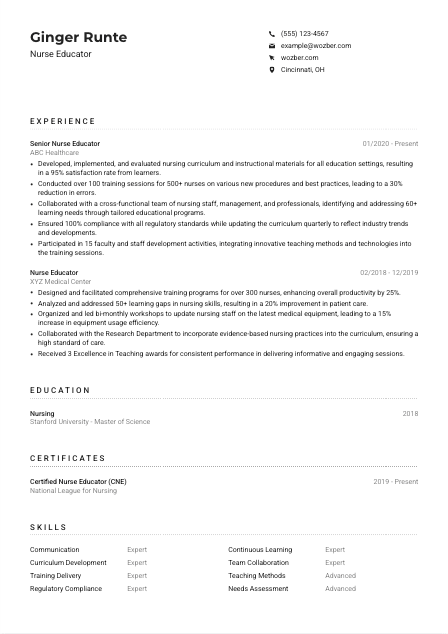
Start by identifying the work that appears repeatedly in the job description, then mirror that language where it truthfully matches your background. For Nurse Educator roles, that usually includes curriculum development, training delivery, learning needs assessment, collaboration with nursing staff, and regulatory compliance. In the example, bullets align closely with responsibilities such as developing instructional materials, running training sessions, and updating curriculum to reflect current standards.
List positions in reverse chronological order and make the titles, employers, and dates easy to scan. Prioritize jobs where you taught nurses, supported competency development, introduced new procedures, or worked on education programs tied to clinical operations. A progression from Nurse Educator to Senior Nurse Educator, as shown in the example, immediately suggests growing scope and trust.
Your bullets should show scale, audience, and outcomes. Useful measures include number of nurses trained, learner satisfaction, reduction in errors, improvement in patient care indicators, workshop frequency, curriculum update cadence, or compliance rates. The sample does this well with details like 100+ training sessions for 500+ nurses and a 30% reduction in errors, which gives hiring teams a concrete sense of educational impact.
Choose accomplishments that reflect what Nurse Educators are actually hired to do. Training staff on new protocols, incorporating evidence-based practice, assessing learning gaps, and partnering with managers on educational planning all matter more than generic nursing duties. If you have broad RN experience, keep the bullets that best support teaching, mentoring, precepting, or staff development.
Strong experience bullets explain what changed because of your work. Instead of saying you "developed curriculum," show what the curriculum supported, who used it, and what improved afterward. In this field, context might include onboarding new nurses, rolling out revised procedures, improving competency scores, or keeping staff training compliant during policy changes.
Your experience section should make it easy to picture you educating nurses in a real healthcare environment. When your bullets connect instruction to safer practice, stronger competency, or better compliance, your value is much easier to understand.
For Nurse Educator roles, education is more than a formality because it often establishes both clinical preparation and teaching credibility. This section should show that your academic background supports the level of instruction, curriculum work, and professional development responsibilities the role requires.
Include your Bachelor of Science in Nursing clearly, since that is a baseline requirement in many Nurse Educator postings. If you also hold a master's in Nursing, Nursing Education, or a related field, place it prominently because it strengthens your candidacy for curriculum design and formal education responsibilities. The example shows both a BSN and an MSN, which aligns well with the stated preference.
List degree, field of study, school, and graduation year in a clean structure. Hiring teams reviewing clinical education resumes do not need extra formatting tricks here. They need to confirm your nursing education background quickly and move on to experience, licensure, and credentials.
If you have graduate work tied to education, leadership, or staff development, ensure it is visible at a glance. A master's with education relevance can support your fit for responsibilities such as designing learning programs, evaluating instruction, and contributing to faculty or staff development initiatives.
Most experienced Nurse Educators can keep this section concise, but targeted additions can help when they reinforce your teaching profile. Coursework in curriculum design, adult learning, simulation, assessment, or evidence-based practice may be worth adding if your work history is still growing.
Honors, awards, or academic recognition can strengthen this section if they reflect teaching excellence, leadership, or high achievement in nursing studies. Keep them only if they add useful context. Once you have substantial educator experience, the academic details should stay secondary to clinical education results.
This section should confirm that your nursing education background supports the level of instruction the employer needs. Clear degree information, especially a BSN and any relevant master's study, helps establish that foundation quickly.
Certifications matter in Nurse Educator hiring because they show continued investment in education standards, professional development, and specialized practice. They can also help distinguish one experienced RN from another when both have similar clinical backgrounds.
Place the most relevant credentials first, especially when the employer has called them out. For this role, Certified Nurse Educator (CNE) and Certification in Nursing Professional Development (CNPD) are preferred, so candidates who hold them should make them easy to find. The example does exactly that, which strengthens alignment immediately.
Do not crowd this section with every certification you have ever earned. Nurse Educator resumes benefit most from credentials tied to teaching, staff development, clinical instruction, or the specialty area you train in. A short, well-targeted list is easier to read than a long catalog of marginally related certificates.
Include dates or status markers that show whether the credential is current. In healthcare education, current credentials matter because employers are often looking for professionals who stay connected to evolving practice standards, teaching methods, and certification requirements.
If you are working toward a relevant educator credential, you may note that when appropriate. Even when a certification is preferred rather than required, it can reinforce your long-term direction in nursing education and staff development. Renewal activity also signals that you maintain professional standards rather than treating credentials as one-time achievements.
For Nurse Educator roles, certifications should reinforce your teaching credibility and professional commitment. Keep the list current, targeted, and easy to scan so the employer can see your strongest credentials without searching for them.
A Nurse Educator skills section should reflect how you teach, what you build, and how you support clinical practice. Generic skill lists do not help much here. Employers are looking for a mix of instructional capability, clinical communication, and program-level coordination.
Read the posting for explicit and implied skill needs, then match them with your real strengths. In this case, curriculum development, training delivery, presentation skills, collaboration, and regulatory awareness all belong in the section because they connect directly to the responsibilities listed.
Aim for a skill mix that shows both educational and clinical value. Nurse Educators often need to assess learning needs, teach varied audiences, update materials, support policy rollouts, and work with nurse managers or interdisciplinary teams. The example balances this well with items such as Curriculum Development, Needs Assessment, Training Delivery, and Regulatory Compliance.
Group or order your skills so the most relevant ones appear first. Practical, role-linked terms are stronger than broad descriptors. "Curriculum Development" and "Teaching Methods" say much more than "hardworking" or "people person," and they map better to ATS optimization as well as to human review.
Your skills section should echo the work you would actually perform as a Nurse Educator. When the language reflects teaching programs, compliance, communication, and learning assessment, the match becomes much clearer.
Language ability matters in nursing education because instruction, policy updates, and competency training depend on clear communication. This section is usually brief, but it can still support your candidacy when the employer has named a language requirement or when multilingual communication is relevant to the care environment.
If the posting specifies language expectations, reflect them directly. Here, advanced English proficiency is necessary, so your resume should state your English level clearly. For Nurse Educators, that supports lecture delivery, written instruction, policy communication, and collaboration across teams.
Additional languages can be valuable when training diverse nursing staff or supporting patient-centered care environments. They are usually a secondary factor, but they can strengthen your profile when they reflect the population or workforce you serve. The sample's inclusion of Spanish adds useful context without overstating its importance.
Choose clear labels such as Native, Fluent, Advanced, Intermediate, or Basic. This is especially important in education-focused roles, where spoken clarity, presentation confidence, and written communication may all be expected at a high level.
If your hospital, clinic, or academic environment serves multilingual communities, relevant language skills deserve mention even when the job posting does not require them. They can support clearer teaching, stronger rapport, and more inclusive staff education.
Do not overstate language ability. If you are asked to teach, coach, or prepare material in a language you listed, your proficiency will quickly become apparent. Accuracy matters here just as much as it does in clinical documentation.
For a Nurse Educator, language skills should support the picture of someone who can teach clearly and work well across diverse teams. Keep the ratings honest and relevant to the environment you serve.
Your summary should quickly establish that you are an educator with clinical grounding, not simply a nurse with teaching interest. In a few lines, it should connect your experience, instructional strengths, and measurable results in a way that prepares the reader for the rest of the resume.
Pull out the two or three themes that define your background most clearly, such as nursing education, clinical experience, curriculum design, or staff development. The summary should reflect the overlap between nursing practice and instruction, since that is what makes this profession distinct.
Begin with who you are professionally, how long you have worked in the field, and the kind of education work you handle. A line such as the sample's opening, which identifies more than 5 years of experience in high-quality nursing education, works because it establishes role identity immediately.
Include concrete outcomes tied to training effectiveness or clinical improvement. Useful examples include improved patient care indicators, reduced errors, high learner satisfaction, stronger competency outcomes, or successful implementation of updated protocols. Keep the claims specific enough to feel credible.
Aim for three to five lines that align directly with the target role. This is not the place to restate every credential or responsibility. It is the place to frame yourself as someone who can educate nurses effectively, build relevant learning programs, and support safe, current practice.
A well-written summary should make your direction unmistakable within seconds. For Nurse Educator roles, that means a concise opening statement that connects clinical credibility, teaching work, and measurable educational impact.
A Nurse Educator resume works best when it shows how your teaching changed practice, improved competency, or supported compliance in a real care setting. Keep the focus on curriculum, training delivery, collaboration with nursing teams, and the outcomes that followed.
Use Wozber's free resume builder to organize that experience into an ATS-friendly resume format, align your wording with the job description, and strengthen ATS optimization without losing clinical specificity. The finished resume should make one thing easy to judge: you can teach nurses in a way that improves care.




