



Use Wozber and land your dream job
Create Resume
No registration required
Dispensing medications, but your resume feels like an expired prescription? Refill your job-seeking confidence with this Staff Pharmacist resume example, created with Wozber free resume builder. Learn how to seamlessly blend your pharmaceutical expertise with job specifications, ensuring your career is always in its therapeutic range!
Staff Pharmacist hiring usually turns on one practical question fast: can this person handle medication safety, clinical review, and patient communication without creating risk? A resume for this role needs to make that visible through dispensing volume, order review, therapy monitoring, regulatory discipline, and the kind of collaboration you have had with physicians, nurses, and patients.
When those details are tailored to the posting, your background reads less like a generic pharmacy history and more like a match for the workflow in front of you. Wozber's free resume builder helps you line up the right terminology in an ATS-friendly resume format, so requirements such as pharmacist licensure, pharmacy systems proficiency, and patient-facing experience are easy to identify. That gives the hiring team a quicker read on whether you can step into safe, compliant practice from day one.
Pharmacy is a credential-driven profession, so the top of the resume needs to be clean, accurate, and immediately usable. This section should confirm who you are, how to reach you, and whether you meet straightforward filters such as title alignment and location, without distracting from the clinical and operational experience that follows.
Use your full name as the clearest heading on the page. Keep it larger than the rest of the text and avoid extra design elements. In pharmacy hiring, the resume is often reviewed alongside licensure and work history, so simple identification matters more than style.
Place "Staff Pharmacist" under your name if that is the role you are pursuing. Matching the posted title helps frame your background correctly, especially if your recent title was Pharmacist, Senior Pharmacist, or Clinical Pharmacist. It tells the reviewer which lane your experience belongs in before they read the first bullet.
Add a reliable phone number and a professional email address that uses your name. If you include a website or LinkedIn profile, make sure it reflects the same positions, dates, and credentials shown on the resume. In a regulated healthcare field, inconsistency around basic details can create unnecessary hesitation.
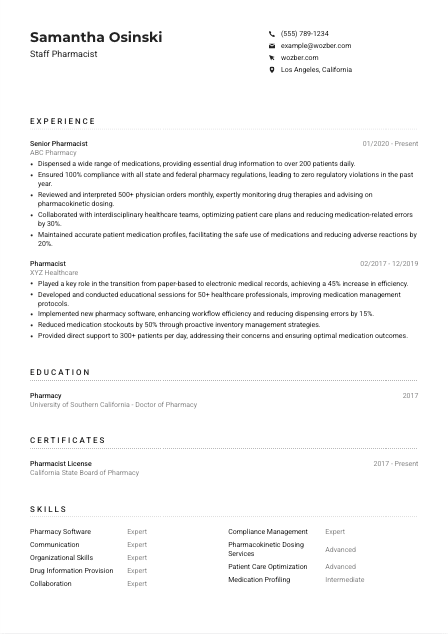
If the posting asks for a candidate in a specific area, list your city and state clearly. Here, "Los Angeles, California" works because the employer specifically requested local availability. Treat that as tailoring to this opening, not as a rule for every Staff Pharmacist resume.
If you link to an online profile, use it to reinforce your pharmacy background. That means current titles, PharmD education, licensure, health-system or retail experience, and major achievements should all line up. A profile that expands on EMR work, medication safety projects, or patient counseling can strengthen the first impression.
This section does not need personality flourishes. It needs accuracy, professionalism, and direct alignment with the posting so the employer can move quickly to your licensure, experience, and patient care record.




For a Staff Pharmacist, experience is where hiring teams look for proof of judgment in real practice. They want to see how you handled dispensing, physician orders, medication profiles, therapy monitoring, patient counseling, regulatory compliance, and the pace of the setting, whether that was retail, hospital, or a mixed environment.
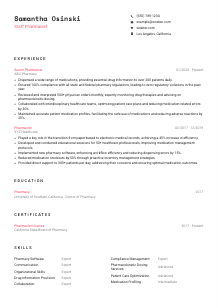
Start by marking the responsibilities that define the job. In this case, those include dispensing medications, providing drug information, reviewing physician orders, monitoring therapies, supporting pharmacokinetic dosing, maintaining medication profiles, and collaborating on patient care plans. Your bullets should echo those duties using your actual scope, rather than generic statements about being responsible for pharmacy operations.
Show your most recent pharmacy work first, with job title, employer, and dates. That structure lets the reviewer quickly confirm whether you meet the required 2+ years in a retail or hospital pharmacy setting. If your background spans both environments, make that visible through the employer type or through the bullet points under each role.
Do not stop at task descriptions like "dispensed medications" or "reviewed orders." Add scope, complexity, and outcome. The sample resume does this well with bullets such as serving over 200 patients daily, reviewing 500+ physician orders monthly, and reducing medication-related errors by 30%. That kind of phrasing shows both workload and practice quality.
Quantify results with numbers that belong in pharmacy work. Useful measures include patient volume, order volume, dispensing accuracy, audit outcomes, turnaround efficiency, medication error reduction, adverse reaction reduction, stockout reduction, or improvements tied to software implementation. Metrics like zero regulatory violations or a 15% drop in dispensing errors tell a hiring manager far more than broad claims about excellence.
Prioritize experience that reinforces medication safety, regulatory compliance, clinical judgment, and team-based care. If an older bullet does not support your candidacy for Staff Pharmacist, rewrite it or leave it out. Every line should help answer whether you can manage prescriptions, protect patient safety, and work effectively with healthcare professionals in a busy pharmacy setting.
The experience section should leave no doubt about your operating level. When your bullets show patient volume, therapy review, compliance results, and collaboration with care teams, the employer can picture you working safely and productively in their pharmacy.
Pharmacy resumes are unusual in one important way: the degree is not background information, it is a gatekeeping credential. Your education section should make the PharmD easy to find and easy to verify, while also supporting the kind of practice environment you are targeting.
If the posting calls for a Doctor of Pharmacy degree from an accredited institution, list that degree exactly and prominently. Do not abbreviate your education in a way that could obscure the credential. For this role, PharmD is not a nice addition. It is a core qualification.
Use a straightforward format with university name, degree, field of study, and year of graduation. The example does this simply with the University of Southern California, Doctor of Pharmacy, and graduation year. That is enough for most Staff Pharmacist applications unless the employer asks for more detail.
Use the formal degree name that mirrors the posting. If your program included strong emphasis in areas that connect directly to the job, such as pharmacokinetics, clinical therapeutics, or drug information, you can surface that through coursework or related training when it adds value. Keep it relevant to the practice setting you are targeting.
Internships, APPE rotations, residencies, or focused academic projects can be worth including if they relate to hospital workflow, patient counseling, medication safety, or interdisciplinary care. Newer pharmacists may need these details more than experienced candidates. As your work history grows, education should stay concise and let experience carry more of the argument.
Academic honors, scholarships, or distinctions can help if they show sustained performance, especially early in your career. Add them when they support your professional credibility, not just to fill space. In pharmacy hiring, the degree and license matter first, with honors acting as supporting detail.
This section should confirm that you meet the academic standard for licensure and practice. Clear PharmD details remove friction and keep attention on how you have applied that training in live pharmacy settings.
In pharmacy, certificates are less about collecting extras and more about proving you are authorized and current. The first item here should answer the immediate compliance question: are you licensed to practice where the employer needs coverage?
Review the posting for mandatory credentials before adding anything optional. Here, the essential item is a current and valid pharmacist license in the state of practice. That belongs at the top of this section because it directly affects employability.
Include licenses and certifications that support your ability to work in the pharmacy environment named in the job. For this role, the California pharmacist license is the clear priority. If you also hold immunization, sterile compounding, MTM, or other pharmacy-relevant credentials, include them when they match the position's scope.
Add dates in a way that makes active status obvious. The sample resume handles this well with "2017 - Present" for the pharmacist license. That small detail matters because employers need to know you can practice legally without chasing clarification.
Pharmacy standards evolve, and so do employer expectations. If you renew a license, add a new credential, or complete role-specific training, update the resume promptly. Current credentials signal professional discipline, which matters in a role centered on medication safety and regulatory compliance.
For a Staff Pharmacist, licensure is one of the fastest screens in the process. Make it visible, current, and directly tied to the state where you want to work.
The skills section should read like a practical summary of how you operate in a pharmacy, not a generic soft-skills list. Focus on the abilities that support accurate dispensing, safe therapy management, patient communication, and smooth use of pharmacy systems in a regulated environment.
Start with the capabilities named or implied in the posting. Here that includes pharmacy software, drug information, communication, organization, collaboration, medication profile management, compliance, and pharmacokinetic dosing support. Those are stronger than broad terms that could belong to almost any healthcare role.
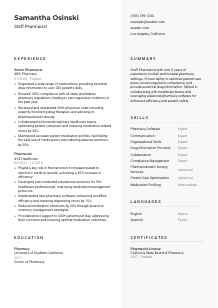
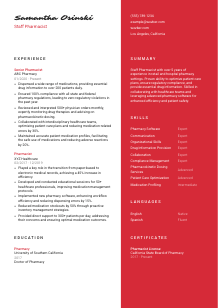
Order the list around what matters most in practice. Technical and clinical skills such as pharmacy software proficiency, compliance management, drug information provision, and patient care optimization should sit near the top. The sample resume also adds collaboration and pharmacokinetic dosing services, which connect closely to the stated responsibilities.
Use a clean format and avoid padding the section with every trait you can name. If you use ratings such as Expert or Advanced, apply them consistently and only where they feel believable against your experience bullets. A short list of relevant skills is more convincing than a long list that mixes core pharmacy work with vague personality terms.
This section should quickly confirm your technical range and your day-to-day operating strengths. When it mirrors the language of the job and matches the experience section, it strengthens both ATS alignment and human review.
Language ability matters in pharmacy because medication safety depends on clear explanations, accurate questions, and reliable handoffs. If the role requires English proficiency, show that immediately, then add other languages that improve patient access or collaboration in your market.
When a posting says you must operate effectively in English, list English at the top with an honest proficiency level such as Native or Fluent. That directly addresses a stated requirement and avoids any doubt about your ability to counsel patients, review orders, or communicate with prescribers and staff.
If you speak another language well enough to use it in pharmacy practice, include it. Spanish can be especially valuable in many patient-facing settings, and the sample resume uses it well as a complementary strength. Treat additional languages as useful practice assets, not decorative extras.
Use clear labels and do not overstate your level. In pharmacy, language claims carry practical consequences because they affect counseling quality, medication instructions, and patient understanding. If you can hold a conversation but not explain dosing or side effects accurately, choose a lower level.
Some employers will weigh extra languages more heavily than others. A community pharmacy serving multilingual neighborhoods may value them strongly, while another setting may simply treat them as a plus. Keep them on the resume when they can improve patient communication or care coordination, especially in diverse markets.
Languages matter because they improve counseling, trust, and adherence. They can also help with team communication in busy healthcare environments. When listed honestly, they show that you can support safer medication use across a broader patient population.
This section works best when it stays practical. Lead with required English proficiency, then add other languages that genuinely help you counsel patients and support care delivery.
The summary should quickly establish your setting, level, and strongest areas of practice. For a Staff Pharmacist, that usually means years of experience, pharmacy environment, patient care scope, regulatory reliability, and one or two capabilities that match the employer's workflow.
Start with a direct line that identifies you as a Staff Pharmacist or Pharmacist and states your years of experience. Mention the setting if it matters, such as retail, hospital, or both. The sample summary does this effectively by opening with more than 5 years across retail and hospital pharmacy settings.
Use the next sentence to surface your strongest match points. For this posting, those would include regulatory compliance, drug information, patient care optimization, order review, collaboration with healthcare teams, and pharmacy software proficiency. Pick the few that best reflect your real background rather than trying to cover everything.
Aim for 3 to 5 lines with specific language. Avoid broad adjectives like "dedicated" or "results-driven" unless they are backed by a real practice detail. A concise summary that mentions compliance, patient safety, and workflow tools is easier to trust than one built from generic claims.
Close on a practical contribution, not a motivational statement. You might emphasize safer medication use, stronger interdisciplinary care, efficient pharmacy workflow, or reliable patient counseling. That final line should sound like a pharmacist describing how they work, not like a generic career objective.
A well-written summary helps the employer understand your practice profile before they reach the first job entry. If it captures your environment, experience level, and patient care strengths clearly, the rest of the resume lands with more force.
Your resume should now make the essentials unmistakable: PharmD education, active pharmacist licensure, relevant pharmacy experience, software proficiency, patient-facing communication, and a track record of safe, compliant medication practice. If those points are easy to find, the hiring team can focus on your judgment and impact instead of searching for basic qualifications.
Before applying, run one more tailoring pass against the posting. Wozber can help tighten wording, improve ATS optimization, and present your experience in an ATS-compliant resume that reflects the pharmacy setting you are targeting. The final version should make it easy to see that you can step into Staff Pharmacist responsibilities with accuracy, efficiency, and sound clinical judgment.




