



Use Wozber and land your dream job
Create Resume
No registration required
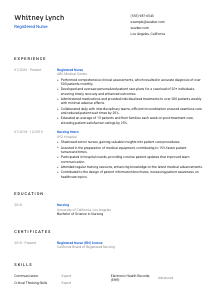
Saving lives, but your resume feels a bit unresponsive? Check out this Registered Nurse resume example, created with Wozber free resume builder. Learn how to match your medical achievements to job demands, ensuring your career prognosis is as healthy as those in your care!
Nursing resumes are read through the lens of patient care, clinical judgment, and safe documentation. Hiring teams want to see whether you can assess patients accurately, carry out treatment plans, communicate with physicians and families, and keep records that hold up in a regulated care environment. If your resume stays too generic, it can hide the very parts of your work that matter most on a unit floor.
A tailored resume quickly surfaces the clinical scope behind your title, which is especially important when ATS filters are looking for terms like BSN, RN license, patient care plans, medication administration, and EHR use. Wozber's free resume builder helps you line up that language in an ATS-friendly resume format so the document reflects actual bedside work, coordination, and documentation standards from the start.
In nursing, the header does more than identify you. It confirms basic hiring facts quickly, including licensure alignment, professional identity, and, when relevant, local availability for a hospital or clinic schedule. Keep this section clean, accurate, and easy to scan.
Place your name prominently at the top in a clear, professional format. Recruiters often review many RN resumes in one sitting, so readability matters. A simple layout with your full name standing out helps them connect the rest of the clinical experience and credentials to you immediately.
List "Registered Nurse" directly under your name if that is the role you are pursuing. Matching the target title helps position you correctly from the first line, especially when the posting is for bedside RN work rather than adjacent roles such as care coordinator, LVN, or nurse educator.
Use one current phone number and a professional email address you check regularly. Hospitals and healthcare groups often move quickly when scheduling interviews, panel meetings, or pre-employment screenings, so your contact details should support fast communication without confusion.
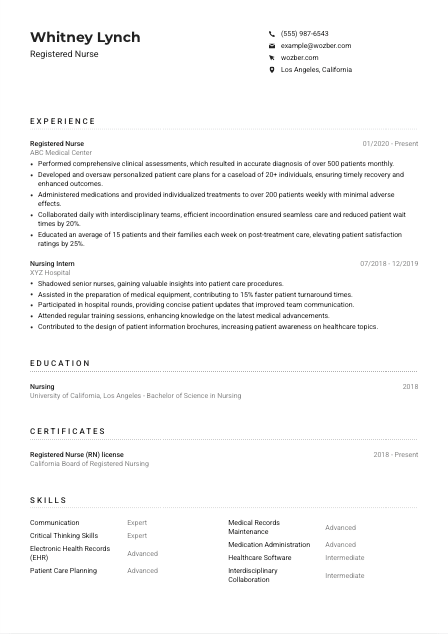
If the employer specifies a location requirement, include your city and state. In the provided example, listing "Los Angeles, California" directly answers the stated requirement without taking up extra space. Only include location when it helps remove a practical hiring question.
Include LinkedIn or a professional webpage only if it supports your nursing background with consistent information, such as clinical experience, certifications, or specialty focus. If the profile is outdated or thin, leave it off. In healthcare hiring, accuracy matters more than extra links.
Your header should settle the basics fast: who you are, what nursing role you hold, and whether you meet immediate logistical requirements. That leaves more attention for your clinical record and patient care work.




The experience section carries most of the weight on an RN resume. Hiring managers look for patient volume, care setting, treatment responsibilities, interdisciplinary coordination, and documentation habits that show you can step into a clinical workflow safely and effectively.
Start by marking the duties and qualifications repeated in the posting. For a Registered Nurse, that usually includes assessments, care plans, medication administration, interdisciplinary collaboration, patient education, and charting. Those themes should appear in your bullets using language that reflects how you actually practiced them.
Use reverse chronological order and make each entry easy to scan with title, employer, and dates. For clinical hiring, recency matters because workflows, documentation systems, and patient care protocols change. Put your most recent RN role first so your current level of responsibility is immediately clear.
Don't stop at listing tasks. Show what your nursing work affected. The sample does this well by tying clinical assessments to accurate diagnosis volume and patient education to higher satisfaction ratings. Similar bullets might show reduced wait times, smoother discharge teaching, lower documentation errors, or efficient care coordination across a caseload.
Quantify where it makes sense with patient counts, caseload size, weekly medication volume, satisfaction scores, turnaround time, or team workflow improvements. Numbers such as "500 patients monthly," "20+ individuals," or "200 patients weekly" give hiring teams a feel for pace, acuity, and scope without overstating your work.
Choose accomplishments that reinforce bedside judgment, treatment execution, communication, and record accuracy. Even earlier roles, such as an internship, should be framed around patient rounds, equipment prep, training, or educational materials if those experiences support your RN trajectory. Leave out unrelated points that do not strengthen your clinical profile.
This section should make your nursing scope visible fast: what settings you worked in, what care you delivered, how you documented it, and what outcomes followed. When those details are specific, your experience reads like current clinical practice rather than a generic job history.
Education is a formal requirement in nursing, so this section needs to be precise. Recruiters are usually confirming degree level, nursing discipline, and institution quickly before moving on to experience and licensure.
If the posting asks for a BSN, list your Bachelor of Science in Nursing clearly and exactly. In the example, "Bachelor of Science in Nursing" from UCLA directly matches the degree requirement and removes any doubt about academic eligibility.
Include degree, field, school, and graduation year in a clean structure. Nursing resumes do not need a complicated education layout. A straightforward entry is easier for both recruiters and ATS parsing, especially when degree requirements are strict.
Write your credential as it appears on your transcript or diploma. If you earned a BSN, say BSN or Bachelor of Science in Nursing, not a shortened or improvised variation. Exact wording helps with ATS optimization and avoids confusion in credential review.
Newer nurses can include honors, clinical rotations, senior practicum details, or coursework tied to the target setting, such as med-surg, pediatrics, or acute care. Once you have solid RN experience, these details become optional unless they support a specialty move.
Student leadership, research, simulation lab work, community health projects, and nursing association involvement can add value when they connect to patient care, teamwork, or clinical initiative. Use them selectively, especially if you are earlier in your career and building out relevant experience.
Your education entry should confirm that you meet the nursing degree requirement without making the reader hunt for it. Clear degree wording keeps the focus where it belongs next, on your license and clinical performance.
For nurses, certifications are not a decorative extra. Licensure is a hiring gate, and specialty credentials can strengthen your case for a given patient population or unit. Present them in a way that makes status and relevance obvious.
Place your Registered Nurse license first and include the issuing board and active dates if applicable. The example lists the California Board of Registered Nursing clearly, which matters because the posting requires a valid RN license in the state of practice.
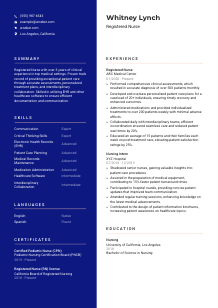
List credentials that align with the kind of nursing work you want to do. A certification such as CPN is useful when your background or target role involves pediatric care. If you hold BLS, ACLS, PALS, or specialty credentials, prioritize those that match the unit or patient population.
Healthcare employers need to know whether a credential is active. Include issue dates, renewal periods, or "Present" where appropriate so there is no uncertainty during screening. This is particularly important for licenses and time-sensitive certifications.
Recent certifications can also reflect the direction of your practice. They show that you are keeping current with patient safety standards, specialty protocols, or evolving care needs. Use this section to reinforce competence, not to list every course you have ever taken.
Your licenses and certifications should eliminate uncertainty about legal eligibility and add context about your clinical strengths. If this section is clear, the employer can move on without having to verify the basics first.
The most useful nursing skills section mirrors real unit work. It should balance clinical capabilities, documentation tools, and the communication skills needed to coordinate care across patients, families, and interdisciplinary teams.
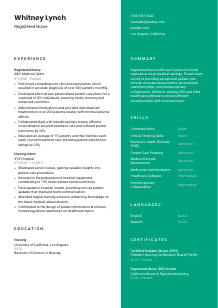
Start with the skills the employer explicitly requests, then add closely related nursing capabilities you genuinely use. In this example, EHR proficiency, communication, critical thinking, patient care planning, medication administration, and medical record maintenance all map directly to the role.
Place the most role-defining skills first. For an RN, that usually means assessment, care planning, medication administration, charting accuracy, interdisciplinary collaboration, and patient education before softer or more general workplace traits. This order tells the reader how you function in practice.
Avoid filling the section with broad terms that are already obvious from your experience. A focused list is stronger, especially when it includes nursing-specific tools and workflows such as EHR systems, treatment coordination, and clinical documentation. The sample skill list works because it stays close to direct care responsibilities instead of drifting into generic filler.
Your skills should echo the care delivery, documentation, and communication demands of the job. When the list is specific, it strengthens both ATS alignment and the employer's read on your day-to-day nursing capability.
Language ability can matter in nursing because it affects patient teaching, rapport, and care coordination. This section becomes especially useful when the role requires strong English communication or when additional languages are relevant to the patient community you serve.
If the posting requires spoken and written English, list English clearly with an honest proficiency level. That is a direct qualification, not a minor detail, because nursing work depends on accurate charting, handoff communication, and patient education.
Order languages by hiring value, not personal preference. English should appear first when it is required. If a second language commonly supports care in your region or specialty, place it next so the employer sees its practical value immediately.
Extra languages can strengthen your resume when they help with education, discharge instructions, or rapport with families. In the example, fluent Spanish is a useful addition in a diverse patient population. It is an advantage, not a substitute for the required nursing qualifications.
Use clear labels such as native, fluent, intermediate, or basic. Do not overstate your level. In healthcare settings, inaccurate language claims can create real communication problems during patient care, consent discussions, or follow-up teaching.
Choose which languages to include based on the patient population and setting you are targeting. Acute care, community health, pediatrics, and outpatient roles may each benefit from different language strengths, so tailor this section to the context rather than listing every conversational skill.
When listed accurately, languages can show added value in patient communication and family education. Keep the focus on care delivery and clarity, especially for roles where communication quality affects outcomes.
A nursing summary should read like a quick clinical snapshot, not a generic introduction. In a few lines, it should establish your license level, experience range, care environment, and the responsibilities you handle with confidence.
Before writing the summary, identify the parts of the position that matter most. For an RN posting like this one, that includes clinical assessments, care plans, medication administration, EHR use, interdisciplinary teamwork, and patient education. Build your opening around those priorities.
Lead with your title and years of relevant experience. The sample summary opens with "Registered Nurse with over 3 years of clinical experience," which works because it tells the employer immediately what level of nurse is applying and how much direct-care time stands behind the application.
Use the next sentence or two to highlight the nursing work most relevant to the role. That may include accurate assessments, individualized treatment planning, collaboration with interdisciplinary teams, EHR documentation, or patient education. Pull from accomplishments already proven in your experience section rather than introducing vague claims.
Aim for 3 to 5 lines with concrete nursing language. Skip broad adjectives and focus on care setting, scope, and outcomes. A concise summary gives the reader an immediate sense of whether your background fits the patient care demands of the role.
Your summary should make the employer understand, within seconds, what kind of nurse you are, where you have practiced, and which core responsibilities you already handle well. That sets up the rest of the resume to confirm the details.
A tailored Registered Nurse resume should make three things easy to see: your license and degree, your current clinical scope, and your ability to document, coordinate, and deliver patient care in a real healthcare setting.
Use Wozber's free resume builder to tighten that alignment, apply ATS optimization with role-specific nursing language, and present your background in an ATS-compliant resume that reflects how you actually practice.
When those pieces are in place, your resume gives hiring teams a clear read on whether you can step into the unit and contribute from day one.




