



Use Wozber and land your dream job
Create Resume
No registration required
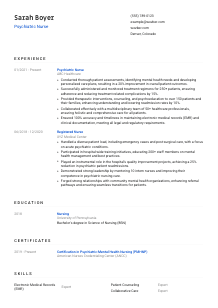
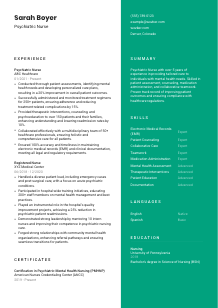
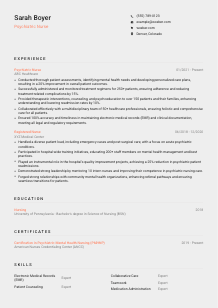
Navigating complexities, but your resume feels complicated? Check out this Psychiatric Nurse resume example, created with Wozber free resume builder. Learn how to weave your mental health care expertise with job demands, ensuring your career stays as sound as your patients!
Psychiatric nursing work is reviewed through the lens of clinical judgment, therapeutic presence, and safe follow-through. Hiring teams want to see how you assess mental status, support treatment plans, administer and monitor medications, document accurately, and work alongside psychiatrists, therapists, and case managers without losing sight of the patient in front of you. Your resume should make that practice visible, not bury it under generic nursing language.
A tailored resume changes how quickly your psychiatric experience becomes clear, especially when an ATS first scans for terms tied to mental health assessments, care planning, EMR documentation, medication administration, and interdisciplinary care. Wozber's free resume builder helps organize that language into an ATS-compliant resume that mirrors the posting naturally, so a reviewer can quickly understand your psychiatric scope and how you support patient stability, safety, and continuity of care.
For psychiatric nursing roles, the top of the resume should remove friction immediately. Contact details, title, and location are simple fields, but they still influence whether a reviewer can place you quickly against licensing, availability, and role match.
Place your full name at the top in a clean, readable format. In healthcare hiring, this section should feel straightforward and professional, the same way a well-charted note does. Keep the styling simple so the role title, credentials, and contact details are easy to scan.
Add "Psychiatric Nurse" directly below your name if that is the role you are pursuing. Matching the target title helps both recruiters and ATS systems connect your background to psychiatric care rather than broader RN work. If your recent experience includes behavioral health, this title frames the rest of the resume correctly from the start.
Include a reliable phone number and a professional email address. Healthcare employers move quickly when they need to fill patient-care roles, so make every detail easy to read and easy to trust. Avoid outdated email handles and double-check that voicemail and inbox settings are interview-ready.
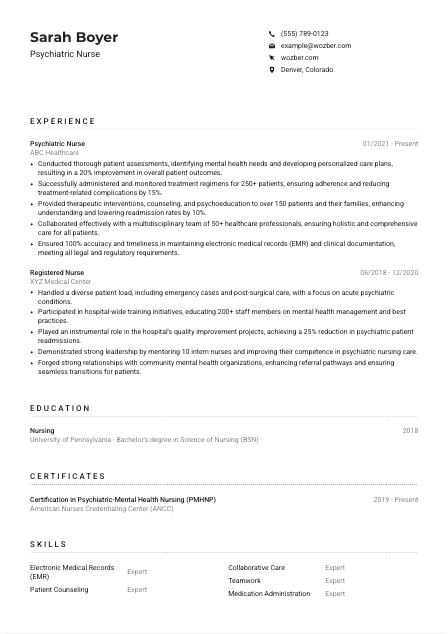
If a posting specifies local availability or relocation, reflect that in your location line. Here, listing Denver, Colorado directly supports the stated requirement and removes a common screening question. Only do this when it is true, of course. Location should solve a hiring concern, not create ambiguity.
Include LinkedIn or a professional site only if it strengthens your application. For psychiatric nursing, that usually means a profile with consistent job dates, credentials, certifications, and nursing scope. Keep it aligned with your resume so employers do not have to reconcile conflicting role titles or timelines.
This section does not need personality copy or extra filler. It should confirm who you are, what nursing role you perform, and whether you meet practical requirements like location and accessibility for interview scheduling.




Experience is where psychiatric nursing becomes concrete. Employers are looking for more than unit names and job titles. They want to understand the patient populations you handled, the interventions you provided, how you managed documentation and medication workflows, and what changed because of your care.
Start by marking the responsibilities that define the opening, then reflect those same priorities in your bullets using language you can honestly support. For psychiatric nursing, that often includes assessments, individualized care plans, therapeutic interventions, medication administration, family education, EMR charting, and interdisciplinary coordination. In the example, the strongest bullets map directly to those expectations instead of relying on broad bedside nursing statements.
List positions in reverse chronological order with title, employer, and dates. That structure matters because hiring teams often need to confirm you have the required time in a psychiatric setting. If you are moving from a general RN role into a more specialized behavioral health position, use the bullets to show psychiatric patient exposure, crisis work, discharge coordination, or mental health training that closes that gap.
Each bullet should combine what you did with why it mattered. Strong psychiatric nursing bullets often begin with actions such as assessed, administered, monitored, educated, de-escalated, collaborated, documented, or developed. The sample bullet about conducting assessments and building personalized care plans works because it links nursing judgment to improved patient outcomes, which is far more persuasive than listing "responsible for patient care."
Numbers make your experience easier to judge when they match real healthcare performance. Useful metrics include patient volume, reduced readmissions, medication adherence, documentation accuracy, treatment-related complication rates, staff trained, or family education reach. In the example, managing treatment regimens for 250+ patients and lowering complications by 15% gives hiring teams a clearer sense of clinical scale and reliability.
Your experience section should foreground psychiatric nursing even if part of your background comes from broader med-surg or emergency work. Keep older or less relevant bullets only when they support transferable strengths such as crisis response, documentation discipline, patient education, or cross-functional coordination. Every line should move the reader toward a clear conclusion: you can deliver safe, documented, therapeutic mental health care.
When this section is tailored well, a reviewer can quickly see your patient population, your clinical responsibilities, and your effect on treatment quality or continuity of care. That is the level of detail that moves psychiatric nursing experience from familiar to credible.
Education is a screening checkpoint in nursing, so clarity matters. For psychiatric nurse openings, the degree section should confirm that you meet the baseline academic requirement without making the reader search for it.
If the posting asks for a BSN, list that credential exactly and prominently. This role specifically requires a Bachelor's degree in Nursing from an accredited institution, so your education section should make that easy to confirm in seconds.
Include the degree name, field of study, school, and graduation year. Keep the format clean and consistent with the rest of the resume. In regulated professions like nursing, straightforward presentation helps recruiters and credentialing teams move quickly through minimum qualifications.
Use language employers will recognize immediately, such as "Bachelor of Science in Nursing (BSN)" when that is accurate for your degree. In the example, the BSN is clearly tied to nursing, which keeps the qualification aligned with the job description and easy for ATS systems to parse.
Relevant coursework can help early-career candidates or nurses transitioning into behavioral health. Subjects like mental health nursing, psychopharmacology, crisis intervention, or behavioral health assessment can support your story when your work history is still developing. If you already have several years of psychiatric experience, keep coursework secondary.
Honors, scholarships, leadership roles, or nursing association involvement belong here only if they add something useful. Strong examples include psychiatric nursing clinical distinctions, research related to mental health care, or leadership in student nursing organizations. If they do not support your psychiatric profile, leave them out.
This section should answer one question fast: do you have the nursing education required for practice in this role. Once that is clear, the rest of the resume can focus on your psychiatric experience, patient care approach, and clinical results.
Certifications carry weight in psychiatric nursing because they show specialty development beyond the RN license. When a posting calls out a mental health credential as preferred, this section becomes a meaningful differentiator.
Review the job description and pull in any certifications the employer mentions. Here, Psychiatric-Mental Health Nursing certification is preferred, so it deserves a prominent place if you hold it. That direct alignment helps your resume surface in ATS review and gives the employer one more reason to keep you in the interview pool.
List certifications that strengthen your psychiatric nursing profile first. A psychiatric-mental health credential is more useful here than unrelated continuing education because it connects directly to assessment, treatment support, and mental health patient care. The example does this well by placing the psychiatric certification front and center.
Add the issue date, renewal range, or active period when relevant. In licensed healthcare work, dates help employers understand whether a credential is current and maintained. That is especially helpful for certifications that require ongoing continuing education or periodic renewal.
Psychiatric nursing changes with new treatment standards, documentation requirements, and patient-care models. Updating certifications shows continued engagement with the specialty. If you complete training in crisis prevention, trauma-informed care, suicide risk assessment, or behavioral health de-escalation, include it when it strengthens your target role.
This section works best when it confirms current, relevant credentials that add weight to your psychiatric nursing background. It should help an employer see that your practice is not only licensed, but actively developed within mental health care.
The skills section should read like the operating language of your practice. For psychiatric nursing, that means balancing clinical, documentation, and therapeutic skills instead of relying on vague traits that could belong on any healthcare resume.
Read the posting for explicit and implied requirements. In this case, EMR use, clinical documentation, assessments, medication monitoring, psychoeducation, counseling, and interdisciplinary collaboration all belong in the skills conversation. You can also add closely related capabilities you genuinely use, such as crisis intervention, treatment planning, or patient de-escalation, when they match your background.
Choose skills that already appear in your work history or summary. If you claim expertise in medication administration or patient counseling, your bullets should show that in action through treatment management, psychoeducation, or family support. The sample resume handles this well by pairing skills like EMR, patient counseling, and collaborative care with quantified accomplishments in those areas.
Put the most role-critical skills first. For a psychiatric nurse, technical and clinical items such as mental health assessment, medication administration, EMR documentation, therapeutic interventions, and patient education usually deserve higher placement than broad terms like teamwork. This makes the section more useful in both ATS optimization and human review.
A hiring manager should be able to scan this list and recognize the daily realities of psychiatric nursing. If the skills reflect real workflows, patient interactions, and documentation demands, they will support the rest of the resume instead of repeating it.
Language skills matter in psychiatric settings because trust, safety, and patient understanding depend on clear communication. Even when English is the only stated requirement, additional language ability can support psychoeducation, family discussions, and more effective rapport with diverse patient populations.
If the role requires English for clinical duties, list English first with an accurate proficiency level. In this posting, that requirement is explicit, so make it easy to confirm. For most candidates, "Native" or "Fluent" is sufficient without additional explanation unless a certification is specifically requested.
After English, include any additional languages you can actually use in a care environment. In psychiatric nursing, even basic or conversational ability can help with comfort, orientation, or simple family communication, though you should never overstate clinical fluency. The example includes Spanish at a basic level, which is useful because it is honest and still potentially relevant.
Use clear labels such as Native, Fluent, Intermediate, or Basic. Ambiguous claims create risk in patient-facing roles where misunderstanding can affect care, consent, or therapeutic communication. Accuracy here matters more than trying to sound impressive.
Some psychiatric environments serve multilingual communities or require closer family coordination. In those cases, another language can strengthen your application, especially for outpatient, community, crisis, or intake-heavy roles. Keep the emphasis proportional to your actual ability and to the employer's patient population.
List languages when they improve your ability to educate patients, reduce communication barriers, or support culturally responsive care. That makes the section relevant to psychiatric nursing practice rather than a generic add-on. When language ability contributes to rapport and understanding, it belongs on the resume.
This section should help an employer understand how you communicate in real care settings. Clear, truthful proficiency levels can strengthen your psychiatric nursing profile, especially when communication quality directly affects patient trust and treatment understanding.
The summary sets the clinical tone of the resume. For psychiatric nursing, it should quickly establish your setting, years of experience, core strengths, and the kind of patient care outcomes you help produce.
Before writing, identify the parts of the role that matter most in the posting. For psychiatric nurse positions, that usually means mental health assessment, care planning, medication administration, therapeutic support, documentation, and interdisciplinary coordination. Your summary should reflect the mix that best matches your own experience.
Open with your years of psychiatric or behavioral health experience and the environments you have worked in, such as inpatient units, community mental health, crisis settings, or hospital-based psychiatric care. The example begins with more than 5 years of experience in tailored mental health care, which immediately establishes specialty relevance.
Follow with two or three strengths tied to the posting and supported elsewhere in the resume. Good summary language might reference patient assessment, counseling, medication management, EMR documentation, or reducing readmissions through education and treatment adherence. Keep it specific enough to sound practiced, not generic.
Aim for a short paragraph of about three to five lines. Avoid soft claims about passion or dedication unless they are backed by details. A concise summary that names psychiatric experience, relevant clinical strengths, and a measurable care outcome will do far more work than a long introduction.
A well-written summary helps the reader understand your psychiatric nursing background before they reach the first job entry. It should frame you as someone who can assess, document, collaborate, and support mental health treatment with consistency from day one.
A psychiatric nurse resume works best when it shows how you think and how you care. Assessments, treatment support, medication administration, therapeutic communication, family education, EMR accuracy, and interdisciplinary coordination should all appear where they are strongest, backed by outcomes and written in language the employer already uses.
Use Wozber to shape that content into an ATS-friendly resume format, refine phrasing with its AI resume builder, and check alignment with an ATS resume scanner before you apply. When the resume is tailored well, hiring teams can quickly recognize the clinical judgment, documentation discipline, and patient-centered mental health care you bring to the role.




