



Use Wozber and land your dream job
Create Resume
No registration required
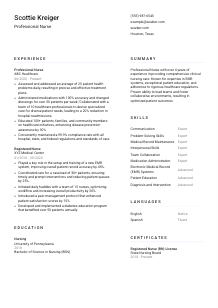
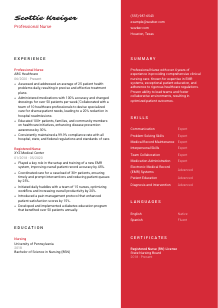
Administering care, but your resume feels weak? Check out this Professional Nurse resume example, created with Wozber free resume builder. Learn how to showcase your medical mastery to match job specifics, nursing your career back to full health!
Professional nursing resumes are read through the lens of patient care. Hiring teams want to see whether you can assess changing conditions, carry out care plans accurately, document in real time, and work smoothly with physicians, therapists, and other nurses in a fast clinical setting. If those realities are buried under generic claims about being compassionate or hardworking, the resume misses what matters most in practice.
A tailored resume changes the first impression from "general healthcare applicant" to "nurse who can step into this unit's workflow." Using Wozber's free resume builder and an ATS-friendly resume format helps you mirror the language of the posting, surface requirements like RN licensure and EMR proficiency, and make your clinical experience easier to read in an ATS and by a nurse manager reviewing patient-care readiness.
In nursing, basic details do more than identify you. They confirm licensure context, local availability, and professional credibility before a hiring team even reaches your clinical experience. Keep this section clean, complete, and aligned with the opening.
Use your full name in a clear, readable format so it stands out immediately. In a healthcare resume, polished presentation matters because the rest of the document should feel as organized as your charting and handoff communication.
Place "Professional Nurse" below your name when that matches the role you are pursuing. This helps frame your background right away, especially if your previous titles include variations such as "Registered Nurse" or unit-specific nursing roles.
List a reliable phone number and a professional email address. Double-check both. In active hospital or clinic hiring cycles, interview requests often move quickly, and a missed call or mistyped email can slow down the process.
If the employer asks for candidates in a specific city or state, include that clearly in your personal details. Here, "Houston, Texas" directly answers a stated requirement and removes doubt about local availability or licensure logistics.
A LinkedIn profile or professional website can help if it reinforces your nursing background, certifications, unit experience, or leadership work. Keep it consistent with your resume and avoid linking to anything that looks unfinished or unrelated to clinical practice.
This section should confirm that you are reachable, professionally presented, and positioned to meet practical hiring requirements. For a Professional Nurse opening, that includes making location and role identity immediately obvious.




The experience section carries the most weight on a nursing resume because it shows how you practice. Employers are looking for patient load, clinical tasks, care coordination, documentation habits, education work, and the outcomes you influenced on the floor, in the clinic, or across the care team.
Before you rewrite bullets, mark the responsibilities the employer emphasizes most. For this opening, that includes patient assessment, care planning, medication administration, routine diagnostic work, record maintenance, patient education, and collaboration with multidisciplinary teams. Your experience bullets should respond to those priorities directly instead of describing nursing work in broad terms.
List your most recent nursing position first so the reader sees your current clinical scope right away. That order also helps an ATS resume scanner connect recent bedside or patient-care experience with the opening, especially when your latest role includes the same duties the employer is hiring for.
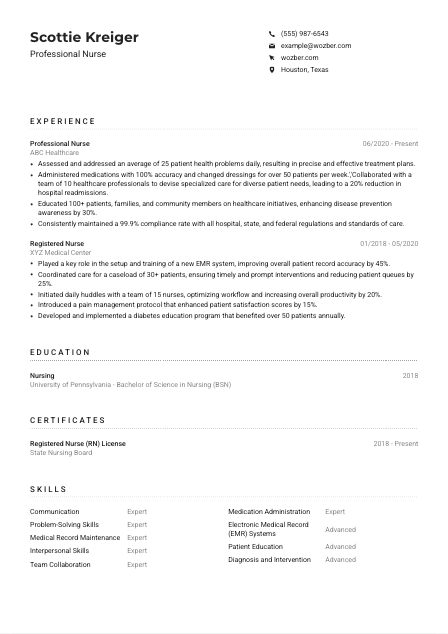
Each bullet should show what you handled, how often or at what scale, and what changed because of your work. The example resume does this well with lines like assessing about 25 patient health problems daily and administering medications with 100% accuracy. That kind of wording gives a clearer picture of nursing judgment and execution than a generic line about providing excellent care.
Quantify patient volume, medication accuracy, readmission reduction, education reach, satisfaction gains, compliance rates, or workflow improvements when those metrics are available. In the sample, reduced readmissions, patient counts, and compliance rates all strengthen credibility because they reflect how nursing impact is often measured in practice.
Use your space for nursing accomplishments tied to patient outcomes, safety, documentation, communication, or team coordination. A hiring manager for a Professional Nurse role will learn more from a bullet about implementing a diabetes education program or improving EMR accuracy than from unrelated achievements that do not connect to clinical care.
The best experience sections make it easy to picture you in a real care environment. When your bullets show patient volume, clinical responsibilities, teamwork, and measurable outcomes, your nursing background becomes much easier to trust and shortlist.
Education is a straightforward section in nursing, but it still carries hiring weight because the degree requirement is often non-negotiable. Present it in a way that confirms your clinical foundation quickly and leaves no room for interpretation.
If the role requires a Bachelor of Science in Nursing, list your BSN clearly and exactly. This posting asks for a BSN or equivalent, so the degree should be easy to find without the reader having to decode abbreviations or search through extra detail.
Include degree, field, school, and graduation year in a clean structure. Nursing resumes benefit from order and consistency, and an ATS-friendly resume format helps ensure this section is parsed correctly alongside licensure and experience.
Match the wording of the requirement where it reflects your real credentials. For example, spelling out "Bachelor of Science in Nursing (BSN)" can help both ATS matching and human review when the posting uses that exact phrasing.
If you are early in your career, honors, clinical rotations, senior practicum work, or coursework in areas like community health, med-surg, pediatrics, or critical care can add useful context. If you already have several years of nursing experience, keep the focus tighter and let your clinical record lead.
Projects, research, or nursing leadership activities from school can help if they connect to patient care, disease prevention, or interdisciplinary work. Include them selectively, especially when they reinforce responsibilities similar to the target role.
For nursing roles, education should answer the degree requirement in seconds. A clean BSN entry helps the employer move on to the parts of your resume that show how you apply that training in practice.
Few resume sections are as important in nursing as licensure. This is where you confirm that you are legally qualified to practice and, when relevant, show added clinical training that supports the population or setting you want to work in.
When the posting requires a valid Registered Nurse license, list it clearly with the issuing body and active dates. In this case, the RN license is a core qualification, so it should never be buried or treated as optional supporting information.
Beyond licensure, include certifications that strengthen your nursing profile for the unit or specialty. ACLS, BLS, PALS, TNCC, or specialty nursing credentials can be valuable depending on the patient population and care environment, but choose only those that genuinely apply.
Show issue dates and renewal or active status where appropriate. In regulated clinical work, current credentials matter, and clear dating makes it easier for a hiring team to confirm you meet compliance expectations.
Nursing standards, documentation systems, and care protocols evolve. Recent certifications or continuing education in medication safety, infection control, chronic disease management, or specialty care can show that your practice stays current, especially if they align with the role's patient population.
Your certificates section should answer one practical question immediately: are you licensed and current for this level of care? Once that is clear, additional nursing credentials can strengthen your profile and point to specialty depth.
A nursing skills section should reinforce the work shown in your experience, not repeat generic traits. Focus on the clinical, documentation, communication, and teamwork capabilities that affect patient care and day-to-day performance.
Start with the posting and identify both direct requirements and implied day-to-day demands. Here, that means EMR proficiency, communication, problem-solving, medical record maintenance, patient education, and collaboration across multidisciplinary care teams.
Nursing hiring decisions rarely hinge on technical tasks alone. Include a mix of care-delivery skills such as medication administration, diagnostic support, and charting alongside communication, patient education, and team collaboration, since all of them affect outcomes and safe handoffs.
Only include skills you can support elsewhere in the resume. The sample list works because items like EMR systems, patient education, and medication administration are backed up by experience bullets. That consistency makes the section credible and useful.
The most effective nursing skills sections read like a snapshot of real practice. When your skills line up with your experience and the employer's care environment, the resume feels grounded and relevant.
Language ability can matter a great deal in nursing because understanding, consent, education, and trust all depend on clear communication. This section should reflect the languages you can use reliably in patient and team settings.
If the role requires English fluency, state your level clearly. For this position, English is a stated prerequisite, so it belongs near the top of the section and should be described accurately.
Extra languages can add real value, especially in diverse communities and patient education work. Spanish, for example, may be especially useful in many healthcare settings because it can support discharge teaching, care instructions, and rapport with families.
Use honest labels such as Native, Fluent, Advanced, or Conversational. In nursing, overstating language ability can create safety issues during patient education or care coordination, so accuracy matters.
If your language ability has helped in community education, prevention outreach, or routine patient interaction, it can reinforce the responsibilities of the role. Keep the claim practical and focused on communication in care settings rather than broad cultural statements.
Some markets and facilities benefit especially from bilingual staff. In the example, Houston makes Spanish an especially practical asset, but treat that as a local advantage rather than a universal requirement for every Professional Nurse role.
For a nurse, language skills are most valuable when they improve understanding, education, and patient comfort. Present them honestly, and they can strengthen both your clinical profile and your usefulness in team-based care.
The summary is your quickest chance to frame your nursing background before the reader gets into the details. It should establish your level of experience, your core clinical strengths, and the parts of your practice that match the opening most closely.
Read the job description for the patterns, not just the keywords. Here, the main themes are clinical care, care planning, EMR use, patient education, collaboration, and regulatory compliance. Your summary should reflect that mix in a few direct lines.
Start with a clear statement of who you are and how long you have practiced. The sample summary does this effectively with "Professional Nurse with over 4 years of experience in providing comprehensive clinical nursing care," which immediately sets scope and relevance.
Choose strengths that map to the employer's actual needs, such as EMR proficiency, patient education, medication administration, interdisciplinary coordination, or compliance with standards of care. The best summaries avoid vague praise and instead point to capabilities that matter on shift and in documentation.
Aim for 3 to 5 lines. That is enough space to establish your nursing profile, mention a few relevant strengths, and prepare the reader for the experience section without repeating your whole resume.
A well-written summary helps the employer understand your nursing scope before they review each role. Keep it concise, job-aligned, and rooted in patient care, documentation, teamwork, and the standards expected in professional practice.
A Professional Nurse resume works when it makes your practice easy to understand: how you assess patients, carry out care plans, document accurately, educate families, and support safe outcomes with the wider care team.
Use Wozber's free resume builder to shape that experience into an ATS-compliant resume, refine wording with role-specific terminology, and keep every section clear in an ATS-friendly resume template.
When your degree, RN license, clinical results, EMR skills, and patient-care strengths are easy to spot, the hiring team can focus on the question that matters most: how quickly you can contribute in a real nursing setting.




