



Use Wozber and land your dream job
Create Resume
No registration required
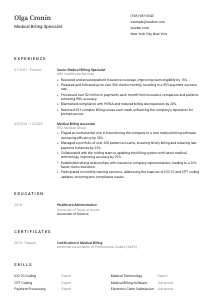
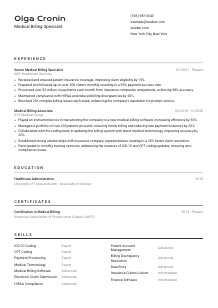
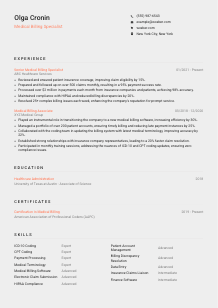
Translating healthcare codes, but your resume still reads like a medical mystery? Decode this Medical Billing Specialist resume example, created with Wozber free resume builder. Learn how to present your billing brilliance in line with job criteria, so your career doesn't get stuck in the "claims denied" folder!
Medical billing work sits where reimbursement, patient communication, and regulatory accuracy meet. A hiring team wants to see that you can move claims through the revenue cycle cleanly, catch eligibility or coding issues early, and handle denials without creating more rework for billing, coding, or front-desk teams.
When your resume is tailored well, the first read quickly shows whether your background matches the employer's billing flow, coding environment, and claim volume. Wozber's free resume builder helps organize that experience into an ATS-compliant resume with language that reflects the posting, so your ICD-10 knowledge, claim follow-up work, and payment processing results are easy to recognize.
This section is brief, but it still affects how quickly your application moves forward. For medical billing roles, clear contact details, the right title, and location alignment can remove easy screening doubts before the hiring team reaches your claims experience or coding knowledge.
Use your full name as the top line of the resume and keep it easy to read. Medical billing is detail-sensitive work, so even the header should look orderly and professional in an ATS-friendly resume format.
Use the exact title "Medical Billing Specialist" if that is the role you are pursuing. That immediately connects your background to claim submission, payment posting, insurance follow-up, and denial resolution rather than leaving the reviewer to guess whether your experience sits closer to coding, front-desk administration, or general healthcare support.
If the employer requires local availability or relocation, show that clearly in your header. In the example, listing "New York City, New York" directly answers the posting's location requirement and removes a basic logistics question from the review process.
Include LinkedIn or another professional profile only if it supports the same story as your resume. For a Medical Billing Specialist, that usually means consistent titles, healthcare employers, certifications, and billing-related tools or accomplishments rather than a generic online presence.
This section should make it easy to contact you and easy to place you in the right hiring lane. If the basics are accurate, professional, and aligned with the posting, the reviewer can move straight to the parts that prove your billing performance.




Hiring managers spend the most time here because medical billing results show up in operational outcomes. Your bullets should connect daily work such as eligibility checks, claim submission, payment posting, denial handling, and HIPAA compliance to measurable improvements in reimbursement speed, accuracy, or account resolution.
Start by marking the responsibilities and terms that define the employer's billing process. For this role, that includes reviewing insurance coverage, preparing and submitting claims, processing payments, resolving discrepancies, answering billing inquiries, and working within HIPAA rules. Use those exact ideas where they reflect your real work so both recruiters and ATS tools can connect your experience to the role.
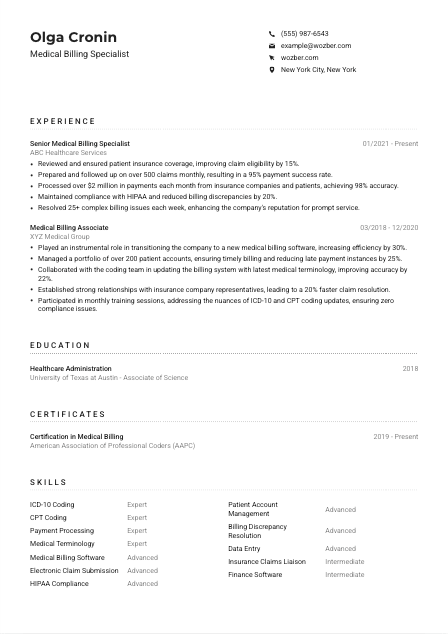
Daily responsibilities matter, but results carry more weight. Instead of only saying you submitted claims or processed payments, show what improved because of your work. The sample resume does this well with details like handling 500+ claims monthly with a 95% payment success rate and processing more than $2 million per month at 98% accuracy.
Medical billing performance is often measured through claim volume, payment accuracy, denial reduction, collection pace, account resolution, and turnaround time. Figures such as reducing billing discrepancies by 20% or speeding claim resolution by 20% tell a hiring manager how you affect cash flow and administrative workload, not just that you stayed busy.
Prioritize experience that shows revenue cycle work, coding familiarity, insurer interaction, patient account handling, or billing software use. If you have broader healthcare administration experience, keep only the parts that support this role. Relevant bullets should make it obvious that you can step into claim follow-up, payment posting, and discrepancy resolution without a long ramp-up.
A Medical Billing Specialist resume stands out when the experience section links your actions to reimbursement results, account accuracy, and compliance. If your bullets show what you processed, what you fixed, and what improved, the hiring team can picture you inside their billing workflow.
Education is usually a qualifying checkpoint for medical billing roles rather than the main selling point, but it still needs to line up with the posting. A degree in healthcare administration, business, or a related field helps confirm that you bring useful grounding in healthcare operations, records, and financial processes.
When the posting asks for an Associate's or Bachelor's degree in Healthcare Administration, Business, or a related area, make that alignment easy to see. The sample resume works because both listed degrees connect directly to the employer's stated preference.
If you have more than one degree, lead with the one that best supports medical billing work. Healthcare administration and business are especially relevant because they tie naturally to insurance processes, patient accounts, revenue cycle coordination, and billing operations.
Most experienced candidates do not need a long course list. Include classes, projects, or honors only if they clearly support billing work, such as healthcare finance, medical terminology, coding, compliance, or health information management.
If you have pursued additional training in ICD-10, CPT, HIPAA, electronic claims, or medical office systems, you can reinforce that here or in certificates. This is especially useful when your degree is broader and you want to show a clear path into billing.
Keep this section concise and aligned with the employer's requirements. Once your degree background is easy to verify, the resume can return focus to the billing experience and coding knowledge that drive hiring decisions.
Certifications carry real weight in medical billing because they suggest current knowledge of coding standards, billing practices, and professional discipline. When a posting prefers certification or asks for one within the first year, this section can quickly strengthen your standing.
If the job description names medical billing certification, place that credential prominently. In the example, the Certification in Medical Billing from AAPC speaks directly to the employer's preference and supports the candidate's experience with claims, coding systems, and compliance.
Choose certifications that relate to reimbursement, coding, compliance, or healthcare administration. A short, relevant list reads better than a crowded section filled with credentials that do not help explain your ability to manage claims and payment workflows.
Certification dates help the employer see whether your credential is active and whether your knowledge is current. In a field shaped by coding updates, payer rules, and compliance standards, timing matters.
If you do not yet hold the preferred certification, you can still address the requirement by noting that you are currently preparing for it or willing to obtain it within the requested time frame. That works best when the rest of your resume already shows hands-on billing experience and familiarity with ICD-10, CPT, and claim workflows.
Relevant credentials add credibility when they line up with the work you have already done. Use this section to confirm that your billing knowledge is formalized, current, and ready for the employer's reimbursement environment.
A medical billing skills section should look like a practical snapshot of how you work, not a generic mix of business terms. The best lists reflect the actual flow of the job, from insurance verification and coding knowledge to claim submission, payment processing, and discrepancy resolution.
Pull skills directly from the posting where they match your experience. Here, that means medical billing software, electronic claim submission, medical terminology, ICD-10, CPT, insurance verification, payment processing, and HIPAA compliance. This improves ATS optimization while keeping the section grounded in real billing work.
Hard skills should lead because this role depends on coding systems, billing platforms, account handling, and claims workflow. Add a few supporting soft skills only when they connect to the work, such as resolving patient billing questions, coordinating with insurers, or catching discrepancies before claims are rejected.
Order the section so the most relevant capabilities appear at the top. In the sample resume, leading with ICD-10 Coding, CPT Coding, Payment Processing, Medical Terminology, and Medical Billing Software quickly tells the reader that the candidate can work across core billing tasks instead of only handling administrative support.
A targeted skills list should mirror the tools, coding knowledge, and workflow responsibilities the employer needs. If the top items match the posting and the experience section proves them, this part becomes a fast confirmation rather than filler.
Language ability matters in medical billing when the role involves patient questions, insurance communication, or support across diverse communities. English may be the required working language, and additional fluency can be helpful when billing issues need clear explanation and fewer misunderstandings.
If the posting states that job duties must be performed in English, show your English proficiency plainly and accurately. Terms such as "Native" or "Fluent" are more useful than vague labels because they set expectations for phone calls, written billing communication, and insurer follow-up.
Additional languages can strengthen your profile when the employer serves a multilingual patient base. In the example, Spanish adds practical value because billing specialists often explain balances, coverage issues, or claim delays to patients who need communication in another language.
Use honest levels for each language. Medical billing conversations can involve payment responsibility, insurance denials, and protected health information, so overstating fluency can create real problems in patient or payer communication.
Language skills are most relevant when they improve account resolution, patient understanding, or coordination with external parties. Mention them if they support the way you work, not simply to fill space on the resume.
If you are actively improving a language used in your workplace or patient population, you can mention that, but keep the focus on usable proficiency. Employers care most about whether you can communicate clearly in situations tied to billing questions and account follow-up today.
For medical billing, language skills matter when they help resolve questions accurately and respectfully. Keep the section factual, and let it support the kind of patient and insurer communication the job actually involves.
The summary is your quickest chance to frame the kind of billing professional you are. It should combine years of experience, core strengths such as claims management or coding knowledge, and one or two outcomes that show how you improve reimbursement accuracy, resolution speed, or billing operations.
Before writing the summary, identify the few requirements that matter most in the posting. For a Medical Billing Specialist, that usually means claim processing, insurance follow-up, coding familiarity, payment handling, and compliance. Build the summary around the parts of that work you do best.
Lead with your title, years of experience, and area of focus. The sample summary does this effectively by identifying the candidate as a Medical Billing Specialist with more than 5 years of experience in claims processing and patient account management.
Use the next lines to show what sets your billing work apart. That might include high payment success rates, strong accuracy in payment posting, faster denial resolution, or reliable handling of coding-heavy claims. Keep the claims specific enough to sound proven, not generic.
Aim for a compact paragraph of three to five lines. The summary should quickly position you for the role and encourage the reader to look for matching proof in your experience section, not repeat every skill or responsibility in the resume.
Your summary should give the hiring team a clear first picture of your claim handling experience, coding fluency, and reimbursement impact. If those points are sharp and well matched to the posting, the rest of the resume has a strong frame to build on.
A well-tailored Medical Billing Specialist resume should make your place in the revenue cycle easy to understand. Show the coding systems you know, the claim volume you manage, the payment accuracy you maintain, and the billing issues you resolve without losing sight of HIPAA and patient communication.
Wozber's free resume builder can help you turn that experience into an ATS-friendly resume template, align your wording with the posting, and check section-level match through an ATS resume scanner. The final result should make one thing clear fast: you can keep claims moving, payments posting, and billing problems under control.




