



Use Wozber and land your dream job
Create Resume
No registration required
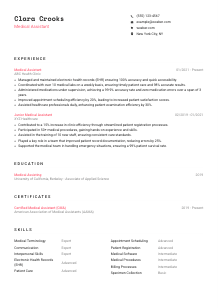
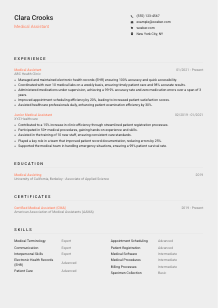
Assisting in health, but your resume feels under the weather? Administer the right dose with this Medical Assistant resume example, created with Wozber free resume builder. Learn how to showcase your clinical and administrative skills to match job requirements, setting your career on a healthy trajectory!
Medical Assistants work at the intersection of patient flow, clinical support, and accurate documentation. Hiring teams look for people who can move smoothly from taking vitals and preparing exam rooms to updating charts, handling scheduling, and coordinating with labs without dropping details that affect care.
A tailored resume changes how quickly that range of work becomes visible. When your wording matches the posting's terms for EHR use, documentation, specimen collection, patient registration, and supervised medication administration, Wozber's free resume builder helps you shape an ATS-compliant resume that makes your day-to-day readiness for a busy practice easier to recognize.
Healthcare employers expect the top of the resume to be clean, accurate, and easy to act on. In a Medical Assistant application, this section should confirm your professional identity and remove simple friction before the reader gets to patient care, charting, or front-desk responsibilities.
Place your full name prominently at the top in a clear, readable font. In a fast review, the header should be as easy to scan as a well-labeled patient chart.
If you are applying for a Medical Assistant position, use "Medical Assistant" directly under your name when that reflects your background. Matching the posted title helps hiring teams and ATS filters connect your profile to the role immediately.
List a current phone number and a professional email address. Accuracy matters here just as much as it does in patient documentation, because one typo can cost you an interview request or follow-up call.
Some employers need candidates who already live in the hiring area or can relocate quickly. For this opening, New York City, NY appears in the requirements, so showing that location in your contact details removes an avoidable question at the start.
A LinkedIn profile can help if it reinforces your resume with consistent dates, certifications, and healthcare experience. Include it only if it is updated and reflects the same level of professionalism as your resume.
This section does not need extra flair. It needs to show that you are reachable, professionally presented, and logistically aligned with the employer's basic hiring requirements.




Medical Assistant experience is reviewed for more than job titles alone. Employers want to see how you supported providers, handled documentation, kept patient flow moving, and contributed to safe, accurate care in a clinic, specialty office, or similar healthcare setting.
Before editing your experience section, mark the responsibilities and requirements that define the job. For this role, that includes patient care support, vital signs, documentation, EHR use, scheduling, billing, specimen collection, and coordination with labs. Those are the threads your bullets should pick up.
List your positions in reverse chronological order so the employer sees your latest healthcare environment first. Include the employer name, your title, and dates clearly. Recent experience with current workflows such as EHR charting, patient intake, and exam preparation usually carries the most weight.
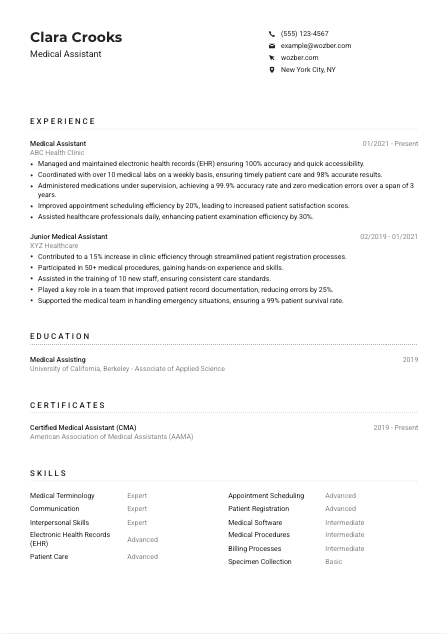
Do not stop at saying you "assisted physicians" or "handled records." Show what that looked like in practice. The sample resume does this well by tying routine Medical Assistant work to outcomes such as 100% EHR accuracy, a 20% scheduling efficiency improvement, and zero medication errors under supervision.
Quantify your work where the number helps the reader understand scale, accuracy, speed, or patient impact. Useful measures for Medical Assistants include documentation accuracy, patient volume, lab coordination frequency, scheduling improvements, billing throughput, reduced record errors, or medication administration accuracy.
Prioritize experience that supports ambulatory care, patient interaction, administrative workflow, and clinical assistance. If you have older or less relevant jobs, trim them back so the reader spends more time on the work that proves you can support providers, patients, and operations in a medical setting.
Your experience section should make it easy to picture you in the clinic. With focused bullets and role-matched language, Wozber's free resume builder and ATS resume scanner can help present your patient care, documentation, and workflow support in terms that hiring teams recognize quickly.
For Medical Assistants, education is often checked early because it confirms formal preparation for clinical and administrative duties. Keep this section straightforward so the employer can quickly see the program, credential level, and training path behind your hands-on experience.
Start with the educational baseline in the posting. Here, completion of a Medical Assistant certification program is specifically requested, while the sample resume also lists an Associate of Applied Science in Medical Assisting. If you have both, include both in a clear way.
List the school, degree or program name, field of study, and graduation year or date. Keep the layout simple so the credential is easy to verify without hunting through extra detail.
When the job description names a type of education or program, use that exact language where it truthfully applies. A Medical Assisting degree, diploma, or completed certification program should not be buried if it is central to the role.
If your professional experience is still growing, relevant coursework, externships, clinical training, or lab practice can help fill in the picture. Focus on training tied to patient intake, vital signs, documentation, infection control, specimen handling, or basic procedures.
Honors, healthcare-related activities, or strong program distinctions can add value, especially for newer candidates. Leave them out if they distract from the core message that you completed the education needed to work effectively in a clinical environment.
This section should confirm that you completed the educational path behind the work on your resume. When the structure is clean and the credential language matches the posting, your preparation is immediately easier to understand.
Certifications carry real weight in Medical Assistant hiring because they show recognized training and current professional standing. When a posting calls out CMA or RMA, the certificates section becomes one of the fastest ways to show that you meet a preferred or highly desired requirement.
Lead with certifications that directly match the job posting. For this opening, Certified Medical Assistant (CMA) and Registered Medical Assistant (RMA) are especially valuable, so they should appear before less relevant credentials.
Choose certifications that connect to outpatient care, clinical support, patient safety, or medical office operations. A shorter, targeted list is more useful than a long list of unrelated coursework or expired training.
Employers want to know whether a credential is current. Include the year earned and, if relevant, indicate that it remains active. The sample resume handles this clearly by showing ongoing status for both CMA and RMA.
If you have added recent certifications in areas such as phlebotomy, EKG, CPR, or updated compliance training, include them when they support the employer's clinical environment. Current learning can reinforce that you stay aligned with changing procedures and standards.
When your certificates line up with the posting, they do immediate work for you. They show that your training is recognized and that your background fits the level of responsibility expected in a Medical Assistant role.
Medical Assistant skills need to reflect a mixed role. Employers usually want to see both clinical capability and front-office reliability, because the job often moves between patient interaction, documentation, scheduling, billing support, and coordination across the care team.
Start by extracting the hard and soft skills named in the job description. Here, that includes medical terminology, procedures, documentation, EHR proficiency, communication, interpersonal skills, patient care, scheduling, billing, and coordination with labs and other providers.
Feature the abilities that matter most in a Medical Assistant workflow. Skills like EHR documentation, vital signs, patient preparation, specimen collection, appointment scheduling, and clear patient communication usually carry more value than broad filler terms.
List the strongest, most relevant skills first and avoid padding the section with everything you have ever touched. The sample resume works because it combines clinical skills such as patient care and medical terminology with operational skills such as patient registration, billing processes, and EHR use.
A hiring manager should be able to scan your skills section and see both sides of the job. When your list reflects clinical support and medical office workflow in the employer's language, your fit for the role becomes much clearer.
In healthcare, language ability affects patient understanding, care coordination, and everyday interactions at the front desk and in the exam room. If a posting asks for strong English communication, your languages section should confirm that requirement clearly and then show any added value beyond it.
If the employer specifies English communication skills, list English clearly with an accurate proficiency level. That checks an explicit requirement and supports your ability to speak with patients, families, providers, and administrative staff.
Order languages by relevance to the role. English should come first here because it is required, while additional languages can follow if they support patient populations you are likely to serve.
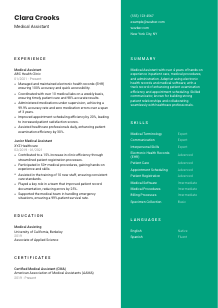
Additional languages can be a real advantage in healthcare settings with diverse patient communities. In the sample resume, Spanish strengthens the profile because bilingual communication can help with intake, instructions, and patient comfort in many clinics.
Use clear levels such as Native, Fluent, Advanced, or Conversational, and keep them truthful. Language claims are tested quickly in healthcare roles where misunderstandings can affect instructions, consent, and patient experience.
If a second language helps you explain procedures, support registration, or build rapport with patients, it is worth including. That is especially useful in large, multilingual cities, though it should remain a value-add rather than a substitute for core clinical skills.
This section should confirm that you can communicate clearly in the required language and, when relevant, support a broader patient population. In patient-facing work, that practical communication range matters.
The summary should quickly establish what kind of Medical Assistant you are, how much relevant experience you bring, and which parts of the role you handle well. A hiring manager should come away with a clear picture of your clinical support, documentation ability, and patient-facing strengths before reading the rest of the resume.
Before writing the summary, identify the few points the employer cares about most. In this case, experience level, certification, EHR proficiency, medical terminology, patient care support, and communication all deserve attention.
Begin with your title and years of relevant experience. The sample resume does this effectively with "Medical Assistant with over 4 years of hands-on experience," which immediately sets the level and context.
Use the next sentence or two to mention the work you actually do well. For a Medical Assistant, that may include patient intake, preparing patients for exams, managing records, supporting procedures, coordinating labs, or improving scheduling and office flow.
Aim for 3 to 5 lines with concrete language, not broad claims. Mention tools or responsibilities that matter, such as EHR systems, medical documentation, medication administration under supervision, or patient communication, so the summary sounds grounded in real healthcare work.
A well-built summary gives the employer a quick read on your level, your strengths, and your relevance to the opening. Once that top section is aligned, the rest of the resume can reinforce the same picture with stronger detail.
A Medical Assistant resume works best when it shows both dependable patient support and steady control of the workflow around it. Your final draft should make it easy to see your experience with exams, documentation, EHR systems, scheduling, labs, and day-to-day coordination in a healthcare setting.
Use Wozber to build an ATS-friendly resume format that reflects the employer's language, highlights missing requirements, and sharpens section-by-section alignment. That gives hiring teams a faster, clearer read on whether you can step into the clinic and contribute from day one.




