



Use Wozber and land your dream job
Create Resume
No registration required
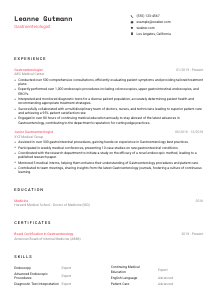
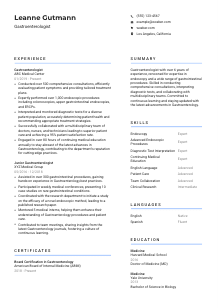
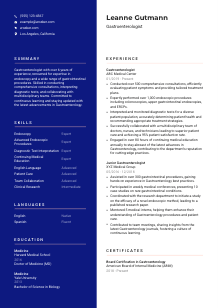
Getting into gastro matters, but your resume feels like digestion trouble? Sample this Gastroenterologist resume example, created with Wozber free resume builder. Learn how to align your medical expertise with job requirements, making your professional profile as smooth as a well-digested meal!
Gastroenterology resumes are read through a clinical lens. Hiring teams want to see whether you can manage consults, interpret GI diagnostics, perform endoscopic procedures safely, and contribute to coordinated patient care without burying those strengths under generic physician language. Your resume should make your procedural scope, post-fellowship experience, and day-to-day clinical judgment easy to recognize within seconds.
Screening often turns on whether your record clearly matches the practice's procedural and credentialing needs, especially for endoscopy-heavy roles. Wozber's free resume builder helps you shape that experience into an ATS-compliant resume by aligning your wording with the job description and keeping the structure clean, so the hiring team can quickly see your readiness for consult volume, procedures, and multidisciplinary care.
For a Gastroenterologist, the header does more than identify you. It should immediately confirm professional identity, provide reliable contact information, and remove obvious questions about availability, especially when a posting names a specific city or state.
Use your full professional name exactly as you would in credentialing, licensing, publications, or hospital records. Keep it prominent and easy to scan. In medicine, consistency matters. If your name appears differently across documents, it can create avoidable friction later in the process.
Place "Gastroenterologist" directly beneath your name so the role is unmistakable. If your background includes advanced procedural focus, keep that detail for the summary or experience section unless the title is formally part of your role. The headline should stay clean and searchable.
List a dependable phone number and a professional email address. Add a website or profile only if it strengthens your candidacy, such as a physician bio, publications page, or academic profile. Every item here should support a smooth handoff to interview scheduling or credential review.
If the employer specifies location, reflect it clearly in your header. Here, Los Angeles, California is part of the requirement, so showing that city and state helps remove doubt about local availability. You do not need a full street address. City and state are usually enough.
Do not add birth date, marital status, photo, or other non-clinical personal details. For a physician resume, the header should stay focused on contact, role identity, and practical availability.
A precise header supports the rest of the resume by confirming who you are, what role you practice, and whether you meet basic logistical requirements. That keeps attention where it belongs, on your clinical background and procedural work.




This section carries the most weight because it shows how you practice. For Gastroenterologists, employers look for patient volume, procedure mix, diagnostic judgment, team-based care, and signs that your work holds up in a real clinical setting.
Read the job description like a patient chart. Mark the requirements that shape the role, such as comprehensive consultations, colonoscopies, upper GI endoscopies, ERCPs, diagnostic interpretation, and multidisciplinary care. Then make sure those same priorities appear naturally in your experience bullets when they reflect your actual work.
List your most recent physician role first, then work backward. For each position, include employer, title, and dates, followed by bullets that show the type of practice you handled. This format helps reviewers quickly trace your post-fellowship progression, scope of responsibility, and current level of autonomy.
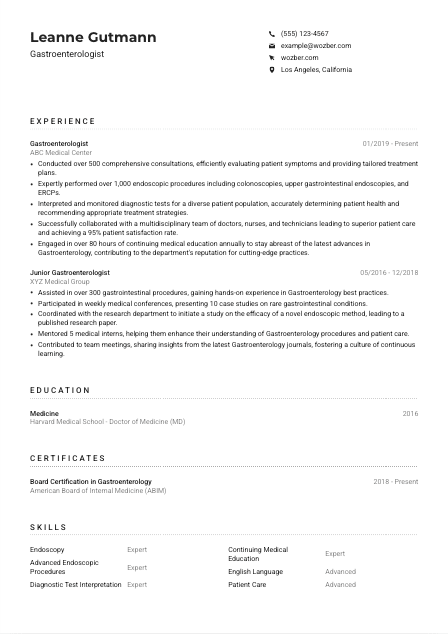
Focus each bullet on work that matters in GI practice: consults completed, procedures performed, diagnostic findings interpreted, treatment plans developed, or care coordination improved. The sample resume does this well with specifics like more than 1,000 endoscopic procedures and over 500 consultations, which immediately communicates both volume and relevance.
Quantify what can be measured in a medical context. Procedure counts, clinic volume, patient satisfaction, CME hours, case presentations, or research output all help when they are accurate and meaningful. A line such as improving patient satisfaction to 95% works because it ties clinical care to a real outcome rather than relying on vague claims.
Keep the section centered on Gastroenterology work. General internal medicine tasks, unrelated early-career duties, or broad leadership claims should stay only if they strengthen the case for your diagnostic skill, procedural competence, or collaboration with surgeons, nurses, anesthesia, pathology, and other care partners.
Your experience section should show what kind of Gastroenterologist you are in practice, not just in title. When consult volume, procedural depth, and care outcomes are clear, the employer can judge your readiness for the role much faster.
In Gastroenterology, education is more than a formality. It confirms the medical training path behind your practice, from medical school through specialty preparation, and helps employers see whether the credential base matches their requirements.
Start with your MD or DO from an accredited medical school because that is a non-negotiable qualification. The job description names this directly, so your degree should be easy to find and written in a standard format with school name and graduation year.
Use reverse chronological order for education as well. Include degree, institution, field if helpful, and completion date. Hiring teams and credentialing staff should be able to scan this section without guessing what came first or what each credential represents.
For a Gastroenterologist, fellowship matters as much as the medical degree because it confirms specialty training. If your current resume only lists medical school and undergraduate education, add your Gastroenterology fellowship in this section or a training section if your resume format allows. That is essential for roles that require accredited fellowship completion.
Academic honors, chief fellow distinctions, research recognition, or GI-focused electives can be useful if they reinforce your development in the specialty. For an experienced physician, keep these details selective so they support, rather than crowd, the more important clinical record.
Continuing education is valuable in Gastroenterology, especially as endoscopic techniques and treatment standards evolve. If CME is substantial, mention it in experience or certificates rather than overloading the education section. The sample resume's 80 annual CME hours is a strong example of how to show current engagement with the field.
Your education section should make the path to GI practice straightforward: medical degree, specialty training, and any distinctions that genuinely matter. When that foundation is clear, the rest of the resume reads with more authority.
Certification carries real weight in physician hiring because it connects directly to scope of practice, payer requirements, and hospital privileging. For Gastroenterologists, this section should confirm specialty standing without unnecessary clutter.
If you are board-certified or board-eligible in Gastroenterology, list that prominently. The posting asks for it explicitly, so this is one of the fastest ways to show that you meet a core screening requirement. The example resume handles this well with ABIM board certification in Gastroenterology.
Choose certifications that affect your medical credibility in the role. Specialty board certification belongs here. Short courses or unrelated certificates usually do not, unless they are directly tied to advanced GI procedures, sedation, or another meaningful part of your current practice.
Add the active date range or certification year so employers can see whether your credential is current. In a regulated clinical environment, recency matters because it speaks to ongoing compliance and professional standing.
Update this section whenever your certification status changes or you complete a credential relevant to your procedural work. In Gastroenterology, that may include advanced endoscopy-related training if it is formally recognized and relevant to the positions you pursue.
A clear certification section answers one of the first questions in physician hiring: are you appropriately credentialed for the specialty? When the answer is obvious, attention shifts quickly to your patient care and procedural experience.
A Gastroenterologist's skills section should read like a snapshot of practical clinical capability. It needs to reinforce procedural competence, diagnostic judgment, and collaboration patterns that already appear in your experience, not repeat generic strengths that could belong to any physician.
Start with the skills the employer actually names or strongly implies. Here, endoscopy, advanced endoscopic procedures, diagnostic test interpretation, English proficiency, and team collaboration are central. Pull those forward when they match your background so both ATS screening and human review see the same core language.
Balance procedural skills with the clinical abilities that support them. Endoscopy, colonoscopy, ERCP, mucosal evaluation, and diagnostic interpretation belong alongside patient care, treatment planning, and multidisciplinary coordination. That mix reflects how GI work is actually delivered.
Do not turn this into a catch-all inventory. Every skill should be something you can back up with procedures performed, cases managed, outcomes achieved, or responsibilities held. The sample resume stays on track by emphasizing endoscopy, advanced procedures, diagnostics, patient care, collaboration, and research rather than listing dozens of broad medical terms.
The best skills section supports the rest of the resume with concise, role-relevant language. If each skill maps back to a real part of your GI practice, the section strengthens both ATS matching and clinical credibility.
Language ability matters in medicine because it shapes consent discussions, symptom gathering, patient education, and coordination with families. For Gastroenterologists, this section is especially useful when the practice serves a diverse patient population or the job posting names language ability directly.
When English is a stated requirement, list it explicitly and use an accurate proficiency level such as Native or Fluent. This helps confirm that you can manage consultations, explain procedures, document care, and communicate with the broader clinical team without ambiguity.
Include additional languages that you can use meaningfully in care settings. In some markets, this can be a clear advantage for patient trust, history-taking, and discharge education. The example resume includes Spanish, which can be particularly relevant in many Los Angeles practices, though that will vary by employer and population served.
Stick to labels such as Native, Fluent, Advanced, Intermediate, or Conversational. Inflated language claims create problems quickly in a clinical environment where precision matters and patient communication must be dependable.
If your practice history includes multilingual patient communication, choose languages that reflect that reality. This is especially helpful in community-based or high-volume outpatient settings where clear explanation of prep instructions, findings, and follow-up plans can directly affect outcomes.
If you are actively improving a language that supports your patient base, it can be worth listing at a modest level. Keep it truthful and useful. In healthcare, even developing language ability can signal cultural awareness and a stronger connection to the communities you treat.
Language skills matter most when they help you communicate clearly in clinical encounters. If this section reflects how you actually practice, it adds practical value rather than filler.
The summary should quickly frame your level of practice before the reader reaches the detail of your experience. For Gastroenterologists, that usually means years post-fellowship, procedural strengths, consult and diagnostic work, and the kind of care environment where you perform best.
Before writing, identify the two or three themes the employer cares about most. In this case, those include post-fellowship clinical experience, endoscopy and advanced procedures, patient evaluation, and collaborative care. Your summary should echo those priorities in a concise clinical profile.
Start with your title, years of experience, and the area of Gastroenterology practice you want to emphasize. A line like the sample's "Gastroenterologist with over 6 years of experience" works because it immediately establishes specialty and seniority without wasting space.
Use the next sentence to specify what you actually do well: performing endoscopic procedures, managing GI consultations, interpreting diagnostic studies, or coordinating treatment plans. If you mention achievements, keep them grounded in clinical work rather than broad adjectives.
Aim for a short paragraph that can be read in a few seconds. Three to four sentences are usually enough. The summary should orient the reader to your GI practice, not repeat your entire resume or drift into generic statements about passion and dedication.
A focused summary helps the employer place your background quickly, from procedural scope to patient care style. When that opening is specific, the rest of the resume has a clear frame.
A well-tailored Gastroenterologist resume should make the essentials easy to confirm: accredited medical training, fellowship preparation, board status, post-fellowship experience, procedural competence, and the ability to manage patient care in a team-based setting.
Wozber's free resume builder, ATS-friendly resume template, and ATS resume scanner can help you align those details with the job description, strengthen wording around procedures and outcomes, and present everything in an ATS-friendly resume format. The final result should make your clinical scope and readiness for the role clear at a glance.




