



Use Wozber and land your dream job
Create Resume
No registration required
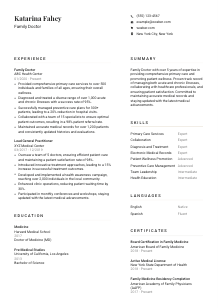
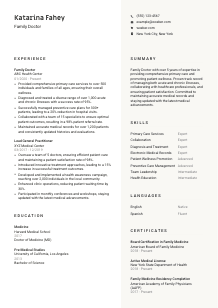
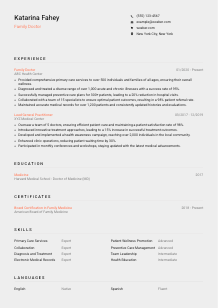
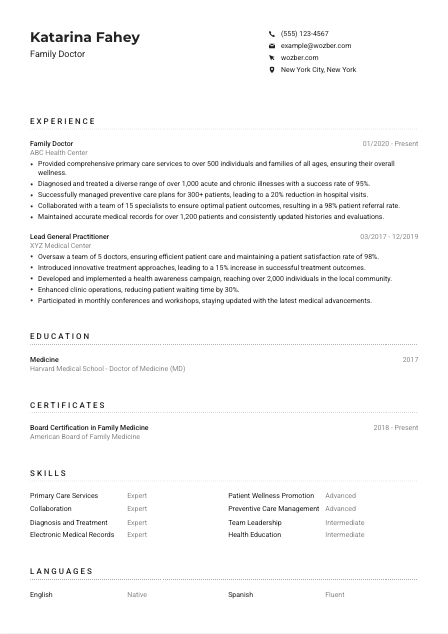
Healing families, but your resume looks under the weather? Check out this Family Doctor resume example, created with Wozber free resume builder. Learn how to blend your holistic care with job specifics with ease, and make your career prognosis as bright as your patients' health!
Family medicine resumes are read through the lens of continuity of care. Hiring teams want to see how you manage the full scope of primary care, from routine wellness visits and chronic disease follow-up to acute diagnosis, referrals, and documentation that keeps treatment plans moving across encounters. Your resume should make that clinical range visible quickly.
Primary care applications often get screened first for a few decisive details: licensure, board certification, residency training, and recent hands-on experience in outpatient care. Wozber's free resume builder helps you shape those credentials into an ATS-compliant resume while keeping your language aligned with the practice's priorities, so the hiring team can quickly recognize that you are prepared to treat a broad patient panel safely and efficiently.
In medicine, missing basics create friction fast. If a clinic cannot immediately confirm who you are, how to reach you, and whether you meet location or role expectations, your application may stall before anyone reads your clinical history. Keep this section clean, complete, and directly relevant to the position.
Use your full name prominently at the top, in a readable format that matches the professional tone of the rest of the resume. For physicians, this header should feel as clear and orderly as a well-kept chart, because it introduces every credential that follows.
Place "Family Doctor" or the closest matching title under your name so your specialty is obvious at a glance. If your prior title was something adjacent, such as General Practitioner, align the headline with the target role when your background truly supports family medicine work, as the sample resume does.
List one reliable phone number and a professional email address with no formatting issues. In a clinical hiring process, small errors here suggest poor attention to detail, which matters in a job built on follow-up, patient communication, and accurate records.
If the employer specifies a city or state requirement, show that clearly in your header. Here, listing "New York City, New York" immediately answers a stated requirement and saves the recruiter from guessing about relocation or licensing logistics.
A LinkedIn profile, physician bio page, or professional website can support your application when it reinforces your clinical background, board status, publications, or community work. Include it only if the content is current and consistent with the resume.
This section should remove any administrative doubt up front. When your identity, specialty, contact details, and required location are easy to confirm, the reader can move straight to your patient care experience.




For a family doctor, experience is where hiring teams look for real scope. They want to see the patient populations you handled, the conditions you treated, how you approached preventive care, and whether you documented and coordinated care reliably in a primary care environment. Generic duty lists will not do that work for you.
Read the job description for the care patterns it emphasizes, then mirror those in your bullet points using language that matches your actual work. In this case, comprehensive primary care, acute and chronic illness management, preventive care, specialist collaboration, and medical record maintenance should all appear in your experience section if they reflect your background.
Start with your most recent physician role and include the practice or health system name, your title, and dates of employment. For medical hiring, recent outpatient experience carries particular weight because it shows current familiarity with patient flow, care standards, and continuity responsibilities.
Describe what you managed and what changed because of your work. The sample resume does this well by tying primary care delivery to patient volume, treatment success, reduced hospital visits, referral coordination, and record accuracy. Those are the kinds of outcomes that make a physician's scope concrete.
Quantify the parts of practice that matter naturally in family medicine: panel size, visit volume, treatment outcomes, preventive care participation, referral coordination, patient satisfaction, reduced wait times, or fewer unnecessary hospital visits. A figure such as "managed preventive care plans for 300+ patients" tells far more than a broad claim about improving wellness.
Prioritize experience that shows you can handle broad-spectrum outpatient care across ages and conditions. Leadership, operations, and community health work can strengthen your resume, but only keep them if they support the main picture of you as a physician who can diagnose, treat, educate, document, and coordinate care effectively.
A strong experience section should show how you practice, not just where you worked. When your bullets cover patient care range, outcomes, collaboration, and documentation, the employer can picture you in the clinic.
For physicians, the education section is straightforward but essential. It confirms the academic path behind your license and board certification, and it should make your medical training easy to review without extra interpretation.
Put your MD or DO degree first and make it easy to find. This posting specifically requires an MD or DO from an accredited medical school, so the degree should be unmistakable in both title and institution.
List degree, field, school, and graduation year in a consistent order. Clean formatting matters here because recruiters and practice administrators often scan this section quickly to confirm core qualifications before moving on to licensure and experience.
Match your education entries to the level of training you completed. An entry such as "Doctor of Medicine (MD), Medicine, Harvard Medical School" is direct and easy to verify. Undergraduate study can stay, but your medical degree should dominate the section.
Most experienced family doctors do not need coursework lists. If you are early in practice or have relevant academic focus areas such as community health, preventive medicine, or underserved populations, include them only when they strengthen your case for the specific position.
Academic honors, leadership roles, or notable research can help when they are relevant and concise. For an established primary care physician, these should support the section rather than distract from clinical experience, licensure, and certification.
This section does not need decoration. It needs to confirm that your medical education lines up cleanly with the role's requirements and supports the rest of your clinical profile.
In family medicine, credentials are operational, not decorative. Board status, residency completion, and an active license directly affect whether you can practice, bill, and join the care team. Present them in a way that makes those essentials easy to confirm.
Pull the required certifications and licenses from the job description first. Here, board certification in Family Medicine, residency completion, and an active unrestricted medical license are central, so they belong at the top of the section.
List the qualifications that most directly support eligibility before optional training or continuing education. The sample resume places Board Certification in Family Medicine, residency completion, and the New York medical license in a sensible order because those are the credentials that answer the employer's first questions.
Show issue dates, renewal windows, or active status when relevant. In healthcare, current standing matters. A certification marked "2018 - Present" or a license shown as active gives the reader immediate clarity on whether the credential is current.
Medicine does not stand still, and neither should your credentials section. Update it whenever you renew a license, maintain board certification, complete CME-backed training, or add relevant credentials that support your scope in outpatient family care.
When your licensure and certification details are current, visible, and ordered well, the employer spends less time checking basics and more time considering your clinical value. That also strengthens ATS optimization because the required terms appear exactly where they should.
The best skills sections for family doctors do not read like personality summaries. They capture the clinical, operational, and interpersonal abilities that support safe outpatient care, coordinated treatment plans, and efficient use of documentation systems.
Start with the skills the employer names or clearly implies, then match them to your own practice. For this role, that includes primary care delivery, diagnosis and treatment, preventive care, collaboration with other healthcare professionals, and accurate medical record management.
Family medicine relies on both technical judgment and communication. Pair hard skills such as chronic disease management, preventive care planning, and electronic medical records with practice-relevant interpersonal strengths such as patient education, collaboration, and professional communication in English.
Prioritize the skills that best support day-to-day work in a primary care setting. The sample list is strongest where it stays close to actual physician work, such as Primary Care Services, Diagnosis and Treatment, Electronic Medical Records, Preventive Care Management, and Patient Wellness Promotion.
This section should reinforce the experience section, not repeat it loosely. If the skills you list map clearly to patient care, coordination, and documentation, they strengthen your case for family medicine roles.
Family doctors often care for diverse patient populations, and language ability can directly affect trust, education, and follow-up adherence. Present languages in a practical way that helps an employer understand how you communicate in the exam room and across the care team.
If the role requires professional English communication, list English clearly with an honest proficiency level. For this posting, that is a baseline qualification and should never be left implied.
Additional languages can strengthen your application when they reflect the patient population you are likely to serve. A language such as Spanish can be especially useful in many primary care settings because it supports patient education, intake accuracy, and stronger rapport during visits.
Choose simple, credible labels such as Native, Fluent, Advanced, or Intermediate. Avoid vague wording. Hiring teams need a realistic sense of whether you can conduct clinical conversations, explain treatment plans, or simply greet patients comfortably.
If you know the practice serves a multilingual community, highlight languages that would help with access, compliance, and continuity of care. Keep the emphasis practical. The value lies in better communication during consultations, referrals, and follow-up, not in listing languages for their own sake.
Think about where language skills make a difference in family medicine: discussing preventive screenings, reviewing medications, clarifying chronic disease plans, and helping families understand next steps. That context gives this section more weight than a simple list alone.
Language skills matter most when they improve care. Listed well, they show that you can communicate professionally, support patient understanding, and work effectively in a diverse primary care setting.
A family doctor summary should quickly establish your level of experience, your clinical range, and the kind of patient care you deliver. It needs to sound grounded in real practice, not like a generic statement about being passionate and dedicated.
Start with the care responsibilities that define the position. For this job, that means comprehensive primary care, acute and chronic illness management, preventive care, collaboration, and accurate recordkeeping. Those themes should shape your opening lines.
Lead with a direct statement of who you are and how long you have practiced. The sample summary opens with "Family Doctor with over 5 years of expertise," which works because it immediately places the candidate within the right specialty and experience range.
Choose strengths that match how family physicians are actually evaluated, such as broad outpatient care, chronic disease management, patient wellness, specialist coordination, or reliable EMR documentation. Keep them tied to your real practice rather than broad claims about excellence.
Aim for a short paragraph that can be read in seconds. Every phrase should earn its space by clarifying your specialty, your primary care scope, or your clinical contribution. If a line could apply equally to any healthcare professional, rewrite it.
Your summary should frame you as a physician who can step into a family medicine setting and manage a real patient panel. When it is specific about scope, experience, and care approach, the rest of the resume lands more convincingly.
A well-tailored family doctor resume should make a few things easy to confirm right away: you have the required medical training, current credentials, recent primary care experience, and a track record of treating patients across preventive, acute, and chronic needs.
Use Wozber's free resume builder to organize that experience into an ATS-friendly resume format, then refine the language with the ATS resume scanner so your qualifications match the posting naturally and clearly. The final result should make one conclusion easy for a practice to reach: you are ready to deliver dependable family medicine care from day one.




