



Use Wozber and land your dream job
Create Resume
No registration required
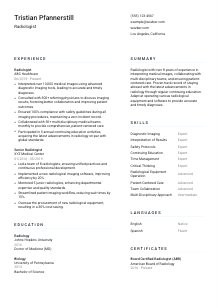
Peering into the anatomy, but feeling opaque about your resume? Check out this Radiologist resume example, created with Wozber free resume builder. Learn how to present your imaging expertise to match the job vision, setting your career trajectory in perfect alignment!
Radiology hiring turns quickly on whether your resume shows dependable diagnostic judgment in a clinical setting, not just technical familiarity with imaging. Hospitals and medical groups want to see that you can interpret studies accurately, communicate findings clearly to referring physicians, and work within patient-safety protocols without slowing care delivery.
When those details are tailored to the posting, your background reads less like a generic physician CV and more like a direct match for the imaging workload, collaboration style, and credentialing requirements behind the opening. Wozber's free resume builder helps organize that language into an ATS-friendly resume format, so board status, imaging experience, and clinical scope are easy to identify early.
This section is straightforward, but in physician hiring, small omissions can create unnecessary friction. Licensing, location, and communication details all affect how quickly a recruiter or credentialing team can move your application forward.
Use your full name in a clean, readable format so it stands out immediately. For a Radiologist, the header should feel professional and clinical, the same way your report writing is expected to be clear and precise.
Place "Radiologist" directly below your name. That keeps your specialty clear for recruiters, department leaders, and ATS parsing, especially when they are reviewing multiple physician resumes across subspecialties.
Use details that support fast outreach for interviews, credentialing questions, or schedule discussions.
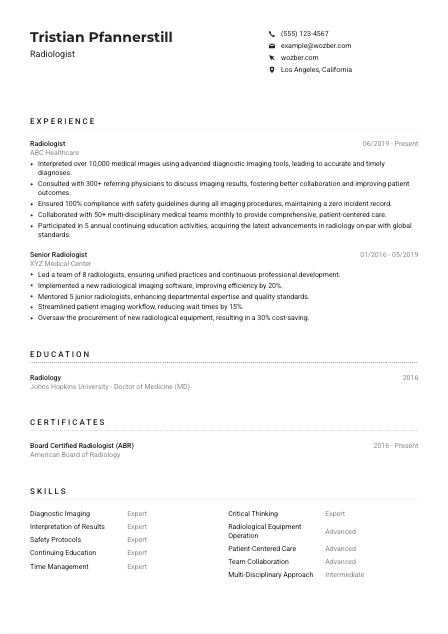
If the employer requires local availability or relocation, show that clearly in your header. In the provided example, listing Los Angeles, California directly supports the posting's location requirement without taking up space elsewhere on the resume.
A LinkedIn profile or professional webpage can be useful if it reflects your current hospital appointments, publications, presentations, or leadership work in imaging. Only include it if the information is polished and consistent with the resume.
Your personal details should remove logistical questions before they arise. Clear contact information, the right specialty title, and any needed location detail help the hiring team focus on your diagnostic and clinical qualifications.




For Radiologists, experience is the section most likely to drive interview decisions. Hiring teams look for the mix of imaging interpretation, physician consultation, workflow contribution, safety oversight, and clinical setting that matches their practice.
Read the job description for the responsibilities that define daily practice, then mirror that language where it matches your actual work. Here, the important themes include interpreting medical images, consulting with referring physicians and patients, following imaging safety protocols, collaborating with multi-disciplinary teams, and staying current through continuing education.
Start with your most recent radiology position and include job title, employer, and dates. That format helps reviewers quickly understand your current level of responsibility, whether you are practicing independently, leading a service line, or coming from a senior staff role.
Focus each bullet on work that matters in radiology practice: image interpretation, report accuracy, physician collaboration, workflow improvement, equipment or software adoption, patient care coordination, and compliance. The sample resume handles this well by leading with interpretation volume and physician consultation instead of generic duties.
Volume, turnaround improvement, team scope, wait-time reduction, incident-free compliance, and implementation gains all add credibility. "Interpreted over 10,000 medical images" and "consulted with 300+ referring physicians" are strong examples because they show workload and collaboration in terms that medical employers immediately understand.
Keep this section centered on imaging practice, diagnostic responsibility, safety, and department contribution. If older experience does not strengthen your case for reading studies, working with clinicians, or improving radiology operations, shorten it or remove it.
Your experience section should tell a department how you work under real clinical demands. Prioritize image volume, consultation patterns, safety performance, team contribution, and measurable operational improvements that matter in an imaging environment.
Radiologist hiring starts with a non-negotiable training path. Your education section should make your medical degree and academic foundation easy to read, especially when a posting specifies MD or DO credentials.
If the employer calls for an MD or DO from an accredited institution, make sure that credential is shown exactly and prominently. This section should answer the medical-degree requirement immediately.
List degree, field or concentration when useful, institution, and graduation year. Keep the structure clean so there is no confusion about where you trained and what level of education you completed.
Use the formal degree name exactly as awarded. In the example, "Doctor of Medicine (MD)" aligns directly with the employer's requirement and leaves no ambiguity for recruiters or ATS screening.
For early-career Radiologists, research, electives, distinctions, or radiology-focused academic work may help show depth. For experienced physicians, keep extra detail selective unless it directly supports the target role, such as imaging research, teaching, or subspecialty focus.
Academic distinctions can add value if they connect to radiology, medicine, or scholarly contribution. Publications, research involvement, or standout performance during medical training are more useful than broad campus activities at this level.
This section does not need decoration. It needs to show, quickly and clearly, that you completed the medical education expected for radiology practice and have the academic background to support your clinical work.
Certification carries real weight in radiology because it speaks to professional standing and eligibility for practice. Employers often look for board certification or board eligibility early, sometimes before they study the rest of the resume closely.
When a posting names the American Board of Radiology, place your ABR certification or board-eligible status clearly in this section. That is one of the first screening points for many radiology openings.
List certifications that reinforce your ability to step into the role, especially board status and other clinically relevant credentials. Avoid crowding the section with items that do not affect your standing as a practicing Radiologist.
Include issue or active dates when they help confirm that a credential is current. In the example, showing ABR certification as active from 2016 to present supports ongoing professional standing.
If you hold additional imaging, safety, or subspecialty credentials, include them when they strengthen your profile for the position. Radiology evolves through technology, protocols, and clinical standards, so recent credentials can reinforce continued engagement with the field.
A concise, well-ordered certification section helps the employer confirm professional standing fast. For radiology roles, clear board information often carries more value than a long list of secondary credentials.
A Radiologist's skills section should feel grounded in daily clinical work, not padded with generic traits. The most useful lists combine imaging expertise, equipment and software familiarity, interpretation strength, and collaboration skills that support patient care.
Identify the capabilities named or implied in the posting, then match them to your real experience. Here that includes operating radiological equipment and software, interpreting results, following safety guidelines, collaborating with physicians, and communicating in English.
Feature the skills most connected to how Radiologists are evaluated in practice. Diagnostic imaging, image interpretation, safety protocols, patient-centered care, and collaboration with multi-disciplinary teams all fit naturally because they connect to clinical performance, not just resume keywords.
Choose skills that deepen the hiring team's understanding of your practice. The sample resume works because it balances technical strengths like radiological equipment operation with clinical and operational skills such as critical thinking, time management, and team collaboration, instead of listing every possible competency.
This list should support the rest of the resume, not repeat it mechanically. Keep the emphasis on the imaging, interpretation, safety, and collaboration abilities that shape radiology work day to day.
Radiologists may spend much of the day with images and reports, but language still matters in consultations, documentation, and patient-facing discussions. If a posting names a language requirement, address it directly and then add any additional languages that are genuinely useful in care delivery.
When English proficiency is stated as a requirement, list English clearly at the top of this section. That confirms you can communicate in reports, physician discussions, and patient interactions within the expected clinical environment.
Extra languages can strengthen your profile in diverse patient populations or referral networks. Spanish, for example, may be valuable in many healthcare markets, but it should be presented as an added asset rather than a substitute for the required language.
Describe your ability accurately with terms such as "Native," "Fluent," or another clear level. Overstating language skill can create problems in clinical conversations where precision matters.
Language relevance depends on where and how you practice. In some markets or hospital systems, multilingual ability can support smoother patient communication and stronger collaboration across care teams.
This section is most useful when it shows communication range that can help with patient understanding, physician coordination, or community reach. Keep it grounded in care delivery, not as a decorative extra.
For Radiologists, language skills support clearer consultations, better patient understanding, and smoother coordination with clinical teams. Lead with required proficiency, then add any languages that strengthen your reach in practice.
Your summary should give a hiring manager a fast clinical snapshot of your background. In a few lines, show your experience level, the kind of radiology work you have handled, and the capabilities that make you credible for the target opening.
Before writing, identify the two or three priorities the employer is most likely to care about first. In this case, that means diagnostic imaging interpretation, collaboration with referring physicians and teams, and adherence to current radiology standards and continuing education.
Start with a direct statement of who you are professionally. "Radiologist with over 8 years of experience" works because it gives immediate context without wasting words.
Use the next sentence or two to highlight the parts of your practice that best match the role, such as image interpretation volume, multi-disciplinary collaboration, equipment and software proficiency, or a track record of timely, accurate diagnoses. The provided example does this well by combining imaging work, patient-centered care, and continuing education.
Aim for a short paragraph that can be read in seconds. Avoid vague claims and focus on the parts of your radiology background that would matter in staffing a reading room, supporting referring physicians, and maintaining quality of care.
A well-written summary tells the reader what kind of Radiologist you are before they reach the rest of the resume. Keep it tight, specific, and aligned with the imaging scope and professional standing the role requires.
A tailored Radiologist resume should now show the essentials without forcing the reader to search for them: medical training, board status, imaging experience, physician collaboration, safety standards, and the scale of your clinical work.
Wozber's free resume builder can help you shape that into an ATS-compliant resume with clear section structure, targeted phrasing, and stronger ATS optimization around the terms that matter in radiology hiring. The result should make it easy for a medical employer to see your readiness to interpret studies, support clinical teams, and step into practice with confidence.




