



Use Wozber and land your dream job
Create Resume
No registration required
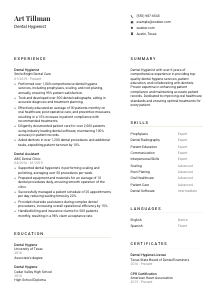
Polishing pearly whites, but your resume feels a bit stained? Browse this Dental Hygienist resume example, created with Wozber free resume builder. Learn how to polish your dental expertise to match job specifics, keeping your career trajectory as pristine as a freshly cleaned smile!
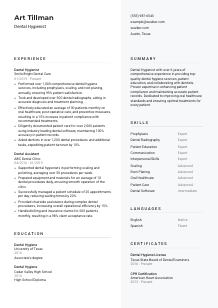
Dental hygienist hiring usually turns on practical clinical trust. A resume has to show that you can move from prophylaxis to patient education to charting without losing accuracy, pace, or chairside rapport. Hiring teams look for a clinician who can manage routine hygiene care, support treatment flow, and keep records clean enough for continuity of care.
When that experience is tailored to the posting, the resume quickly separates direct hygiene practice from adjacent dental support work. Wozber's free resume builder helps organize that content in an ATS-friendly resume format, so required terms like dental hygiene license, radiographs, scaling, and patient education are easy to read by both screening systems and the practice team reviewing your clinical background.
This section should confirm basic eligibility fast and keep the focus on your clinical qualifications. For a Dental Hygienist, clean contact details and accurate location information help remove avoidable questions before the reader gets to licensing, hygiene services, and patient-facing experience.
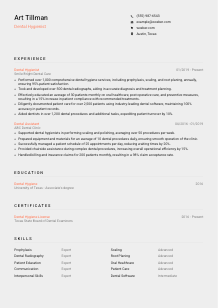
Use your full name as the header and place "Dental Hygienist" directly beneath it. That immediately frames your background around licensed hygiene practice rather than broader dental support work, which matters when employers are sorting between hygienists, assistants, and front-office candidates.
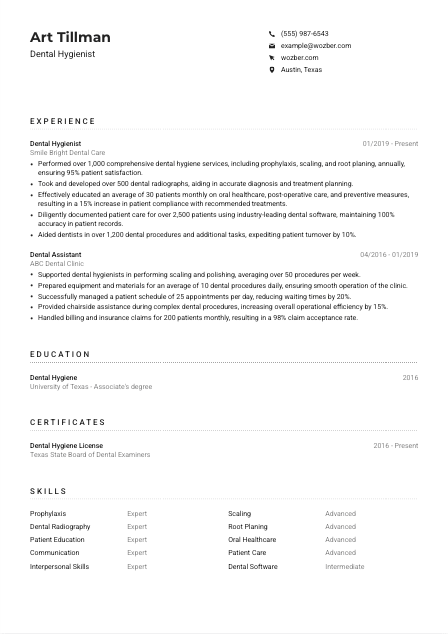
If the target role is Dental Hygienist, use that exact title in your heading. It keeps the resume aligned with the posting language and helps ATS matching. In the example, listing "Dental Hygienist" at the top makes the candidate's direction clear before the reader reaches the experience section.
Include a reliable phone number and a professional email address, ideally based on your name. In a patient-care role where schedules move quickly, missed calls can cost you interviews. Make sure every contact detail is current and easy to scan.
Some openings include a location filter, as this one does with Austin, Texas. When a practice wants someone already based locally, listing your city and state helps remove relocation concerns. Keep it simple. City and state are enough unless the employer specifically asks for more.
A LinkedIn profile can help if it reinforces your hygiene background with consistent titles, dates, recommendations, or continuing education. Include it only when it adds useful detail about clinical work, patient care, or dental practice experience. Skip links that are incomplete or unrelated to healthcare.
This section should confirm who you are, where you are, and that you are applying as a Dental Hygienist. Once those basics are clear, the rest of the resume can stay focused on clinical scope and patient care.




For Dental Hygienists, experience carries the most weight when it shows clinical range and day-to-day consistency. Hiring managers want to see the services you performed, the patient volume you handled, the documentation standards you followed, and how well you supported dentists and patients in an active practice.
Start by identifying the clinical work named in the job ad, then make sure your recent roles reflect the same responsibilities where they genuinely apply. Here, that includes prophylaxis, scaling, root planing, radiographs, patient education, charting, and assisting during procedures. If you meet the "2+ years in a dental practice" requirement, make that timeline easy to confirm from your dates and titles.
For every job, include your title, employer name, and dates in reverse chronological order. That structure helps a practice quickly understand whether your background comes from direct hygiene work, assisting, or another dental setting. If your earlier experience was as a Dental Assistant, keep it, but make sure your hygienist role is the clearest and most detailed.
Your bullets should show what you actually did in the operatory and what changed because of your work. The sample does this well by citing more than 1,000 hygiene services annually, 500 radiographs, and a 15% improvement in patient compliance. Those details tell a hiring team that the candidate can handle volume, educate patients effectively, and contribute to treatment follow-through.
Numbers work best when they reflect real practice performance. Patient satisfaction, number of procedures, radiographs completed, charting accuracy, compliance rates, daily appointment load, or faster patient turnover are all useful because they connect your work to clinic operations. Choose measures that fit your actual background rather than adding vague percentages.
Prioritize accomplishments that support the target role. Clinical cleanings, periodontal care, x-rays, post-operative instructions, preventive education, treatment support, and dental software documentation should appear before less relevant admin tasks. Even if you include earlier support experience, frame it around transferable dental workflow knowledge that strengthens your case for the hygienist seat.
A strong experience section should leave no doubt that you can perform hygiene services, document care accurately, and contribute to an efficient dental practice. Make the clinical scope visible in every role.
Dental hygiene is a licensed profession, so education is a qualification checkpoint, not a filler section. The degree listed here should immediately confirm that you meet the academic requirement to practice and support the license shown later in the resume.
When a posting asks for an Associate's degree in Dental Hygiene from an accredited institution, place that credential first and state it clearly. This is one of the first things a practice will look for because it connects directly to licensure eligibility.
Use a simple format that includes the institution, degree, field of study, and graduation year. Reverse chronological order is usually best. In the example, "Associate's degree" and "Dental Hygiene" are both easy to spot, which helps the reader confirm the requirement in seconds.
If your diploma says "Associate's degree in Dental Hygiene," use that phrasing instead of shortening it too much. Accurate wording improves ATS alignment and reduces any ambiguity about whether your program matches the role's educational requirement.
If you completed coursework or school-based training in periodontal therapy, radiography, preventive care, community oral health, or patient management systems, add it only when it strengthens your application. This is especially useful for newer hygienists who want to show clinical depth beyond the degree title.
Academic honors, dental hygiene association participation, community clinic rotations, or oral health outreach can help when they reflect hands-on patient care, professionalism, or commitment to preventive dentistry. Keep these additions relevant and brief.
Your education section should quickly answer one key question: do you have the academic foundation required to practice as a Dental Hygienist? Put that answer near the top and make it unmistakable.
In dental hygiene hiring, certifications are part of basic practice readiness. A missing or unclear license can stop an application early, no matter how strong the rest of the resume looks. This section should confirm that your credentials are current, relevant, and easy to verify.
When the posting names a valid state dental hygiene license and current CPR certification, list those before any optional credentials. They are essential for legal practice and patient safety, not secondary additions. In this example, the Texas dental hygiene license and CPR certification should be immediately visible.
If you hold additional certifications, choose the ones that strengthen your profile as a hygienist, such as local anesthesia, nitrous oxide monitoring, radiology, infection control, or periodontal-focused training where applicable. Skip certificates that do not add value to chairside care or dental practice operations.
Naming the issuing body and date range helps show that your credentials are active and legitimate. For regulated healthcare roles, that detail matters. "2016 - Present" or a visible renewal date gives the employer confidence that your paperwork is current.
Continuing education matters in a field shaped by clinical standards, infection-control expectations, and evolving patient-care protocols. If you have recent relevant certifications or renewals, include them to show that your knowledge is staying current with practice requirements.
This section should confirm that you can step into patient care without credentialing questions slowing the process. Clear licensing and CPR details make the rest of your resume easier to trust.
A Dental Hygienist skills section should read like a practical clinical toolkit. It needs to reflect the procedures, patient communication, and documentation work that actually shape performance in a dental practice, not a long generic list of strengths.
Use the job description to identify both explicit and implied skills. Here, the obvious ones include prophylaxis, scaling, root planing, radiography, patient education, documentation, communication, and assisting with procedures. These are stronger than broad terms because they map directly to daily clinical work.
List hard skills and interpersonal skills together when both matter to the role. A hygienist needs technical precision during treatment, but also the ability to explain preventive care, calm anxious patients, and communicate clearly with dentists and front-desk staff. The sample's mix of dental radiography, patient education, communication, and interpersonal skills is a solid model.
Resist the urge to include every skill you have touched. Select the capabilities that best support the target position and your strongest experience. A shorter list built around hygiene services, patient care, charting, and clinic workflow reads better in ATS screening and gives hiring teams a more accurate picture of your fit.
The best skills section tells a practice what you can handle from the first patient of the day to the last chart note. Keep it centered on treatment, communication, and reliable clinical workflow.
Language skills matter in dentistry because patient understanding affects consent, compliance, home care, and follow-up. If a practice serves a multilingual community, the ability to explain oral hygiene instructions clearly can improve the patient experience in a very practical way.
If the posting asks for strong spoken and written English, make that clear in your languages section and reinforce it through polished resume writing overall. In a role that includes patient education, charting, and coordination with dentists, English proficiency needs to be obvious.
List English prominently, especially when it is named in the job description. This helps both ATS systems and human reviewers confirm a stated requirement without having to infer it from the rest of the resume.
Additional languages can be a real asset in dental practices that serve diverse patient populations. In the example, Spanish adds value because it can help with patient instructions, preventive education, and rapport during appointments. Treat that as a helpful differentiator, not a universal requirement.
Use clear levels such as native, fluent, intermediate, or basic. Overstating language ability can create problems quickly in a healthcare setting where communication affects treatment understanding and patient trust.
If you know the clinic works with a multilingual patient base, highlight any language ability that would help with oral health education, post-operative care instructions, or front-to-back communication. Keep the focus on patient interaction, not on listing languages for their own sake.
For a Dental Hygienist, language ability matters when it improves patient understanding and day-to-day communication in the practice. List only what you can use confidently in real clinical conversations.
The summary is where you frame your clinical profile in a few lines. For Dental Hygienists, it should quickly establish your level of experience, the hygiene services you handle well, and the kind of patient care environment you are prepared to step into.
Before writing the summary, identify the main needs in the role. In this case, the employer wants an experienced hygienist who can perform core hygiene procedures, take radiographs, educate patients, document care, and support dentists as needed. Your summary should reflect that mix, using language you can support elsewhere in the resume.
Lead with a direct statement such as "Dental Hygienist with 6+ years of experience in preventive care, periodontal support, and patient education in dental practice settings." That kind of opening quickly tells the reader your profession, seniority, and care focus.
Use the next sentence to highlight relevant strengths such as scaling and root planing, radiography, patient compliance improvement, or accurate dental software documentation. The sample summary works because it ties experience to concrete value in patient care and record accuracy rather than relying on generic enthusiasm.
Aim for a short paragraph that sounds like a healthcare professional, not a generic profile statement. Avoid filler about passion or hard work unless it is backed by real scope, measurable outcomes, or recognizable dental practice responsibilities. Four focused lines are usually enough.
When the summary is tailored well, the reader understands within seconds that you have the experience, procedures, and patient-care judgment the role requires. That clarity sets up the rest of the resume.
A Dental Hygienist resume works best when every section reinforces clinical readiness. Your contact details confirm eligibility, your experience shows procedure volume and patient-care results, your education and certificates confirm licensing foundations, and your skills and summary keep the focus on treatment, communication, and accurate documentation.
Use Wozber's free resume builder to shape that information into an ATS-compliant resume with clean structure and role-matched language. Wozber's AI resume builder and ATS resume scanner can help surface missing requirements, tighten phrasing, and improve alignment with the posting, so the finished resume makes your hygiene experience easy for a dental practice to evaluate.
When the resume is tailored well, the hiring team can quickly see that you are ready to step into patient care, maintain records accurately, and support smooth clinical flow from the first appointment onward.