



Use Wozber and land your dream job
Create Resume
No registration required
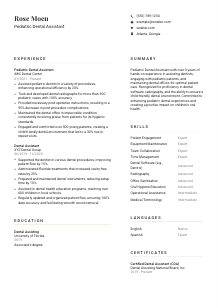
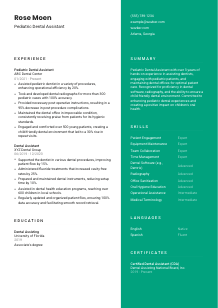
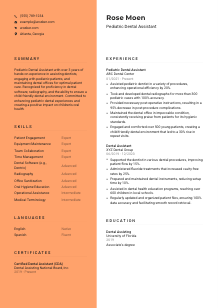
Nursing little teeth, but your resume feels toothless? Check out this Pediatric Dental Assistant resume example, created with Wozber free resume builder. It shows how easily you can blend your child-centric care with job expectations, making your career shine like a kid's smile!

Pediatric dental offices move quickly, and the assistant often sets the tone before the dentist even begins treatment. Your resume needs to show more than chairside support. It should make clear that you can keep procedures running smoothly, handle radiographs accurately, maintain a clean operatory, and help children feel safe enough to cooperate during care.
A tailored resume helps a hiring team quickly distinguish pediatric experience from general dental support, especially when they are scanning for child-focused care, radiography, certification, and dental software use. Wozber's free resume builder helps organize those details into an ATS-friendly resume format so your background reads clearly in both an ATS and a clinical review. That makes it easier to see whether you can step into a pediatric practice and contribute from day one.
Front-office basics matter in pediatric dentistry because practices need dependable communication, local availability, and a professional presentation before they ever review your clinical experience. Keep this section simple, accurate, and aligned with the practical requirements of the opening.
Place your full name at the top in a clear, readable format. Avoid decorative styling. In a busy dental office, hiring teams should be able to identify your application instantly, especially when they are reviewing several assistants with similar certifications and experience.
Include "Pediatric Dental Assistant" directly under your name when that matches the role you are pursuing. This immediately frames your background around pediatric chairside support, child interaction, radiographs, and operatory readiness rather than general dental assistance.
List a reliable phone number and a professional email address. Use an email format based on your name if possible. Pediatric practices need quick follow-up for interviews, working interviews, and schedule discussions, so this information should be current and easy to read.
If the employer requires local presence or relocation, include your city and state. In this example, listing "Atlanta, Georgia" directly addresses a stated requirement and removes uncertainty about whether you can report onsite for a pediatric practice.
Include LinkedIn or a professional website only if it supports your application with certifications, dental training, or a consistent work history. If you add it, make sure it matches your resume details and reflects the same pediatric dental focus.
Your personal details should answer the basic operational questions immediately: who you are, how to reach you, and whether you meet practical requirements such as location. Once that is clear, the hiring team can focus on your pediatric dental experience.




This section carries the most weight because pediatric dental hiring depends heavily on real procedure support, patient interaction, and daily reliability in the operatory. Focus on what you handled, how well you handled it, and what changed because of your work.
Pull the main responsibilities from the job description and reflect them in your bullets using your real experience. For a pediatric dental assistant, that usually means assisting during procedures, taking radiographs, giving post-op instructions, stocking and sanitizing rooms, and helping children stay calm. The sample resume does this well by directly naming pediatric procedures, x-rays, office hygiene, and patient comfort.
Start with your most recent position and work backward. For each role, include your title, employer, and dates. This format helps employers quickly see whether your recent experience is in a pediatric office, which matters when they need someone who already understands child-focused workflow and behavior management.
Do not stop at describing tasks. Show what your support improved. Strong bullets mention smoother patient flow, fewer post-procedure issues, faster setup, or better patient retention. In the example, achievements such as a 20% efficiency gain and a 30% rise in repeat visits give the employer a clearer picture of day-to-day impact in the practice.
Use metrics that feel natural for the role, such as number of radiographs completed, accuracy rates, patient volume, complication reduction, setup time saved, or education sessions delivered. "Took and developed dental radiographs for more than 300 pediatric cases with 100% accuracy" is effective because it combines technical competence with meaningful scope.
Choose bullets that support the target role first. General dental experience still helps, especially if it shows procedure support, sterilization, records accuracy, or oral hygiene education, but pediatric-facing details should lead. If part of your background is outside pediatrics, frame it around transferable work such as patient flow, fluoride treatment support, or communication with families.
Your experience section should make it easy to picture you in a pediatric operatory. When your bullets connect chairside duties to child comfort, clinical accuracy, and smoother office performance, your value becomes much easier to judge.
For pediatric dental assistant roles, education is usually a qualification checkpoint rather than a storytelling section. Present the training that confirms you meet entry requirements and have the clinical foundation to work safely in a dental setting.
Include your high school diploma or equivalent if the employer asks for it, and make sure your dental assisting program is easy to find. Many postings, including this one, specifically require completion of an accredited dental assisting program, so that credential should never be buried.
List the degree or diploma, field of study, school name, and graduation year or date. Straightforward formatting helps a hiring manager confirm your training quickly, especially when they are checking multiple applications for program completion and clinical preparation.
If you earned an Associate's degree in Dental Assisting or a similar credential, state it clearly. The example resume does this effectively with "Associate's degree" in "Dental Assisting," which aligns closely with the education expected for chairside and radiography responsibilities.
If you are early in your career, you can include coursework, honors, or clinical training related to radiography, infection control, pediatric care, or dental materials. For experienced candidates, this is optional unless it adds something your work history does not already show.
Pediatric practices value assistants who stay current on safety protocols, updated procedures, and child-focused care techniques. If you have recent continuing education in radiography, infection prevention, or pediatric patient management, include it when it strengthens your alignment with the role.
Education should confirm that you have the formal preparation required to work in a dental office and support pediatric treatment safely. Keep it direct and easy to verify.
Certification matters in dental assisting because it signals legal eligibility, current standards knowledge, and technical readiness for patient care. In many offices, this section is reviewed early, especially when radiographs and state compliance are part of the job.
If the posting requires a current Dental Assistant certification or state license, place that credential prominently. This example calls for active certification or licensure in the state of practice, so your resume should make that status unmistakable.
List the certifications most relevant to pediatric dental work first. A Certified Dental Assistant credential is highly relevant because it supports your case for procedure assistance, infection control, and clinical standards. Add other current credentials only if they strengthen the role match.
Show the date earned and, if applicable, the active period or expiration. For credentials that require renewal, this reassures the employer that your certification is current and usable. The sample's "2019 - Present" format works well for that purpose.
As your career progresses, add certifications that support pediatric practice needs, such as radiography authorization, CPR, infection control, or expanded functions where applicable in your state. These are especially useful when they match common responsibilities in the offices you are targeting.
Your certifications tell an employer whether you can step into regulated clinical work without delay. Keep them current, clearly listed, and tied to the kind of pediatric dental support the office needs.
Pediatric dental assistant resumes work best when the skills section reflects actual clinical workflow and patient interaction. Balance technical abilities with the interpersonal strengths that matter when children are anxious, procedures are scheduled tightly, and the office depends on smooth coordination.
Read the job description closely and identify the skills being asked for in plain language. Here, that includes dental software proficiency, English reading ability, pediatric office experience, radiography, and child-friendly patient engagement. Those terms should appear in your skills section if they genuinely reflect your background.
Include technical skills such as radiography, dental software, sterilization, charting, and operatory setup alongside patient-facing skills like comforting children, explaining care to parents, and team coordination. The sample resume handles this well by combining Dentrix-related software knowledge with patient engagement and oral hygiene education.
Do not overload the section with broad workplace traits. Prioritize skills that connect to treatment support, office readiness, compliance, and communication in a pediatric setting. A shorter list built around real tools and daily responsibilities is usually stronger than a long list of vague strengths.
Your skills should reinforce the picture already established by your experience. When they reflect pediatric workflow, radiography, software use, and child-centered communication, they help complete a credible profile.
Language matters in pediatric dental care because assistants often explain instructions, reassure children, and communicate clearly with parents or guardians. This section should reflect any language ability that supports safe care, accurate understanding, and a more comfortable patient experience.
If the posting states that you must read complex texts in English, list English clearly with an accurate proficiency level. That requirement connects directly to reading clinical instructions, chart notes, consent-related information, and post-operative guidance.
If you speak additional languages, include them. In pediatric practices serving diverse families, another language can improve intake communication, help explain oral hygiene steps, and make parents more comfortable asking questions.
Choose straightforward levels such as Native, Fluent, Intermediate, or Basic. Hiring teams need a realistic sense of whether you can handle casual conversation, instructions, or more detailed patient communication.
Multiple languages are not required for every pediatric dental assistant opening, but they can be a real advantage in community-focused practices. Treat them as a practical communication asset, not as filler.
When you speak with families in the language they understand best, post-op instructions, appointment preparation, and preventive education often go more smoothly. That kind of communication support can be especially valuable in pediatric care, where trust and clarity matter at every visit.
Your language section should show whether you can communicate clearly in the practice environment and, when relevant, support families more effectively. Keep it honest, useful, and tied to patient care.
The summary sits at the top of the resume, so it should quickly establish your level of experience, your pediatric focus, and the clinical strengths most relevant to the role. Keep it short, but make every phrase earn its place.
Review the posting before writing your summary so you know which points deserve top billing. For pediatric dental assistant roles, that often means years of pediatric experience, certification status, radiography, dental software, and the ability to create a calm experience for children and parents.
State your title and your years of relevant experience early. A line such as "Pediatric Dental Assistant with over 3 years of hands-on experience" works because it tells the reader both your specialty and your level of practice within the first few words.
Use the next sentence to highlight two or three qualifications most relevant to the opening, such as pediatric procedure support, radiography, dental software proficiency, child engagement, or post-operative communication. The sample summary does this by pointing to software, radiography, and a child-friendly dental environment.
Aim for a short paragraph that reads naturally and avoids generic claims. Focus on real qualifications and outcomes instead of soft phrases about passion or hard work. A summary should quickly tell the employer what kind of pediatric support you provide and where you add value in the office.
A well-written summary should tell the reader, within seconds, that you have the pediatric dental experience, clinical competence, and patient-facing skills this practice needs. It sets up the rest of the resume to confirm that impression.
A pediatric dental assistant resume works best when it shows three things clearly: you can support treatment efficiently, keep the clinical environment compliant and organized, and help children and families feel at ease throughout care. When those strengths are backed by specific experience, current certification, and the right terminology, the resume becomes much easier to trust.
Use Wozber's free resume builder to shape your content into an ATS-compliant resume, refine wording with role-specific language, and check alignment with the job through ATS optimization tools. The finished resume should make one conclusion easy for a pediatric practice to reach: you are ready to contribute in the operatory, with patients, and across the daily rhythm of the office.




