



Use Wozber and land your dream job
Create Resume
No registration required
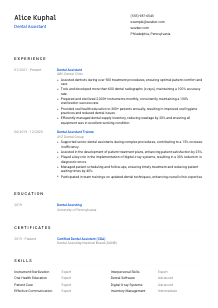
Being a cavity warrior, but your resume feels like pulling teeth? Check out this Dental Assistant resume example, built with Wozber free resume builder. It shows how to highlight your chairside talents to match dental job requirements, paving the way for your dental career to sparkle as bright as those freshly polished pearly whites!
Dental assistants work at the point where chairside precision, infection control, and patient reassurance all happen at once. Hiring teams look for resumes that make that mix visible quickly, especially whether you can support procedures smoothly, handle radiographs accurately, keep instruments and operatories ready, and communicate clearly with patients before and after treatment.
When those details are tailored to the posting, the resume reads less like general healthcare support and more like true dental office experience. Wozber's free resume builder helps you shape that experience into an ATS-compliant resume by aligning your wording with the job description, so core strengths like digital x-ray work, sterilization routines, and patient education are easy to recognize from the first scan.
In a dental office, small details carry weight. Your contact section should show the same level of order and professionalism expected around patient records, scheduling, and clinical documentation.
Use your full name as the clearest identifier on the page, set slightly larger than the rest of the text. Keep the presentation simple and readable. In a healthcare setting, visual clutter can make a resume feel less organized than the work itself requires.
Place "Dental Assistant" directly under your name if that is the role you are pursuing. Matching the posted title helps both ATS systems and hiring managers connect your background to chairside assisting, radiographs, sterilization, and patient care without guessing.
Include a phone number you answer reliably and a professional email address. Check both carefully. A dental practice hiring for a busy front-to-back support role will often move quickly when scheduling interviews, and one typo can cost you that call.
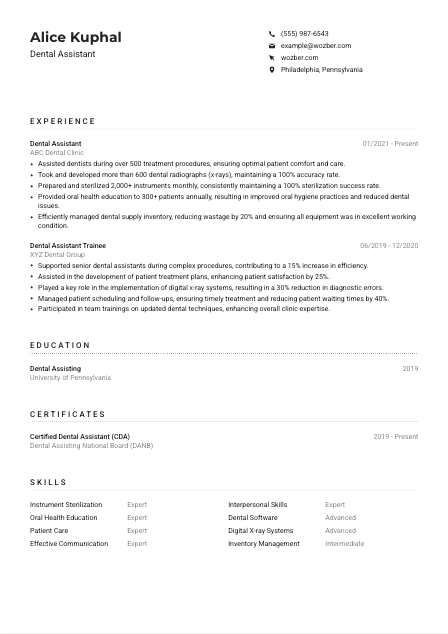
If the posting names a location requirement, include your city and state. For the example role, listing Philadelphia, Pennsylvania immediately answers a practical screening question about local availability. If you are relocating, make that clear instead of leaving the employer to assume.
A LinkedIn profile can help if it reflects the same employment dates, certifications, and dental experience shown on your resume. Keep it consistent. If it is outdated or too generic, leave it off until it accurately supports your application.
This section should confirm that you are reachable, professional, and aligned with the basics of the opening. Keep it neat and accurate, just like the work environment you want to join.




This is where a dental assistant resume earns credibility. Employers want to see the clinical routines, patient-facing work, and office support tasks you have already handled in a real practice setting.
Read the description and mark the tasks that define daily work. For a dental assistant, that usually means assisting during procedures, taking radiographs, sterilizing instruments, educating patients, and maintaining supplies or equipment. Those should shape which bullets you keep and how you phrase them.
List roles in reverse chronological order with your job title, employer, and dates. In a field where experience can range from trainee support to full chairside responsibility, that structure helps employers understand your progression and the level of independence you have handled.
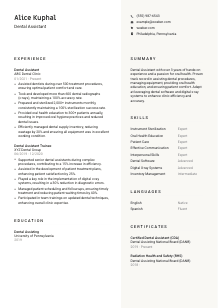
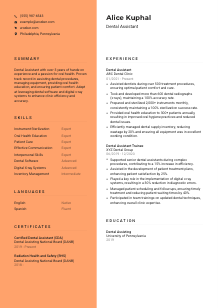
Use accomplishment bullets that show scope, pace, and reliability. The sample resume does this well with details like assisting in more than 500 treatment procedures and taking over 600 dental radiographs. Metrics like procedure volume, sterilization accuracy, patient education reach, or reduced supply waste give employers a much clearer picture than task-only bullets.
A useful bullet explains what improved because of your work. That could be faster room turnover, fewer diagnostic errors after a digital x-ray rollout, lower supply waste, stronger patient compliance with postoperative instructions, or smoother scheduling flow. In dental offices, efficiency and patient experience are tightly connected, so results matter.
If you have worked in other healthcare or administrative roles, include them only when they support the target job through patient care, documentation, sterilization, scheduling, or equipment handling. Keep the strongest emphasis on work that proves you can contribute in the operatory from day one.
Your experience section should leave no doubt that you understand how a dental practice runs. When your bullets show procedure support, radiographs, sterilization discipline, and patient communication in concrete terms, hiring managers can picture you in the room.
Dental assistant hiring usually starts with a straightforward education check. This section should confirm that you completed the training needed for the role without making the reader hunt for it.
Start with the education most relevant to the opening. For many dental assistant roles, that means a high school diploma or equivalent plus completion of an accredited Dental Assisting program. If your program directly matches the posting, make that easy to spot.
Present each entry with school, program or degree, field of study, and graduation date. Clean structure matters for ATS parsing and for fast human review, especially when the hiring team is checking qualifications alongside certifications and hands-on experience.
Use the exact title of your credential or training whenever possible. If you completed a Dental Assisting program, write it clearly instead of relying on vague labels. In the sample resume, listing Dental Assisting as the field immediately supports the role requirement.
If you have limited dental office experience, include coursework, lab training, or externship details that connect to radiography, infection control, chairside assisting, or patient preparation. Those details help bridge the gap between school and practice.
Honors, student leadership, or related activities can help, especially for newer candidates, but keep them relevant. A detail is worth keeping if it supports clinical discipline, patient interaction, or healthcare training, not simply because it fills space.
This section should quickly confirm that you meet the educational baseline for dental assisting. Once that is clear, the rest of your resume can focus on how you work in a real clinic.
Certifications often carry real weight in dental assisting because they point to hands-on capability, legal scope, and current technical knowledge. If the role mentions certification or licensure, this section deserves close attention.
Check whether the employer asks for a state-specific certification or license, radiography qualification, or a commonly recognized credential such as CDA. Even when a posting phrases this flexibly, listing the relevant certification clearly can remove uncertainty early in the review.
Order certifications by hiring value, not by whichever was earned earliest. For a dental assistant, credentials tied to general chairside practice, radiation safety, expanded functions, or state compliance should appear before less relevant training.
Include the certifying body and the date earned or validity range. The sample resume does this effectively with DANB credentials such as Certified Dental Assistant and Radiation Health and Safety. That makes it easier for employers to confirm that your qualifications are current.
Dental regulations, radiography permissions, and state-level requirements can shift, and some practices will screen for active credentials before they review the rest of your resume in detail. Update this section whenever you renew, add, or replace a certification.
When this section is current and relevant, it strengthens your case for immediate contribution in the clinic. It tells the employer you meet the standards attached to the work, not just the title.
A dental assistant skill list should feel grounded in the operatory and the patient experience. Focus on the tools, routines, and interpersonal strengths that shape daily work in a practice, not generic workplace traits.
Pull specific skills from the posting and match them to your real experience. If the role asks for dental software, digital x-ray systems, instrument sterilization, oral health education, or communication skills, use those exact terms where they are true to your background.
Dental offices need both. Pair technical abilities such as radiograph handling, infection control, tray setup, and inventory management with patient care, communication, and interpersonal skills. The sample resume strikes that balance well, showing both equipment-related and patient-facing strengths.
Do not crowd this section with every skill you have ever used. Prioritize the abilities most tied to the target job and that you can support in your experience section. A shorter list that matches the posting and reflects real dental workflows will do more for ATS optimization than an inflated list of vague terms.
The best skill sections read like the real support system behind a dentist's workflow. If your list reflects radiographs, sterilization, patient care, software use, and communication, it is doing its job.
Language ability matters in dental assisting because instructions must be understood clearly before treatment, after procedures, and during routine education on oral hygiene. This section becomes more valuable when language use connects directly to patient care.
If the posting specifies professional English, list English first and state your level clearly. That matters in a role where you may explain postoperative care, confirm patient history, or relay instructions during treatment.
Include additional languages when you can use them comfortably in real interactions. In many practices, bilingual communication can help with intake, reassurance, scheduling, and oral health guidance for a broader patient base.
Choose clear levels such as Native, Fluent, Intermediate, or Basic. For patient-facing healthcare roles, overstating language ability can create real communication problems, so accuracy matters more than ambition here.
Extra languages can be especially useful in clinics serving diverse neighborhoods or family practices with high patient volume. If a second language has helped you explain procedures or build trust with patients, it deserves a place on the resume.
In dental settings, language ability supports consent, comfort, and follow-through on care instructions. The sample resume's English and Spanish combination is a good illustration of how language can widen your usefulness without replacing your core clinical qualifications.
List languages when they strengthen your ability to guide, reassure, and educate patients. In a dental office, that practical communication value is what makes this section matter.
Your summary sits at the top of the resume, so it should identify your level quickly and point to the parts of your background that matter most in a dental practice. Keep it specific enough to sound practiced, not generic.
Before writing, identify the two or three themes repeated in the job description. For this role, that includes procedure support, radiographs, sterilization, patient education, and dental software use. Your summary should pull from those priorities instead of offering broad healthcare language.
Start with a direct line that states your profession and amount of experience, such as a dental assistant with 3+ years in clinical practice. The sample summary does this effectively and immediately places the candidate at the right level.
Mention a few strengths that define how you work, such as chairside assistance, digital x-rays, oral health education, patient comfort, or clinic efficiency. If you have a standout result, such as high radiograph accuracy or process improvements, work that in naturally.
Aim for 3 to 5 lines. That is enough room to establish your experience, your strongest dental skills, and the kind of contribution you make in practice. Skip filler about being motivated or hardworking unless the rest of the sentence proves it through real work.
A sharp summary helps the reader understand your clinical range before they reach the first job entry. It should sound like someone who has supported treatment, managed patient interactions, and kept a dental office moving.
A dental assistant resume works best when it shows the rhythm of the job clearly: procedure support, radiographs, sterilization, patient education, and dependable clinic organization. When each section reflects those priorities with accurate terms and measurable details, hiring teams can tell quickly whether you can step into their workflow.
Use Wozber's free resume builder to turn that experience into an ATS-friendly resume format, refine the language with role-specific keywords, and check alignment with an ATS resume scanner. The finished resume should make your clinical value easy to recognize before the interview even starts.