



Use Wozber and land your dream job
Create Resume
No registration required
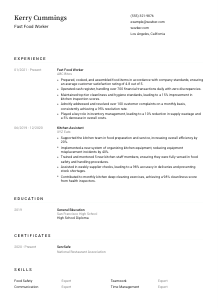
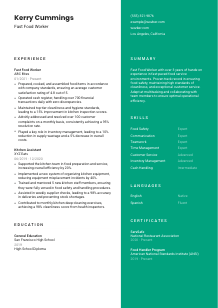
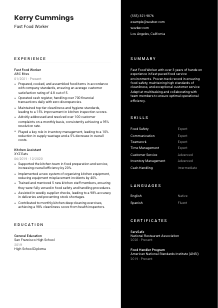
Flipping patties, but your resume is getting fried? Check out this Fast Food Worker resume example, created with Wozber free resume builder. Learn how to season your fast food skills to match the job, so your career can be as sizzling as those golden fries!
Fast food work is built on consistency under pressure. Hiring managers want to see that you can keep orders moving, follow food safety rules, stay accurate at the register, and still handle customers professionally during a rush. Your resume should make that day-to-day reliability visible right away.
When the resume mirrors the language of the job posting, it becomes much easier for both the hiring team and the ATS to connect your background to the actual shift demands. Wozber's free resume builder helps you line up job titles, food service keywords, and an ATS-friendly resume format so your experience reads clearly as preparation for the pace, standards, and customer contact the role requires.
For a fast food role, the contact section does more than identify you. It confirms practical details quickly, especially when the employer needs someone local, reachable, and ready to work in a customer-facing environment. Keep this section clean, accurate, and closely aligned with the posting.
Your name should sit at the top in a clear, readable format. No decorative styling, no crowded layout. In high-volume hiring, managers often scan resumes quickly between shifts or during store operations, so make your header simple and easy to spot.
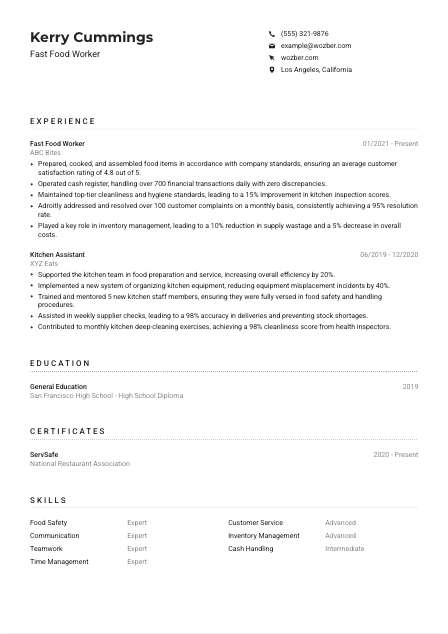
If you are applying for a Fast Food Worker position, use that title directly under your name when it matches your background and the target posting. This helps frame your resume immediately and supports ATS matching. In the example, "Fast Food Worker" appears clearly in the header, which removes any guesswork about the candidate's target role.
Include a phone number and professional email address you check regularly. For shift-based roles, a missed call can mean a missed interview. Double-check for typos, and avoid outdated details or unnecessary extras that do not help the employer contact you faster.
Some food service employers want candidates who can start quickly and already live in the area. Here, the posting specifically asks for someone located in Los Angeles, California, so listing city and state is useful and relevant. If a local requirement appears in your target job, reflect it directly in this section.
Most fast food resumes do not need a portfolio website, and LinkedIn is optional. Add a profile or site only if it supports your application with consistent work history, customer service experience, or hospitality credentials. If you include one, make sure it matches the dates, titles, and details on your resume.
Your personal details should answer the practical basics fast: who you are, what role you are targeting, how to reach you, and whether you meet local availability requirements. Once that is clear, the employer can focus on your food service experience.




Experience carries the most weight on a fast food resume because it shows how you perform in real service conditions. Hiring managers look for proof that you can prepare food to standard, keep the line moving, handle cash accurately, maintain sanitation, and respond well when customers need help. This is where your resume should feel most concrete.
Before rewriting your bullets, mark the duties that appear in the ad. For this opening, the priorities are food prep, cooking, assembly, register operation, sanitation, customer service, and inventory support. Those responsibilities should shape which parts of your background you highlight and which words you use.
Start with your most recent role and include job title, employer, and dates. This structure helps the employer see whether you already have recent fast-paced food service experience, which matters here because the posting asks for at least 1 year in that kind of environment.
Avoid vague lines like "responsible for food prep." Show what you handled and how well you handled it. The example does this effectively with bullets such as preparing, cooking, and assembling food items according to standards while maintaining a 4.8 out of 5 customer satisfaction rating. That tells the employer both the task and the result.
Fast food work produces measurable results, so use them when you have them. Daily transaction volume, inspection scores, complaint resolution rates, food waste reduction, speed improvements, or training results all strengthen your resume. Handling 700 transactions a day with zero discrepancies or improving inspection scores by 15% gives hiring managers a much clearer picture than broad claims about being hardworking.
Choose bullets that reinforce your ability to succeed on a shift. Food handling, cleanliness, customer recovery, team support, stocking, and inventory control are all highly relevant. Even if you have broader restaurant experience, give more space to the parts that match counter service, back-of-house execution, and routine operational standards.
Your experience section should show that you can step into service, follow standards, and contribute immediately. When your bullets cover food prep, cash accuracy, sanitation, customer interaction, and inventory support with real results, your resume starts to look job-ready.
Education is usually a shorter section for fast food roles, but it still matters when the posting sets a clear baseline. If the employer asks for a high school diploma or equivalent, make that information easy to find so no one has to search for it.
Start with the exact requirement in the job ad. Here, the employer asks for a high school diploma or equivalent, so that credential should be listed clearly. If you meet a required qualification, do not bury it below less relevant details.
List the school name, diploma or degree, field if relevant, and graduation year. For roles that prioritize shift readiness and service experience, a straightforward format works best. The example's high school diploma entry covers the requirement without overexplaining it.
If you are early in your career, related training can strengthen the overall picture. A food handler course or ServSafe certification should usually appear in the certificates section, but it also reinforces that your education is backed by practical food safety knowledge.
You do not need to pad this section. Include extra coursework or school-based training only if it relates to hospitality, food handling, customer service, or workplace safety. Otherwise, keep the section lean and let your experience do the heavier lifting.
Managers reviewing hourly service resumes often move quickly. A compact education section with one or two clean entries is enough. The value here is clarity, not detail for detail's sake.
Education should confirm that you meet the posted requirement and then get out of the way. Once that is established, your resume can return the focus to service experience, food safety, and day-to-day execution.
Certifications matter more in food service than they do in many other entry-level roles because they point directly to safe handling practices and compliance habits. If you hold a recognized food safety credential, make sure it is visible and current.
Lead with certificates that connect directly to the posting. In this case, ServSafe or a similar food handler program is preferred, so those belong at the top of the section. That immediately supports the employer's requirement for strong knowledge of food safety and handling procedures.
You do not need a long list. A few well-chosen certifications tied to food handling, sanitation, or restaurant operations are more persuasive than unrelated training. The example keeps the focus on ServSafe and a food handler program, which is exactly the kind of alignment employers want to see.
Food safety credentials lose value if the employer cannot tell whether they are active. Include the issue or validity dates clearly. If a certification needs renewal soon, update it before applying when possible.
If you plan to stay in food service, updated certifications can support growth into trainer, shift lead, or broader restaurant roles. Even for frontline fast food work, current food safety training shows that you understand standards that affect inspections, customer health, and store compliance.
Relevant certificates help your resume speak the language of food safety, sanitation, and operational standards. For a fast food opening, that can be the detail that moves your application ahead of someone with similar experience but no formal credential listed.
A fast food skills section should reflect how the work actually gets done. That means combining food handling and cash-related abilities with customer service, communication, and teamwork. Keep the list close to the realities of the role instead of filling it with generic workplace terms.
Use the job description as your starting point. Here, the employer highlights food safety, food handling procedures, communication, customer service, and the ability to manage transactions. Those terms should appear in your skills section when they reflect your actual background.
Put the most relevant skills first. For this kind of role, that often includes food safety, cash handling, customer service, teamwork, time management, cleanliness standards, and inventory support. The example works well because it centers skills tied to daily store operations rather than broad resume filler.
Keep the list easy to scan. You can separate technical and people-facing skills, or simply order them by relevance. What matters is that the employer can quickly connect your skill set to the station work, register duties, and customer interaction the job requires.
This section should back up the story told in your experience. When the skills match the posting and reflect real shift responsibilities, the employer can quickly picture you handling service, food prep, and customer contact without a long learning curve.
Language skills can be especially useful in fast food because the work is immediate, customer-facing, and often done in diverse communities. Clear communication affects order accuracy, service speed, and how well you handle questions or complaints at the counter.
Always lead with the language the employer specifically asks for. Here, the role requires the ability to articulate effectively in English, so English should be listed clearly with an honest proficiency level.
If you speak another language used in your local customer base, include it. In many fast food environments, an additional language can help with order clarification, customer comfort, and smoother service during busy periods. The example includes Spanish, which can be a useful strength in many communities, though it will not be required in every opening.
Terms like "Native," "Fluent," "Conversational," or "Basic" work well because they set realistic expectations. Avoid exaggerating. In customer-facing work, overstating language ability can create problems during live service interactions.
You do not need to turn this into a long profile. Include the languages that matter for the job and present them clearly. For most fast food resumes, two or three entries are plenty.
Some stores serve neighborhoods where multilingual service is a real advantage. When that is true, language skills can strengthen your resume beyond the formal job requirements because they support faster service and better customer experience on the floor.
Language skills are most useful when they connect to service quality. If they help you communicate clearly with customers and teammates, they deserve a place on the resume.
The summary is your short introduction at the top of the resume, and for a fast food role it should establish three things quickly: your level of food service experience, your grasp of food safety and cleanliness, and your ability to handle customers in a busy setting. Keep it short, but make every line pull its weight.
Start with a direct line that identifies you as a Fast Food Worker or food service professional and states your experience level. The example summary does this well by leading with more than 3 years of hands-on experience in fast-paced food service environments.
Choose strengths that match the employer's priorities. Food safety, cleanliness, customer service, cash handling, and multitasking are all strong options when they are backed by your experience. Keep the emphasis on what you do well during actual service operations.
A summary should usually stay within 3 to 5 lines. That is enough space to frame your background without repeating the full experience section. Short, specific wording works better than broad claims about passion or dedication.
Use terms that already appear in the job ad when they accurately describe your background. That helps with ATS optimization and makes your resume feel closely aligned with the opening. Wozber's AI resume builder can help surface missing keywords and sharpen the phrasing so the summary reflects the actual requirements of the role, especially around food safety, customer service, and fast-paced food preparation.
A good summary gives the employer a fast read on your service background and operational strengths. By the time they reach your experience section, they should already expect to see food safety knowledge, customer-facing reliability, and solid performance in a busy restaurant environment.
A fast food resume works best when it shows practical readiness, not generic enthusiasm. Focus your content on food prep, sanitation, register accuracy, customer service, and the pace of the environments where you have worked.
Use Wozber to organize that experience into an ATS-compliant resume, strengthen the match with the posting through targeted wording, and review alignment with an ATS resume scanner. The final result should make it easy to judge whether you can step into the role and perform well from day one.




