



Use Wozber and land your dream job
Create Resume
No registration required
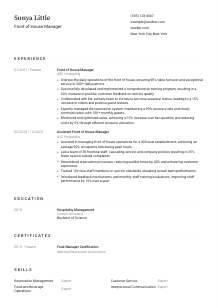
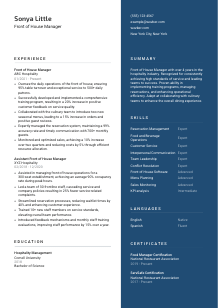
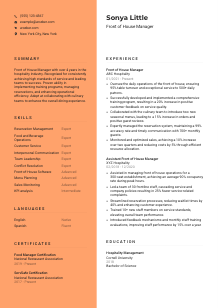
Steering service with a smile, but your resume seems off-stage? Step into this Front of House Manager resume example, created with Wozber free resume builder. Learn how to spotlight your hospitality leadership and guest-focused touch to match job criteria, making sure your career takes center stage with a standing ovation!
Front of house management gets judged in real time. Service standards slip, reservations back up, a training gap shows up on the floor, and the manager is the person expected to steady the room fast while keeping guests, staff, and sales on track. Your resume should make that operating control visible, especially through team leadership, service execution, and commercial results.
When a resume is tailored well for this role, the first read becomes much clearer. Hiring teams can quickly see whether you have actually run high-volume service, coached staff, handled reservation flow, and influenced revenue or guest satisfaction. Wozber's free resume builder helps shape that experience into an ATS-compliant resume with language that matches the posting, so the hiring team can immediately connect your background to front-of-house performance.
In hospitality hiring, contact details are not a formality. They show whether you are local, reachable, and presenting yourself with the same professionalism expected on the floor. Keep this section clean, accurate, and easy to scan.
Place your full name at the top in a clean, readable format. Front of House Manager roles are guest-facing leadership positions, so even the presentation of your header should feel polished and organized.
Add "Front of House Manager" directly under your name when that is the role you are pursuing. This removes ambiguity right away and helps both recruiters and ATS systems connect your application to the opening.
List a reliable phone number and a professional email address. Double-check both. In restaurant and hospitality hiring, interview scheduling often moves quickly, and a missed call or typo can cost you momentum.
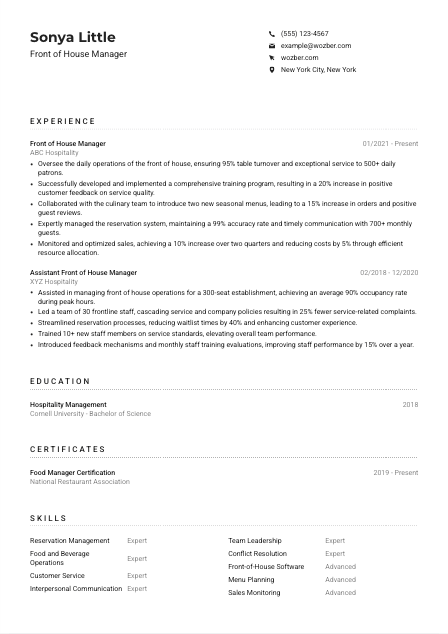
If the posting specifies a city, show that clearly in this section. In the example, listing "New York City, New York" immediately addresses the employer's location requirement without taking up unnecessary space with a full street address.
A current LinkedIn profile can reinforce your management background, career progression, and hospitality credentials. If you include it, make sure titles, dates, and certifications match the resume so your application reads consistently across every touchpoint.
Your personal details should answer the practical questions first: who you are, how to reach you, and whether you already meet basics such as location. Keep it crisp so the reader can move straight to your service leadership experience.




This section carries the most weight for a Front of House Manager. Hiring teams want to see what kind of floor you ran, how you led staff, how you handled service pressure, and whether your decisions improved guest experience, sales, or efficiency.
Pull the main priorities from the posting and reflect them in your bullet points. For this role, that means daily front-of-house operations, staff training, reservation management, coordination with the kitchen, and KPI reporting. If you have done that work, state it directly instead of describing your job in broad hospitality terms.
Start with your current or most recent position and include job title, employer, and dates. This helps the reader track your progression from earlier supervisory work into full front-of-house leadership, as shown in the example's move from Assistant Front of House Manager to Front of House Manager.
A hiring manager already knows that a Front of House Manager oversees service. What matters is how well you did it. Strong bullets show execution and result, such as improving guest feedback, increasing table turnover, reducing waitlist times, or lifting sales through better staffing and service coordination.
Numbers make hospitality management experience more credible when they reflect how the floor actually performs. Table turnover, covers served, occupancy, reservation accuracy, guest feedback scores, sales growth, labor control, and complaint reduction all work well here. The example does this effectively with metrics like 95% table turnover, 99% reservation accuracy, and a 10% sales increase.
If your background includes several hospitality roles, give the most space to positions where you managed staff, owned service standards, or influenced revenue and guest experience. Keep older or less relevant work brief unless it directly supports the move into front-of-house management.
Your experience section should show that you can run service, lead people, and improve business performance under pressure. When the bullets are tailored to real front-of-house outcomes, your management capability becomes much easier to trust.
Education usually supports your candidacy rather than carrying it, but it still helps frame your preparation for hospitality leadership. Present it clearly and give extra attention only when the degree adds direct relevance to service operations, restaurant management, or guest experience.
List your highest or most relevant qualification first. A degree in Hospitality Management, Hotel Administration, Business, or a related field can strengthen your profile, though many Front of House Managers are hired primarily on operational experience.
Include degree, field of study, school name, and graduation year. Clear structure matters because recruiters often scan education quickly unless the employer has named a specific academic requirement.
If your degree connects closely to restaurant or hotel operations, make that connection visible. In the example, a Bachelor of Science in Hospitality Management adds useful context because it supports the candidate's background in service standards and operational leadership.
Relevant coursework can help if you are earlier in your career or if the classes tie closely to the role, such as food and beverage management, menu development, hospitality finance, or service operations. Skip course lists if your work history already proves those areas more convincingly.
Honors, leadership roles, or major hospitality projects are worth adding when they reinforce your management track. Keep them brief and relevant. This section should support your readiness for the floor, not distract from your professional record.
Use education to reinforce your hospitality foundation, especially if it connects to food and beverage operations or guest service management. Then let your experience do the heavier lifting.
Certifications matter more in hospitality than in many management roles because some are tied directly to compliance and daily operations. If a posting asks for a food safety credential, make sure that requirement is easy to find.
When the employer names a certification, include it exactly as recognized in the industry. Here, a valid Food Manager Certification or ServSafe certification is a stated requirement, so those credentials should appear clearly and without abbreviation confusion.
Focus on certifications that support restaurant leadership, safety, service standards, or beverage knowledge. A shorter, targeted list is stronger than a long inventory of unrelated courses.
Include the issue date or active date range so the employer can tell the credential is current. The example handles this well with entries such as "2019 - Present," which quickly signals active standing.
Front-of-house leaders are often expected to stay current on food safety, responsible service, and operational standards. If you renew credentials regularly or add new training over time, that supports your credibility as someone trusted to run service responsibly.
Relevant certifications can answer a hiring requirement in seconds. For a Front of House Manager, that can be the difference between looking broadly experienced and looking immediately qualified.
The best skills section for a Front of House Manager reads like the control panel behind strong service. It should reflect how you manage the floor, support staff performance, use systems, and keep revenue and guest experience moving in the right direction.
Read the description closely and mirror the skills you genuinely use. For this opening, that includes interpersonal communication, front-of-house software, reservation management systems, food and beverage operations, menu planning, service standards, and KPI reporting.
This role blends systems and service leadership. Balance technical skills such as reservation management, sales monitoring, and front-of-house software with people skills like team leadership, conflict resolution, training, and guest communication.
Choose the skills that best support your target role instead of pasting in every capability you have. The example works because it centers on front-of-house essentials such as reservation management, menu planning, customer service, and KPI analysis, all of which support ATS optimization without reading like keyword stuffing.
A hiring manager should be able to glance at this section and recognize someone who can run service, coach a team, and work the systems behind the guest experience. Keep the list focused enough to make that picture clear.
Language skills can matter on the floor because guest service depends on fast, clear communication. For some venues, English proficiency is the baseline requirement. In others, an additional language can help with guest relations, staff communication, or upselling.
If the posting requires English, list it clearly with an honest proficiency level. For this role, English should appear first because the employer specifically asks for effective communication in English.
Additional languages are worth including when they are relevant to the venue's clientele or staff mix. Spanish, for example, can be useful in many hospitality settings, but treat it as an added asset rather than a universal expectation.
Use straightforward labels such as Native, Fluent, Intermediate, or Basic. Accuracy matters. In a management role, language claims can quickly be tested in guest interactions, staff coaching, or conflict resolution.
If you speak more than one language, think about how it supports real front-of-house tasks. It may help with welcoming guests, handling complaints smoothly, coordinating with a diverse team, or communicating event details without delay.
A basic or conversational level can still be worth listing when it adds service value and is presented honestly. In hospitality, even limited language ability can help create a smoother guest experience in the right setting.
List the languages that genuinely help you manage service and communicate well on the floor. For this role, clear English is essential, and any additional language should support the guest experience in a concrete way.
Your summary should sound like someone ready to take charge of service, not like a generic hospitality profile. In a few lines, show your level, your operating strengths, and the kind of results you have delivered across staff performance, guest experience, and commercial outcomes.
Before writing the summary, note the employer's biggest priorities. Here, those include front-of-house leadership, staff training, reservation oversight, menu collaboration, and performance reporting. Your summary should reflect the parts of your background that match those demands most closely.
Begin with a direct statement of who you are professionally. A line such as "Front of House Manager with 4+ years in hospitality operations" works because it establishes both role identity and experience level without wasting space.
Follow with capabilities that matter on the floor and in the numbers, such as leading service teams, improving guest satisfaction, managing reservation flow, or partnering with culinary teams on menus and events. The example summary does this well by combining training, reservations, operational efficiency, and dining experience improvement.
Aim for a short paragraph where every sentence carries hiring value. Skip broad claims about passion or dedication unless they are backed by concrete management strengths, service outcomes, or food and beverage knowledge.
Your summary should quickly place you in the hiring manager's mind as someone who can lead the floor, protect service standards, and contribute to performance. Once that framing is in place, the rest of the resume can prove it.
A Front of House Manager resume should make one thing easy to understand fast: you can run service well, lead people confidently, and keep the business side of the floor under control. That means clear metrics, relevant certifications, practical skills, and language that matches the posting without sounding forced.
Wozber's free resume builder can help you turn that experience into an ATS-friendly resume template, refine role-specific phrasing with AI support, and check alignment with an ATS resume scanner before you apply. The finished resume should leave very little doubt about your ability to manage guest experience, staff performance, and front-of-house results from day one.




