



Use Wozber and land your dream job
Create Resume
No registration required
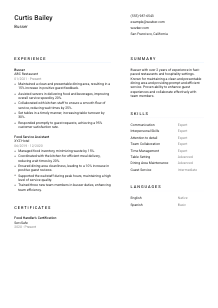
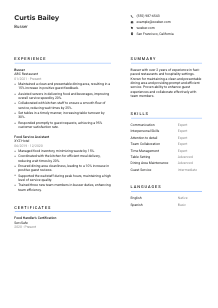
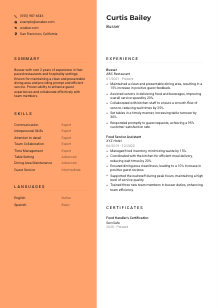
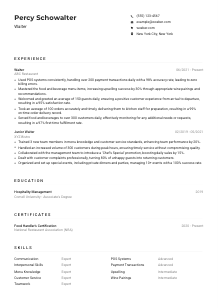
Clearing tables, but your resume is a little cluttered? Declutter it with this Busser resume example, cleaned up using Wozber free resume builder. Learn how to present your table-waiting skills to match job requirements, making your career journey as clean and organized as your section of the dining room!
Busser work is built on timing, awareness, and consistency. Hiring teams want to see that you can reset tables fast, keep service areas stocked, support servers without slowing the floor, and stay attentive to guest needs during rush periods. Your resume should make those service habits visible, not bury them under generic hospitality language.
When a busser resume is tailored well, the first scan quickly shows floor experience, cleanliness standards, guest-facing support, and practical requirements such as food handling credentials or local availability when requested. Wozber's free resume builder helps organize that information in an ATS-friendly resume format, so the resume reads clearly to both screening systems and restaurant managers looking for someone who can step into service smoothly.
Restaurant hiring moves quickly, so your contact section should answer the basic operational questions at a glance. For a busser role, that means clear identification, reliable contact information, and any location detail the posting specifically asks for.
Use your full name in a slightly larger font than the rest of the header. In restaurant hiring, managers often review several applications in one sitting, so a clean, readable name line helps your resume feel organized from the start.
Place "Busser" directly under your name if that is the role you are applying for. This keeps your positioning clear and avoids confusion with adjacent titles such as food runner, host, or food service assistant.
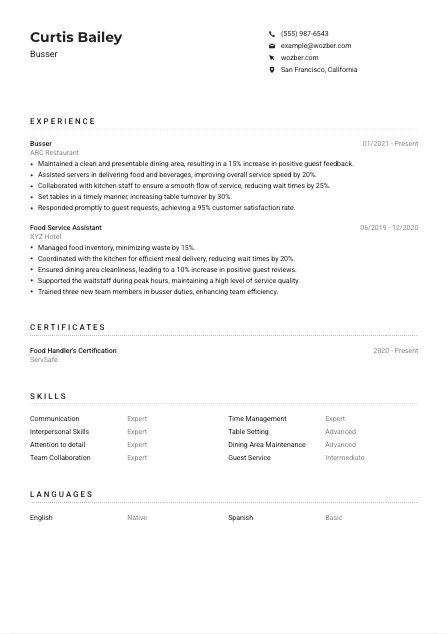
List a current phone number and a professional email address. If the posting requires local availability, include your city and state. In the example, "San Francisco, California" works because the employer specifically asks for candidates based there.
A LinkedIn profile can help if it matches your resume and shows steady hospitality work, certifications, or customer service experience. Skip links that do not strengthen your application. For most busser candidates, a clean header is more useful than extra links.
Do not add age, marital status, photo, or other personal information unrelated to the job. Save the space for details that matter on the floor, such as location, availability, and role alignment.
Your personal details should make it easy to contact you, place you in the right market when needed, and see that you are applying specifically for busser work.




For bussers, experience carries the most weight when it shows pace, service support, and floor discipline. A hiring manager is looking for proof that you can keep tables turning, maintain clean dining areas, coordinate with servers and kitchen staff, and stay composed during busy shifts.
Read the posting and mark the tasks that define day-to-day success. For this role, that includes clearing and resetting tables, stocking cutlery and glassware, helping deliver food and beverages, maintaining cleanliness, and responding quickly to guest requests. Use those phrases naturally in your experience bullets so your background matches the actual work.
List positions in reverse chronological order, starting with your latest hospitality role. Include the employer name, your job title, and dates. If your title was something adjacent, such as Food Service Assistant, make the bullets do the work of showing busser-relevant duties like dining room maintenance, runner support, or peak-shift coordination.
Do not stop at "cleared tables" or "helped servers." Show what your work improved. The example does this well with bullets such as increasing table turnover by 30% and improving service speed by 20%. Those outcomes tell a restaurant manager you understand pace, not just tasks.
Good busser metrics include table turnover, wait-time reduction, guest satisfaction, positive feedback, support during peak hours, or cleanliness-related review gains. Even one or two grounded numbers make your experience more credible than a list of routine duties.
Choose experience that supports the hiring decision for a busser position. Restaurant, hotel, banquet, catering, or food service work usually belongs here. If an older job does not connect to guest service, teamwork, cleanliness, or fast-paced physical work, trim it back or leave it out.
Your experience section should leave no doubt that you can keep the dining room moving, help the team during rushes, and contribute to a better guest experience.
Busser roles do not always depend on formal education, but the section still helps round out your background. Keep it brief and clean, especially if your strongest value comes from hands-on restaurant experience.
List your diploma, GED, or highest completed program even if the posting does not name an education requirement. It gives hiring teams a complete application and shows basic credential history.
Add the school name, credential, and graduation year if you want to include it. There is no need to overbuild this section for busser roles unless your training is directly tied to hospitality, culinary service, or customer-facing work.
If you completed coursework in hospitality, food service, customer service, or restaurant operations, mention it briefly. That kind of training can reinforce your understanding of service standards, cleanliness, and guest interaction.
A class in workplace safety, food sanitation, or customer service can strengthen this section, especially if your work history is still growing. Keep it concise and tied to restaurant performance.
Honors, student leadership, or activity involvement only belong here if they support reliability, teamwork, or service-minded work. For most busser resumes, short and relevant is the better choice.
This section should support your application without competing with the experience that shows how you work on the floor.
Certifications matter more in food service than they do in many entry-level roles because they connect directly to safety and compliance. If a posting calls for a Food Handler's certification, make sure it is visible and current.
Lead with any certificate the employer specifically requests, such as a current Food Handler's certification. In the example, listing the ServSafe credential directly supports the job requirement and removes an obvious hiring question.
Only include certifications that strengthen your case for restaurant work. Food safety, sanitation, guest service, and hospitality training belong here. Unrelated certificates can distract from the role you are targeting.
Include the issuing organization and the active date or renewal period when relevant. Restaurants need to know whether a required certification is valid now, not just that you once completed it.
If you have completed newer training in workplace safety, allergen awareness, or service standards, include it when it aligns with the job. It shows that you can step into current restaurant procedures with less ramp-up time.
A clear certificate section tells the employer you meet food-service requirements and are ready to work within restaurant safety standards.
A busser skills section should reflect the real rhythm of service. Focus on the abilities that keep the dining room clean, tables ready, guests supported, and communication flowing between servers, kitchen staff, and the floor team.
Start with the skills named or implied in the posting. For this role, that includes communication, interpersonal skills, attention to detail, teamwork, table setting, dining area maintenance, guest service, and time management during fast-paced shifts.
Do not rely only on broad traits like "hardworking" or "friendly." Pair service-minded strengths with practical abilities such as resetting tables quickly, stocking service stations, carrying trays safely, supporting food delivery, or maintaining clean work areas under pressure.
Group your strongest and most relevant skills first so the section reads fast. The sample resume works because it combines interpersonal strengths with busser-specific abilities instead of listing generic qualities alone.
The best skills section makes it easy to picture you handling service pace, team coordination, and dining room upkeep without supervision.
Language skills can matter in hospitality because service depends on quick, clear interaction. For a busser role, the key point is to confirm the level of English the employer needs, then add any additional languages that genuinely support guest service.
If the posting asks for strong English language skills, list English with an accurate proficiency level. This job does, so that detail should not be left implied.
Additional languages can be useful in restaurants that serve diverse guests or support multilingual teams. If you speak Spanish, Cantonese, or another commonly used language in your market, include it if you can actually use it in service interactions.
Choose straightforward levels such as Native, Fluent, Intermediate, or Basic. That gives managers a realistic sense of how comfortably you can communicate with guests and coworkers.
Multilingual ability can help with guest requests and smoother team communication, especially in busy dining rooms. Still, it should support your application rather than replace the need for core busser experience and reliability.
If your confidence improves through work experience or training, revise the proficiency level. Accurate language information matters in customer-facing roles where miscommunication can slow service.
This section works best when it shows you can communicate clearly with guests and coworkers in the environment you are applying to.
A busser summary should sound like someone who already understands restaurant pace. In a few lines, show your level of experience, the kind of service environment you know, and the ways you help the floor run more smoothly.
Start with a direct line such as "Busser with 2+ years of experience in fast-paced restaurants and hospitality settings." That immediately tells the reader whether you meet the baseline for the position.
Mention the abilities most relevant to busser work, such as maintaining clean dining areas, supporting servers, responding to guest needs, and working well with kitchen and front-of-house teams. The example summary succeeds because it stays close to those service realities.
Aim for 3 to 5 lines. Restaurant managers do not need a long profile here. They need a quick read on your experience, pace, and reliability in guest-facing service.
If one employer emphasizes table setting and stock maintenance while another focuses on runner support or guest interaction, reflect that difference in your summary. This is also where Wozber's AI resume builder can help surface the right phrasing from the posting and improve ATS alignment without making the language sound forced.
Your summary should quickly position you as someone who can walk into a busy dining room, support the team, and keep service standards steady from the first shift.
A busser resume works when it shows more than willingness to help. It should show pace, cleanliness, teamwork, guest awareness, and the ability to keep service moving during busy hours.
Use Wozber to tighten the structure, match your wording to the posting, and build an ATS-compliant resume with clear sections and role-specific language. When your experience, certification, and service skills are easy to spot, a restaurant manager can quickly see that you are ready for the floor.




