



Use Wozber and land your dream job
Create Resume
No registration required
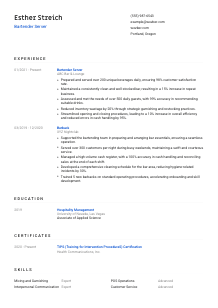
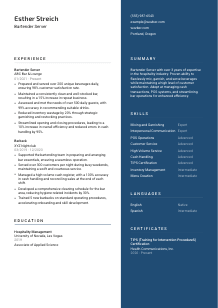
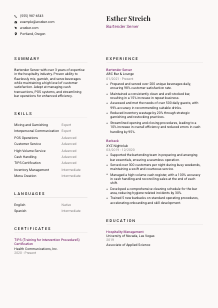
Juggling drinks with flair, but your resume falls flat? Shake up your story with this Bartender Server resume example, created with Wozber free resume builder. Learn how to blend your mixology skills and customer service charm to match job requirements, serving your career prospects with a refreshing twist!
Busy bars and dining rooms run on consistency. Hiring managers want to see that you can keep drinks accurate, guests looked after, cash handled cleanly, and the bar stocked and safe even when the pace spikes. Your resume should make that operating rhythm visible, not just say you have hospitality experience.
A tailored resume helps separate general front-of-house experience from true bar-ready performance. When your wording matches the posting's priorities, from beverage preparation and responsible alcohol service to POS use and closing duties, Wozber's free resume builder helps you shape that into an ATS-compliant resume that shows where you can step into service quickly and hold standards under pressure.
In hospitality hiring, the top of the resume needs to answer practical questions fast. Can you be reached easily, are you targeting the right role, and do you meet any location requirement without extra follow-up? Keep this section clean, direct, and specific to the Bartender Server opening.
Use your full name in a clear, readable font so it stands out immediately. In restaurant and bar hiring, managers often scan resumes quickly between service periods, so visibility matters more than styling.
Add "Bartender Server" directly under your name when that is the job you are applying for. This helps position you correctly from the first line and makes your experience easier to read through the lens of drink service, guest interaction, and floor support.
List a reliable phone number and a professional email address you check regularly. If a manager wants to set up a trial shift or interview quickly, any typo here can cost you the opportunity.
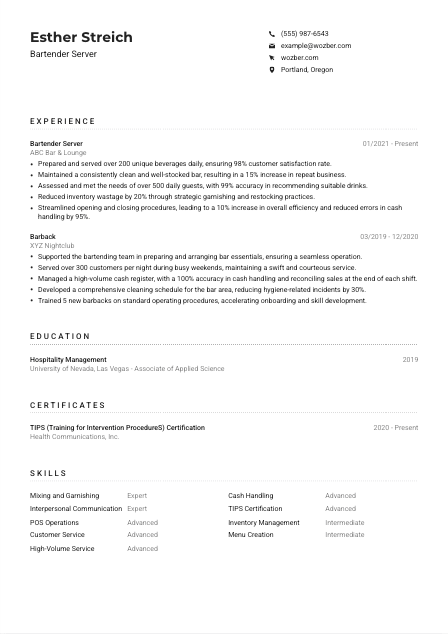
If the employer asks for local availability, state your city and state clearly. In this example, listing Portland, Oregon immediately addresses the posting's location requirement and removes doubt about scheduling, commute, or relocation.
Include LinkedIn or a personal site only if it supports your application with relevant hospitality background, event work, or beverage-related projects. If the link is sparse or unrelated, leave it off and keep the focus on service experience.
This section should make you easy to contact and easy to place. For a Bartender Server role, that means clear identity, the right job title, and any location detail that helps the employer move you to the next step.




This is the section hiring teams read most closely for bar and floor roles. They want to know whether you have handled volume, kept drink quality consistent, managed guest interactions well, and stayed accurate with inventory, cash, and closing routines. Your bullets should reflect real service conditions, not generic task lists.
Read the job description and mark the duties that define day-to-day success. For this role, that includes mixing and serving drinks to standard, maintaining a clean bar, reading guest needs, handling POS transactions, and managing opening and closing work. Use those priorities to decide which past responsibilities deserve space.
List positions in reverse chronological order with your title, employer, and dates. A clear timeline helps the reader quickly spot relevant bar, server, or support experience, especially when they are checking whether you meet the 2+ years requirement in high-volume service.
Each bullet should show what you handled and what happened because of it. Strong examples include beverage volume, guest satisfaction, speed, stock control, cash accuracy, or smoother shift transitions. In the sample resume, "Prepared and served over 200 unique beverages daily" works because it ties drink production to pace and consistency, not just effort.
Metrics give hiring managers a better read on your shift-level impact. Useful numbers in this field include covers served, beverages prepared, repeat business, waste reduction, register accuracy, training results, or efficiency gains during opening and closing. The sample's 20% drop in inventory wastage and 95% reduction in cash-handling errors are the kind of details that make operational strength credible.
Prioritize experience that shows bar service, guest-facing work, cash handling, sanitation, or high-volume coordination. If you include adjacent roles such as barback, frame them around transferable skills like restocking, supporting fast service, reconciling cash, or training new staff, as the example does.
Your experience section should leave no question about whether you can work a busy bar, serve guests well, and close out a shift accurately. Focus on service volume, bar standards, and operational control.
Education rarely leads a Bartender Server application, but it can still strengthen the profile. Relevant study in hospitality, food service, or customer-facing operations helps explain your training, especially if you are earlier in your career or moving up from support roles.
Start with the posting. Many Bartender Server jobs focus more on experience, certifications, and service skill than on a formal degree. Even so, a hospitality-related credential can support your application by showing structured exposure to guest service, operations, or venue management.
List the school, degree, field of study, and graduation year or date. Avoid overbuilding this section unless your coursework directly connects to restaurant, beverage, or hospitality operations.
If your program covered hospitality management, food and beverage operations, guest relations, or event service, include that relevance through the field name or a brief note. In the example, an Associate of Applied Science in Hospitality Management reinforces the candidate's grounding in service environments.
Include honors, leadership, or activities only when they support the role. Student event planning, hospitality clubs, or service-focused volunteer work can help, especially if they involved guest coordination, teamwork, or high-tempo environments.
Keep the layout and date style consistent with the rest of the document. In hospitality hiring, clean presentation signals professionalism and attention to operational detail, both of which matter on the floor and behind the bar.
Use education to reinforce your hospitality foundation, not to crowd out stronger service experience. When it is relevant and clearly presented, it adds credibility without distracting from the bar work that matters most.
For bartending and alcohol service roles, certifications carry real weight because they connect directly to compliance and guest safety. If the posting names a required credential, make it easy to find and easy to confirm.
Put TIPS certification or the relevant state-mandated responsible alcohol service credential near the top of this section. The posting here asks for TIPS or an equivalent, so that certificate should be impossible to miss.
Prioritize credentials tied to alcohol service, food safety, customer safety, or hospitality operations. A short, relevant list is stronger than padding the section with unrelated courses.
Alcohol service certifications often need to be current, so add the issue date and, if relevant, renewal period. In the sample resume, showing "2020 - Present" helps indicate the certification is active and maintained.
As your career grows, add certifications that sharpen your range, such as advanced beverage training, food handler permits, or venue-specific compliance credentials. These additions can be especially useful when moving into higher-volume or more regulated service settings.
Certification details should reassure the employer that you understand responsible service and can step into the role without compliance gaps. Put the required credential first and keep the section current.
A Bartender Server skills section should read like the toolkit of someone who can handle service, not like a generic list of personality traits. Focus on the abilities that affect drink quality, guest experience, pace, and shift accuracy.
Build this section from the posting's requirements and from the skills your experience actually supports. Here, the clearest priorities are mixing and garnishing, POS operation, cash handling, customer service, high-volume service, inventory support, and strong spoken communication.
Put the most role-critical skills first. For a Bartender Server, beverage preparation, guest interaction, responsible alcohol service, and transaction accuracy should appear before less central abilities. The sample resume does this well by leading with mixing, communication, POS operations, and customer service.
Present the skills so a hiring manager can scan them in seconds. You can group them by hard and soft skills or simply list them by importance. If you use ratings, make sure they reflect your actual working level and match what your experience bullets prove.
Choose skills that connect directly to shift performance. When your list reflects drink execution, guest handling, and operational reliability, the resume reads like someone ready for live service.
In bars, restaurants, and nightlife venues, language ability can affect speed of service, guest comfort, and upselling. This section matters most when the posting names a language requirement or when additional languages genuinely help you serve a broader guest mix.
If the job asks for strong English, list English clearly and use an accurate proficiency level. This posting does, so English should be prominent rather than implied.
Include additional languages that can improve guest interaction, explain menu items, or help with service recovery. Spanish, for example, can be a practical asset in many hospitality settings, as shown in the sample resume.
Use clear labels such as Native, Fluent, Advanced, or Intermediate. Honest proficiency levels help the employer understand whether you can take orders smoothly, hold conversation with guests, or assist in simpler interactions.
If language skills have helped you recommend drinks, handle guest concerns, or support a diverse crowd, make that connection briefly elsewhere in the resume. In hospitality, language value shows up in smoother service and better rapport.
If you work in a tourist-heavy area, multilingual venue, or fast-paced downtown setting, stronger language ability can widen the kind of guest service you can handle. Add progress only when it is real and useful for the jobs you are targeting.
List languages when they add practical value at the bar or on the floor. Clear proficiency levels help employers understand how you communicate with guests in live service situations.
Your summary should quickly establish what kind of Bartender Server you are. In a few lines, show your experience level, the service environment you know best, and the operational strengths that match the opening.
Before writing, pull out the requirements that define the job. For this opening, that means high-volume experience, drink preparation, customer rapport, POS and cash handling, and responsible alcohol service. Your summary should reflect that mix without turning into a checklist.
Start with your title and years of relevant hospitality experience. A line like "Bartender Server with 3+ years in high-volume hospitality settings" gives the reader immediate context and frames the rest of the resume.
Choose specialties that match the role and that your experience section backs up. Good examples include mixing and garnishing to recipe, reading guest preferences, maintaining bar flow during rush periods, and managing POS or cash reconciliation accurately. The sample summary does this by combining beverage service with customer satisfaction and operational efficiency.
Aim for 3 to 5 lines. Avoid broad claims about being hardworking or passionate unless you anchor them in bar realities such as service volume, cleanliness standards, or reliable cash handling. Short, concrete language works best here.
A focused summary helps the employer understand your bar style before they reach the first job entry. It should quickly show whether you can handle the pace, standards, and guest interaction the role demands.
A Bartender Server resume should show more than personality. It should show that you can mix accurately, move through busy service without losing control of the bar, handle guests well, and close a shift with clean numbers and clean standards.
As you update your resume for new openings, mirror the wording of each posting carefully and adjust the emphasis based on the venue's priorities, whether that is cocktail knowledge, speed, cash accuracy, or responsible alcohol service. Wozber's free resume builder and ATS resume scanner make it easier to align your content, strengthen ATS optimization, and organize it in an ATS-friendly resume format.
When the resume is tailored well, hiring teams can quickly see that you are ready to step onto the floor and contribute from day one.




