



Use Wozber and land your dream job
Create Resume
No registration required
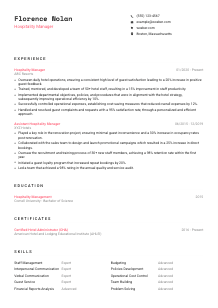
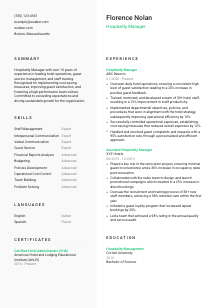
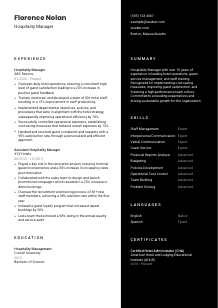
Surpassing standards, but your resume lacks hospitality finesse? Check into this Hospitality Manager resume example, created with Wozber free resume builder. Learn how to match your guest-centric acumen to job criteria, and make sure your career journey is paved with as many five-star reviews as your establishments!
Hospitality Managers are trusted with the part of the business guests remember first and talk about later. A resume for this role needs to show steady operational control, strong team leadership, and the ability to protect guest experience while managing budgets, service standards, and daily hotel performance.
When those strengths are tailored to the posting, hiring teams can quickly separate broad hospitality experience from true management-level ownership. Wozber's free resume builder helps you shape an ATS-compliant resume around the exact language of the role, so priorities like hotel operations, staff development, and expense control surface clearly in both ATS screening and human review.
This section is brief, but it still does real work in hospitality hiring. Clear contact details, the right title, and location alignment help the employer move straight to your operations and leadership background without pausing over avoidable questions.
Your name should be the most visible text on the page, set in a clean, readable style. Hospitality leadership calls for polish and professionalism, so keep the presentation simple and confident rather than decorative.
Place the role title directly under your name and match the wording in the posting when it fits your background. For this opportunity, using "Hospitality Manager" immediately connects your resume to the opening and keeps your positioning consistent from the first line.
List a reliable phone number and a professional email address, ideally based on your name. In a management role built on responsiveness, guest communication, and team coordination, outdated or casual contact details create the wrong impression fast.
If a posting names a city or relocation requirement, make that easy to see. Here, Boston, Massachusetts matters, so a candidate already based there, like the example resume, should include it plainly. If you are relocating, state that clearly rather than leaving the employer to guess.
Include LinkedIn or a personal professional page if it supports your application with consistent career history, certifications, or hospitality achievements. For management candidates, an online profile can reinforce progression from assistant management to full operational leadership.
These details should remove friction, not create it. Once your title, contact information, and location are easy to confirm, the employer can focus on your guest service results, team leadership, and hotel operations experience.




This is the section most hiring managers will study first. Hospitality employers want to see how you ran operations, led staff, handled service issues, improved performance, and controlled costs in real hotel or lodging environments.
Before editing your experience bullets, mark the responsibilities that define the job. In this case, the posting centers on daily hotel operations, team development, departmental procedures, budget control, and guest complaint resolution. Those themes should guide which achievements you keep, expand, or cut.
Start with your most recent position and include employer, title, and dates in a format that is easy to scan. For hospitality management, career progression matters. Moving from an assistant role into full management, as shown in the example, quickly tells the reader you have grown from support leadership into direct operational accountability.
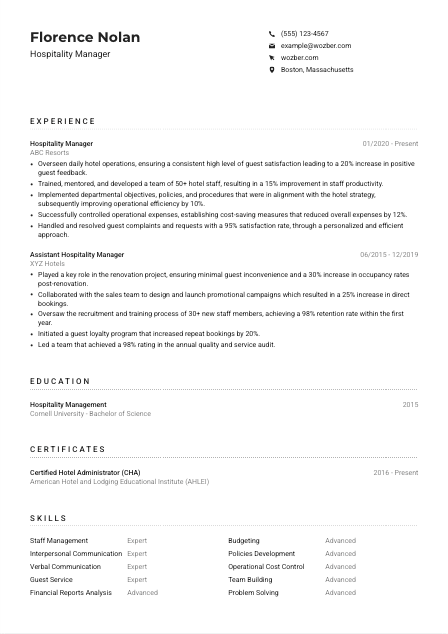
Do not stop at describing what you were responsible for. Show what changed because of your work. "Oversaw daily hotel operations" becomes stronger when tied to a 20% increase in positive guest feedback or a 95% guest satisfaction rate on complaint resolution. Those are the outcomes hotel leaders track.
Guest feedback scores, occupancy gains, direct bookings, retention, audit ratings, staffing scope, and expense reduction all carry weight here. The sample resume works because it pairs leadership actions with numbers such as leading 50+ staff members, reducing expenses by 12%, and improving operational efficiency by 10%.
Trim accomplishments that do not support your case for running a property, department, or service function. Prioritize examples that show supervision, budget handling, policy implementation, service recovery, training, and collaboration with sales or operations teams. Relevance is especially important when you already have more than 5 years of experience and need your strongest management work to lead.
Your experience section should make it easy to picture you running the floor, coaching the team, reading the numbers, and resolving guest issues before they escalate. That level of operational ownership is what moves a Hospitality Manager resume forward.
Education will not outweigh weak management experience, but it still matters in hospitality hiring, especially when the posting calls for a bachelor's degree in hospitality or a related field. Present it clearly so the employer can confirm the requirement at a glance.
If you hold a bachelor's degree in Hospitality Management or a related discipline, make that easy to find. The example resume does this well with a Bachelor of Science in Hospitality Management, which directly meets the stated educational requirement.
List the degree, field of study, school name, and graduation year. This section should be quick to scan. A hiring manager reviewing multiple hotel candidates does not need extra wording here, just accurate academic information presented cleanly.
Write out the major instead of leaving it implied. Hospitality Management, Hotel Administration, Business Administration, or Tourism Management each frame your background differently, and that context helps the employer understand how formal training supports your operational work.
For experienced Hospitality Managers, detailed coursework is usually optional. Include it when it points to useful preparation in hotel finance, operations management, service quality, or revenue-related topics. Otherwise, let your management results carry more weight.
If your training extends beyond your degree, make sure the most relevant credentials are easy to find elsewhere on the resume. For this role, a CHA certification is preferred, so education and certifications should work together to show both formal preparation and continued industry development.
This section does not need decoration. It needs to confirm that you have the academic base expected for hotel leadership and let the reader move quickly back to the operational results that define your candidacy.
Certifications matter most when they strengthen your authority in hotel operations, property leadership, and service standards. For hospitality management roles, they can also show that your development did not stop once you moved into supervision.
When a certification is explicitly preferred, include it prominently. Here, the Certified Hotel Administrator, or CHA, is worth highlighting because it aligns directly with the employer's stated preference and reinforces management-level credibility.
A shorter, focused list is usually stronger than a long catalog of unrelated training. Give priority to credentials tied to hotel administration, guest service leadership, compliance, revenue operations, or supervisory development.
If the certification is active, renewed, or recently completed, list the timing clearly. The example resume shows the CHA with a date range, which helps the employer understand that the credential is part of the candidate's ongoing professional profile rather than a one-time course from years ago.
Hospitality managers are expected to adapt to changing guest expectations, staffing pressures, cost targets, and operational standards. Recent certifications or continuing education can support that story, especially if your experience bullets also show policy updates, training programs, or service improvements.
Well-chosen certifications should strengthen your case for managing people, service standards, and hotel operations at a higher level. Keep the section focused, current, and directly connected to the work.
A Hospitality Manager skill list should read like the operating toolkit behind your results. The best selections connect to how you manage staff, control costs, respond to guests, and keep the property running smoothly across departments.
Start with the language the employer uses. This posting points clearly to staff management, budgeting, financial report analysis, interpersonal communication, and guest issue handling. Those are the terms and capability areas your skills section should reflect when they match your background.
Choose skills you can support elsewhere on the resume with achievements or scope. If you list operational cost control, your experience should show expense reduction or budgeting outcomes. If you list team building, it should connect to hiring, training, retention, or productivity improvements.
Avoid filling this section with generic traits. Focus instead on hospitality management skills such as guest service recovery, departmental policy development, budget oversight, staff coaching, quality audits, and cross-functional coordination. The example resume handles this well by pairing people leadership and guest-facing strengths with financial and operational skills.
Every skill listed should be believable because the rest of the resume backs it up. That connection between skill, scope, and result is what makes a Hospitality Manager profile convincing.
Language skills can be highly relevant in hospitality because communication sits at the center of guest service, team supervision, and issue resolution. Present them in a way that reflects the actual communication demands of the property and the posting.
Check the posting for any stated language expectations and list those first. Here, English fluency is required, so your resume should show that clearly and early in the section.
Use plain labels such as Native, Fluent, Intermediate, or Basic. In hospitality management, language ability affects guest communication, written responses, staff instructions, and escalation handling, so clarity matters more than embellishment.
Additional languages can be valuable, especially in properties serving international guests or diverse local markets. Spanish, for example, may strengthen front-of-house communication, staff coordination, or service recovery in some hotel environments, even when it is not required.
Only claim a level you can handle in real guest and team interactions. If you would struggle with complaint resolution, written communication, or performance conversations in that language, choose a lower proficiency label.
Some Hospitality Manager roles involve multilingual staff, international travelers, event clients, or brand standards that require polished written communication. In those settings, language skills can add practical value beyond guest greetings and casual conversation.
This section works best when it reflects real communication strengths that support guest satisfaction and team leadership. Keep the ordering logical and the proficiency levels honest.
Your summary should quickly frame the scale of your hospitality background and the kind of results you deliver. In a few lines, it should connect operational leadership, guest experience, team development, and financial control without drifting into generic claims.
Start by identifying the management themes at the center of the posting. Here, that means hotel operations, guest satisfaction, team development, budgeting, and communication. Those ideas should shape the summary more than broad statements about passion or dedication.
State your profession and experience clearly. A line such as "Hospitality Manager with 10+ years in hotel operations" gives immediate context and aligns well with a posting that asks for at least 5 years in hospitality management.
Choose achievements that show how you run a hotel environment. The sample summary works because it points to cost-saving measures, guest satisfaction improvements, and team performance, all of which match the hiring priorities for this opening.
Aim for a short paragraph, not a career biography. The best summaries read like a quick operating profile: who you are, what environments you have managed, and what results tend to follow your leadership.
A well-written summary gives the reader an immediate sense of your management scope and operating style. By the time they reach your experience section, they should already expect to see guest satisfaction gains, stronger teams, and disciplined hotel operations.
A Hospitality Manager resume works when it shows more than service mindset. It should clearly present hotel operations leadership, staff development, budgeting discipline, and the ability to resolve guest issues without losing control of standards or costs.
Use Wozber's AI resume builder to tailor each section to the job description, strengthen ATS optimization, and present your background in an ATS-friendly resume format that keeps your most relevant management experience easy to read. The finished resume should make one thing clear fast: you can run a property, lead a team, and protect the guest experience.




