



Use Wozber and land your dream job
Create Resume
No registration required
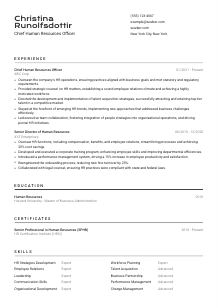
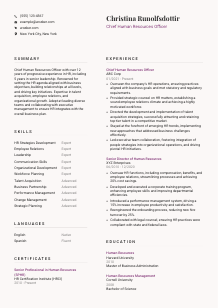
Shaping workplaces, but your resume lacks personnel power? Check out this Chief Human Resources Officer resume example, created with Wozber free resume builder. Learn how to align your HR wins with job standards, making your career ascent as smooth as a successful onboarding!
A Chief Human Resources Officer resume has to show executive judgment, not just long tenure in HR. At this level, hiring teams want to see how you shaped people strategy around business priorities, handled employee relations with maturity, and kept HR operations compliant while the organization changed, grew, or faced pressure. Your resume should make that strategic range visible in plain language.
When CHRO resumes are tailored well, the difference shows up quickly in screening. The reader can tell whether you have led enterprise-level HR work or simply managed individual functions. Using Wozber's free resume builder and an ATS-compliant resume structure helps surface the right language from the job description, so your executive collaboration, talent strategy, and operational oversight are easy to identify from the first scan.
For a CHRO, the header should read like an executive introduction. Keep it clean, credible, and aligned with the role so there is no confusion about your level, location, or how to contact you.
Use your full name as the most prominent text in the header. A CHRO resume does not need design tricks here. Clear presentation signals executive polish and makes the document easier to review in both human and ATS workflows.
Place "Chief Human Resources Officer" directly beneath your name if that is the role you are targeting. For senior HR leaders moving up from VP or Senior Director level, this title choice helps position the resume around enterprise HR leadership rather than narrower functional ownership.
Include a reliable phone number and a professional email address. If you add a website or LinkedIn profile, make sure it reflects the same leadership scope shown in your resume, including board-facing work, workforce strategy, or transformation initiatives if those are central to your background.
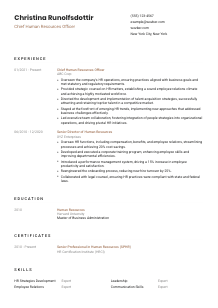
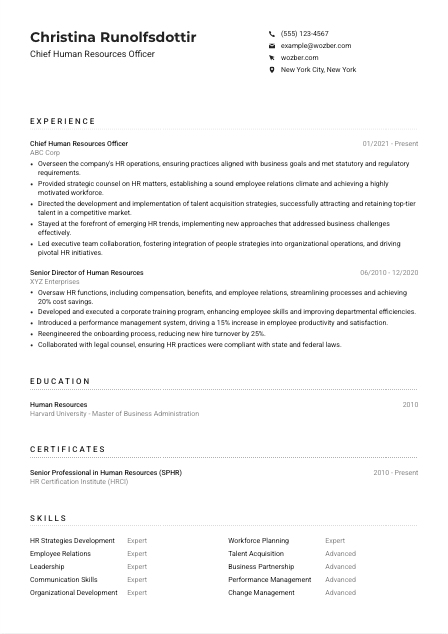
If the employer specifies a location, include it clearly in your header. In the example, listing "New York City, New York" directly answers a stated requirement and removes a common point of friction early in the review process.
A polished LinkedIn profile can reinforce your executive brand, especially for CHRO roles where reputation, leadership presence, and cross-functional influence matter. Make sure titles, dates, and major achievements match your resume exactly.
Your personal details should remove doubt, not create it. A clean header confirms that you are applying at the right level, reachable, and positioned for the specifics of the opening.




The experience section carries most of the weight on a CHRO resume. Employers are looking for evidence that you have led HR as a business function, influenced executive decisions, and delivered outcomes across talent, culture, compliance, and organizational performance.
Start by reading the job description for the actual leadership demands behind the wording. For this opening, the central themes are HR strategy tied to business objectives, executive partnership, talent acquisition, employee relations, and regulatory alignment. Those priorities should shape which achievements you feature and how you phrase them.
List positions in reverse chronological order and emphasize titles that show progression into senior HR leadership. CHRO and Senior Director of Human Resources roles immediately establish scale, authority, and readiness for strategic oversight across multiple HR functions.
Each bullet should show what you led, what changed, and why it mattered to the organization. Strong CHRO bullets often cover policy direction, workforce planning, culture initiatives, executive advising, succession planning, or organization design. In the example, statements about aligning HR operations with business goals and integrating people strategies into company operations work well because they describe executive-level contribution, not day-to-day task lists.
Quantify impact where the numbers reflect HR performance. Useful metrics include retention, turnover reduction, time-to-fill, engagement improvement, productivity gains, compliance outcomes, cost savings, training adoption, or onboarding results. The sample's 20% cost savings, 15% productivity increase, and 25% reduction in new-hire turnover give hiring teams a much clearer view of business impact.
Choose examples that support a CHRO brief, even if your background includes many years of broader HR work. Prioritize initiatives involving executive counsel, enterprise policy, multi-function oversight, and strategic people planning. Leave out lower-level bullets that focus only on routine administration unless they support a larger outcome such as process redesign, risk reduction, or organizational change.
By the end of this section, the reader should be able to see that you have already operated as a senior HR decision-maker. Show business alignment, measurable people outcomes, and the leadership range expected from a CHRO.
Education is rarely the deciding factor for a CHRO, but it still needs to line up cleanly with the role. At this level, the section should confirm that your academic background supports your strategic and operational HR leadership.
Check the posting for required and preferred credentials, then make sure your education section answers them directly. Here, a bachelor's degree in Human Resources, Business Administration, or a related field is required, with a master's degree preferred. If you meet both, make that easy to spot.
List each degree with the institution, degree name, field of study, and graduation year. Executive resumes benefit from clarity here. A compact format keeps attention on the qualification itself instead of formatting choices.
If your degree title or specialization ties directly to HR leadership, show it in full. The example does this well with a Bachelor of Science in Human Resources Management and an MBA focused on Human Resources, which reinforces both technical grounding and business perspective.
Most CHRO candidates do not need coursework unless it adds something distinctive, such as labor relations, organizational psychology, or executive leadership training relevant to the target role. Honors or thesis work can also help if they connect naturally to people strategy or business leadership.
If you have completed leadership programs, governance education, DEI strategy coursework, or advanced HR development outside formal degrees, include them if they reinforce your current level. Senior HR hiring often values continued learning when it speaks to change leadership, compliance complexity, or enterprise workforce planning.
Your education section should quickly confirm that you meet the academic bar and bring a business-minded HR foundation. Keep it concise, relevant, and easy to review.
Certifications can add weight on a CHRO resume when they reflect current expertise and recognized standing in the HR profession. They are especially useful when they support your depth in strategy, compliance, or enterprise people leadership.
Some CHRO postings name certifications directly, while others leave them implied through expectations around strategic HR leadership and regulatory knowledge. Even when not required, widely recognized credentials can strengthen your positioning if they are relevant and current.
Lead with certifications that hiring teams will immediately associate with advanced HR capability. An SPHR, SHRM-SCP, or equivalent senior credential is usually more valuable here than short general business courses. The example's SPHR fits well because it supports executive-level HR credibility.
Show the award or active date when it helps demonstrate that the credential is current. For regulated and policy-heavy HR leadership work, recency matters because employment law, total rewards practices, and workforce expectations continue to shift.
For CHRO roles, certifications are most useful when they suggest continued engagement with the profession. Renewed credentials, labor law updates, coaching certifications, or executive development programs can all reinforce that you stay current on emerging HR practice and organizational challenges.
A focused certification section can strengthen your profile, especially when it reinforces strategic HR leadership and current professional knowledge. Keep the emphasis on credentials that matter at executive level.
The skills section should mirror how senior HR work is actually evaluated. That means balancing strategic leadership capabilities with core HR domains such as talent, employee relations, organizational development, and compliance.
Read past the keyword list and identify the capabilities the role depends on. In this case, that includes HR strategy development, executive communication, talent acquisition leadership, employee relations, and broad command of compensation, benefits, and development. Build your skills list from those operating realities.
A CHRO resume should show both domain expertise and executive capability. Include HR-specific strengths such as workforce planning, performance management, organizational development, and compliance, alongside leadership skills such as change management, strategic planning, and business partnership. The sample's mix generally gets this balance right.
Put the most important skills first, especially those named or strongly implied in the posting. This improves ATS optimization and helps reviewers quickly connect your background to the opening. Keep the list focused enough that every item reinforces your CHRO profile rather than reading like a broad HR inventory.
Your skills section should read like a summary of executive HR capability. If each item supports the leadership, functional, and business demands of the role, the section is doing its job.
Language ability matters in HR when it affects communication, workforce reach, and executive presence. For a CHRO, this section should stay accurate and relevant, especially when the posting explicitly names a required language.
Review the job posting for language expectations before adding anything else. Here, command of English is essential, so that should appear first and be stated clearly.
Use honest levels such as Native, Fluent, Advanced, or Professional Working Proficiency. For an executive HR position, English fluency often underpins board communication, policy messaging, employee relations work, and written guidance across the organization.
Additional languages can be valuable when they help you communicate across a diverse employee base, support international operations, or strengthen trust in employee-facing settings. In the example, Spanish adds breadth without distracting from the primary English requirement.
Do not overstate your level. Language claims are easy to test in interviews, and credibility matters even more in HR leadership roles where communication and trust are central to the job.
If you are targeting a multinational company, a workforce with significant language diversity, or a role with cross-border HR responsibilities, your languages can carry more weight. When they are not central to the role, keep the section brief and factual.
List the languages that matter, describe your proficiency honestly, and let the section support the communication demands of the role rather than overstate them.
The summary should establish your level quickly and point the reader toward the most relevant parts of your background. For a CHRO, that usually means strategic HR leadership, executive partnership, and a track record across core people functions.
Start by identifying the two or three themes the employer is hiring for, then center your summary on those themes. For this opening, business-aligned HR strategy, senior leadership experience, and broad oversight across talent and employee relations are the most important threads.
State your title or leadership identity and your years of experience in a direct first line. Phrasing such as "Chief Human Resources Officer with 12+ years of progressive HR experience" immediately sets the level and helps both ATS systems and human reviewers understand your seniority.
Mention the strengths that matter most for the target role, such as executive collaboration, talent acquisition strategy, organizational development, or employee relations leadership. The sample summary works because it connects senior experience with business alignment and cross-functional influence instead of listing generic personality traits.
Aim for a short paragraph that can be read in seconds. Four to five lines is usually enough to establish your CHRO profile, highlight your most relevant strengths, and encourage the reader to continue into the experience section where the detail lives.
A well-written summary tells the reader, right away, what kind of HR leader you are. Make it specific enough to the role that your strategic value is clear before they reach the first job entry.
A Chief Human Resources Officer resume should show that you can connect people strategy to business performance, guide executives on difficult workforce decisions, and lead HR operations with credibility. When each section supports that story, the document reads like a senior leadership profile rather than a collection of HR duties.
Wozber's free resume builder can help you turn that experience into an ATS-friendly resume template with stronger ATS optimization, clearer role alignment, and faster revision using the ATS resume scanner. The final result should make one thing easy to judge: you are prepared to lead the full HR agenda at executive level.