



Use Wozber and land your dream job
Create Resume
No registration required
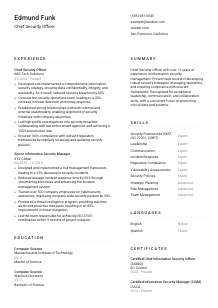
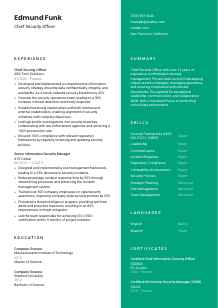
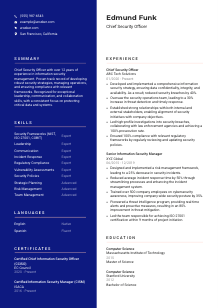
Shielding organizations, but feeling your resume is a bit vulnerable? Check out this Chief Security Officer resume example, built with the Wozber free resume builder. Learn how to showcase your strategic defenses and threat-aware leadership, ensuring your career trajectory matches the level of protection you provide!
A Chief Security Officer resume has to show executive judgment under pressure. Hiring teams want to see who can set security direction for the business, steer incident response when risk turns real, and keep governance, operations, and compliance moving together without losing sight of business priorities.
When that story is tailored well, your leadership path reads clearly in both human review and ATS screening. Wozber's free resume builder helps you align your wording with the job description, keep an ATS-compliant resume structure, and make it easy to recognize the mix of strategy, security operations, and cross-functional influence expected from a senior security leader.
For a Chief Security Officer, the top of the resume should feel controlled and intentional. This section is brief, but it still affects how quickly a reviewer can place you at the right leadership level and confirm practical requirements.
Put your full name at the top in a clean, readable format, then give it space. At senior security levels, presentation matters because it sets the tone for the rest of the document. Wozber's ATS-friendly resume template helps keep this section structured so your header stays easy to parse and easy to scan.
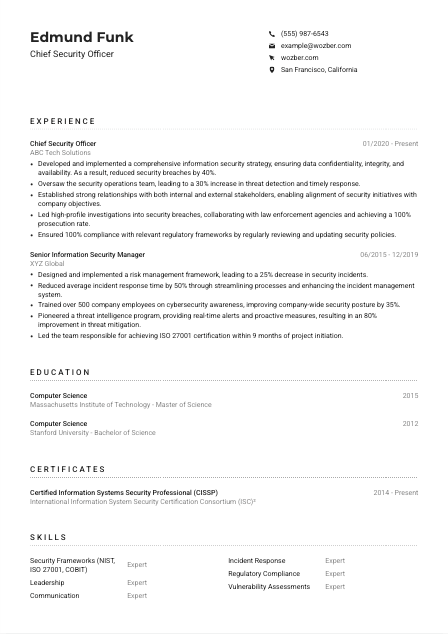
Place "Chief Security Officer" directly under your name if that is the role you are pursuing and your background supports it. Matching the target title to the posting helps frame your experience immediately and improves ATS alignment. In the sample resume, that direct title match removes any doubt about seniority or role direction.
List a reliable phone number and a professional email address, ideally based on your name. Senior security hiring often moves through confidential conversations and board-level interviews, so avoid casual handles or clutter. Double-check every detail. A missed digit or typo is an avoidable credibility issue.
If the employer specifies a location requirement, include your city and state exactly. Here, San Francisco, California is part of the stated criteria, so showing it in the header answers a practical screening question right away. Use location to meet the posting, not as filler when it is irrelevant.
A LinkedIn profile or personal site can support your resume if it reflects the same leadership story, certifications, and major security initiatives. For a CSO, this is especially useful when you have board presentations, speaking appearances, governance work, or large-scale transformation programs worth reinforcing. Keep it current and consistent with the resume.
Your personal details should establish executive polish, confirm the basics quickly, and remove friction from the first review. For a Chief Security Officer application, that means accurate contact information, a title aligned to the role, and location listed when the employer requires it.




This section carries the most weight for a Chief Security Officer. Employers are looking past generic security management and into the scale of your leadership, the maturity of your security program, your response to incidents, and your ability to influence business decisions across the organization.
Start by marking the core responsibilities and requirements in the posting. For this role, that includes building an enterprise security strategy, managing security operations, leading incident response, maintaining policies and standards, and working across stakeholders. Those phrases point to what your experience bullets should emphasize, and they are also the terms ATS systems are likely to score.
List roles in reverse chronological order and make the progression visible. A CSO resume should show how you moved from managing programs or teams into owning enterprise risk, governance, and security direction. In the sample, the path from Senior Information Security Manager to Chief Security Officer works because it reflects growing scope and authority rather than a flat list of similar duties.
Each role should show what you led, what changed, and why it mattered. Prioritize work such as security strategy development, SOC oversight, threat and vulnerability management, incident investigations, regulatory compliance, and stakeholder alignment. Good bullets sound like executive ownership, not task lists. "Developed and implemented a comprehensive information security strategy" lands better than "Responsible for security planning."
Quantify results where you can with realistic security indicators: breach reduction, detection improvement, response time, audit results, certification milestones, training reach, or compliance rates. The sample resume uses metrics well, including a 40% reduction in security breaches and a 50% faster incident response time. Those numbers work because they tie directly to risk reduction and operational performance.
At this level, every bullet should reinforce executive readiness. Remove technical details that belong to a security engineer resume unless they show strategic scope, program leadership, or a major business outcome. Keep the focus on governance, risk, resilience, operations leadership, and cross-functional influence. That makes your experience read like a security executive, not a hands-on specialist applying one level too high.
Your experience section should make it clear that you have already led security at the level the role demands. When the bullets show program ownership, measurable risk reduction, incident leadership, and business alignment, the resume reads like a credible Chief Security Officer application from the first role downward.
Education matters here because the posting sets a baseline and hints at preferred academic depth. For a Chief Security Officer, the degree line will not outweigh leadership experience, but it still needs to confirm the right technical foundation for enterprise security oversight.
Check the posting for the exact education requirement and mirror it accurately when you qualify. This role asks for a bachelor's degree in Computer Science, Information Systems, or a related field, so your degree should be listed in plain terms. Do not make reviewers infer relevance from abbreviations or partial wording.
List institution, degree, field of study, and graduation year or date range in a consistent format. Senior candidates do not need to over-design this section. A straightforward presentation keeps the focus on qualification rather than decoration and helps ATS systems parse the information correctly.
If you hold a master's degree, include it prominently, especially when the posting says it is preferred. In the example, the Master of Science in Computer Science supports the candidate's senior profile and complements the required bachelor's degree. That said, a master's degree is an advantage, not a substitute for security leadership results.
Most Chief Security Officer resumes do not need coursework, but there are exceptions. Include research, thesis work, or major academic projects only when they connect directly to security architecture, risk, governance, digital forensics, or another area central to the role. Keep it selective and senior-level.
Honors, published research, or notable technical affiliations can stay if they reinforce your authority in information security or computing. For a seasoned executive, this material should be brief and only included when it still says something useful about your background. The bar is relevance, not completeness.
Your education section should confirm that you meet the stated academic requirement and, where applicable, show the deeper technical grounding that supports executive security leadership. Keep it clear, accurate, and proportional to the rest of the resume.
In security leadership hiring, certifications still carry real weight because they signal recognized knowledge in governance, risk, and program leadership. For a Chief Security Officer, they work best when they complement a mature track record rather than trying to compensate for missing scope.
Start with the credentials the employer already values. Here, CISSP, CISM, and CCISO are all called out as highly desirable, so they should be easy to find on your resume if you hold them. Matching relevant certifications to the posting is one of the simplest ways to strengthen both human review and ATS scoring.
Order certifications by role relevance, not by the date you earned them. For a CSO resume, governance and leadership-oriented credentials usually belong ahead of more specialized technical certifications unless the role has a very specific technical emphasis. The sample gets this right by foregrounding CISSP, CISM, and CCISO.
Name the certification clearly, add the issuing organization, and show the active or renewal timeframe when appropriate. This matters in security because employers often want to confirm that your credentials are current and maintained. It also reflects ongoing engagement with the field's standards and practices.
As your role expands from operations leadership into enterprise governance and executive strategy, your certifications should reflect that shift. Continue adding credentials that strengthen your standing in risk management, security leadership, compliance, and business alignment. Continuous development matters in a field where frameworks, regulations, and threat models keep changing.
Your certifications should reinforce the picture already created by your experience: a leader with recognized command of security frameworks, governance, and enterprise risk. When the credentials align tightly with the posting, they add immediate credibility.
A Chief Security Officer skills section should read like an executive capability snapshot, not a long inventory of tools. Focus on the areas that shape enterprise security outcomes: frameworks, governance, operations oversight, incident leadership, risk management, and the communication needed to move security decisions across the business.
Use the job description to identify the exact capabilities the employer is screening for. In this case, that includes NIST, ISO 27001, COBIT, leadership, communication, collaboration, incident response, vulnerability assessment, and policy oversight. Those are the terms to reflect when they honestly match your background.
A CSO needs more than technical credibility. Your skills should show command of frameworks and security operations alongside strategic planning, stakeholder management, regulatory compliance, and team leadership. The example resume balances both sides well by pairing framework knowledge with leadership, communication, and risk management.
Do not overload this section with every platform, product, or niche competency you have used across a long career. Choose the skills that support the actual scope of the role and that you can back up elsewhere in the resume. A shorter list of high-value skills reads better than an unfocused catalog, especially in senior security hiring.
This section should quickly confirm that you cover the strategic, operational, and governance dimensions of the role. When the skill choices mirror the posting and match the evidence in your experience section, your resume feels coherent and well-targeted.
For a Chief Security Officer, language proficiency matters because the role depends on clear communication during incidents, policy discussions, board reporting, and cross-functional coordination. Treat this section as operationally relevant, not decorative.
Read the posting closely and list any required language first. Here, English proficiency is specifically named, so it belongs near the top of this section. When a language appears in the job description, include it in clear terms instead of assuming it will be inferred.
Use straightforward labels such as Native, Fluent, Intermediate, or Basic. For senior security roles, vague claims can create problems later because communication often involves executive briefings, incident escalation, vendor negotiations, and regulatory discussions. Clarity matters.
Extra languages can be useful when the company operates across regions, works with global vendors, or handles cross-border investigations. In the sample, Spanish adds breadth without distracting from the required English proficiency. Include additional languages when they help explain your operating range, not just to fill space.
Only claim the level you can sustain in meetings, written communication, and high-pressure situations. A Chief Security Officer may need to explain incidents, defend policy decisions, or coordinate with external partners, so overstating fluency can backfire quickly. Accuracy is part of credibility.
If the employer's security program spans multiple countries, multilingual ability may support stakeholder management and regional coordination. If the role is primarily domestic, keep this section brief and focused. Let the scope of the organization determine how much emphasis language skills deserve.
Your languages section should confirm you can communicate at the level the role requires and, where relevant, support international coordination. For this posting, clear English proficiency is the main point to establish.
The summary is where you set your level fast. For a Chief Security Officer, it should establish years of leadership, the kind of security programs you have led, and the business outcomes you influence, all in a few lines that sound specific and earned.
Before writing, pull out the priorities that define the opening. Here, the resume needs to speak to enterprise security strategy, senior leadership experience, security operations oversight, incident response, compliance, and collaboration across the organization. Those should shape the summary's language and emphasis.
Start with a direct statement of who you are professionally. A line such as "Chief Security Officer with 12+ years in information security management" gives immediate context and helps anchor seniority. It also works well for ATS alignment when the title matches the target role.
Choose achievements that show enterprise impact, not narrow task ownership. Examples from the sample include reducing security breaches, improving threat detection, and maintaining full compliance with regulatory frameworks. Results like these show how you lead security as a business function, not just as a technical discipline.
Aim for 3 to 5 lines with no filler. Avoid generic claims about being dynamic, passionate, or results-driven unless the resume immediately proves them. The best summaries for this level sound measured and specific, giving the reader a reliable preview of strategy, governance, and operational command.
Your summary should make the reader expect enterprise-scale security leadership before they reach the experience section. When it names your seniority, reflects the posting's priorities, and points to measurable security outcomes, it does that job well.
A Chief Security Officer resume should leave no doubt about your ability to lead security strategy, guide incident response, manage risk, and align security programs with business objectives. That clarity comes from tailoring each section to the actual role, not from packing the page with every accomplishment you have ever had.
Use Wozber's AI resume builder and ATS resume scanner to tighten language, surface missing requirements, and keep everything in an ATS-friendly resume format. The result should make one thing easy to judge: you are ready to lead security at the enterprise level.




