



Use Wozber and land your dream job
Create Resume
No registration required
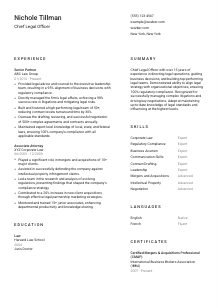
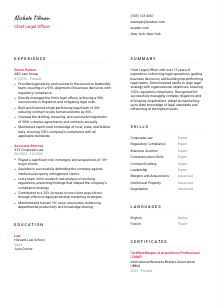
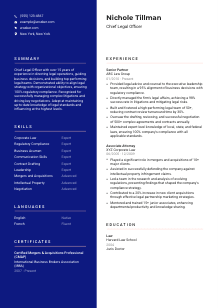
Wielding the gavel, but your resume feels overruled? Check out this Chief Legal Officer resume example, created with Wozber free resume builder. Learn how to tie your strategic counsel to company bylaws, so your future career verdicts always come out in your favor!
Chief Legal Officer hiring turns quickly on judgment, range, and executive presence. At this level, employers are not looking for a senior lawyer who can simply review contracts or manage outside counsel. They want someone who can steer legal risk across the business, advise the board on consequential decisions, and translate complex regulatory or transaction issues into clear business direction. Your resume needs to show that level of authority in concrete terms.
A tailored resume changes how that authority comes across in early screening. When the language reflects board counsel, legal team leadership, M&A exposure, compliance oversight, and contract negotiation in the same terms used by the employer, both people and systems can place you correctly as a top legal executive rather than a broad corporate attorney. Wozber's free resume builder helps shape that alignment in an ATS-compliant resume so your experience reads clearly at executive level from the first pass.
For a Chief Legal Officer, the header should establish credibility fast and remove basic friction. This section is simple, but it still carries practical value. It confirms who you are, where you are based, and how a board recruiter or executive search team can reach you without hunting through the page.
Use your full name as the most prominent line in the header, with clean formatting and no extra credentials stacked around it. At board and C-suite level, clarity matters more than design flourishes. Your name should read like an executive identifier, not a branding exercise.
Place "Chief Legal Officer" directly beneath your name if that is the role you are pursuing. This immediately frames the rest of the resume around enterprise legal leadership. If your current title is different, such as General Counsel or Senior Partner, keep the target title here and make the progression clear in your experience section.
Include a reliable phone number, a professional email address, and a relevant website or LinkedIn profile if it supports your candidacy. For legal executives, that profile should reinforce board advisory work, leadership scope, major transactions, litigation oversight, or regulatory depth. Check every detail carefully. A typo in contact information undercuts the precision expected from senior legal leadership.
When a role names a location requirement, include your city and state clearly in the header. Here, New York, New York is specifically requested, so showing that upfront removes an obvious screening question. That does not mean every Chief Legal Officer resume needs location emphasis, only that you should mirror it when the employer makes it material.
A website or profile link should lead to something useful, such as a polished LinkedIn page, speaking profile, publications, or governance-related background. For this level of legal role, the best links extend your executive credibility rather than repeat the resume. If the content is thin or outdated, leave it off until it reflects your current leadership scope.
Your personal details should confirm executive polish in a few lines. Accurate contact information, a title aligned to the role, and any required location detail make it easy for the employer to move straight to the substance of your legal leadership.




This is the section that carries the most weight for a Chief Legal Officer. Hiring teams want to see how you have handled legal risk, supported executive decision-making, led teams, and influenced outcomes that mattered to the business. Titles help, but the real proof sits in the scope of your work and the results attached to it.
Read the posting for the operating priorities behind the title. In this case, the employer is asking for board and executive counsel, corporate law depth, mergers and acquisitions, intellectual property, regulatory compliance, contract negotiation, and legal team leadership. Those themes should shape the examples you choose and the language you use throughout the section.
List roles in reverse chronological order and include your title, organization, and dates in a clean format. Then make the level of responsibility obvious through the bullets. For senior legal roles, that means showing reporting influence, business partnership, team size, outside counsel oversight, transaction complexity, litigation exposure, or compliance remit, not just day-to-day legal tasks.
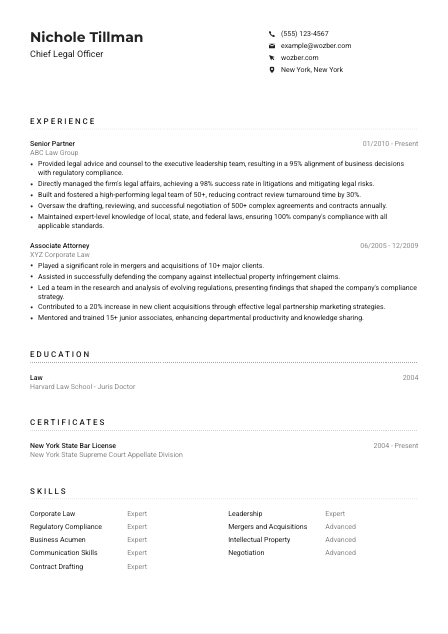
Your strongest bullets should show what legal problem or business issue you handled, what action you led, and what changed because of it. The sample resume does this well in places by tying executive counsel to compliance alignment and by showing legal team leadership through reduced contract review time. Similar bullets could cover deal execution, dispute resolution, governance support, policy redesign, or risk reduction across a business unit.
Quantification matters here, but it should sound native to legal leadership. Good measures include litigation success rate, contract volume, outside counsel spend, transaction value, review turnaround time, compliance rate, team size, or reduction in legal exposure. The sample's 500+ agreements annually and 30% faster contract review are useful because they connect legal activity to scale and operational improvement.
Trim or downplay experience that does not support senior legal leadership. Earlier roles can still help if they show M&A participation, IP matters, regulatory analysis, or client-facing negotiation, as the associate attorney example does. What matters is that the overall section reads like a progression toward enterprise legal leadership, not a collection of unrelated legal responsibilities.
By the end of this section, the employer should understand the scope of legal matters you have led, the business decisions you have influenced, and the executive environments in which you have already performed. That is what turns experience into a credible Chief Legal Officer profile.
Education will not outweigh your executive track record, but for a Chief Legal Officer it remains a threshold section. The degree, school, and legal foundation need to be easy to find because they support eligibility, professional stature, and the baseline expected for senior counsel and board-facing roles.
Lead with your Juris Doctor and the law school that awarded it. The job description specifically requires a JD from an accredited law school, so that credential should be immediately visible. If your education section starts with another degree or buries the JD below the fold, fix the order.
Keep the format direct: degree, field, institution, and graduation year. At this level, there is no need to over-design the section. The sample resume keeps it concise with "Juris Doctor" from Harvard Law School, which is enough to establish the educational foundation without distracting from the more important experience section.
If coursework, concentrations, or academic distinctions clearly connect to the target role, include them selectively. This can be useful when a role leans heavily toward corporate governance, securities, intellectual property, or compliance-heavy industries. Do not force academic detail if your career history already shows stronger proof.
Senior candidates do not need to relive law school, but honors can still help when they reinforce legal caliber. Law review, graduating with distinction, or notable fellowships may be worth including if space allows. Keep them brief and avoid turning the section into a transcript summary.
Continuing legal education, governance programs, or specialized executive coursework can strengthen your profile, especially in fast-changing regulatory or transactional environments. If those items are substantial, place them where they fit best on your resume, often in certificates or a separate professional development area rather than expanding the education entry too far.
This section should quickly confirm that your legal foundation meets the formal requirement and supports the seniority of the role. Once that is clear, the rest of the resume can stay focused on how you have applied that training in high-stakes business settings.
For a Chief Legal Officer, certifications and licenses should reinforce authority, not pad the page. Bar membership is essential. Additional credentials matter when they sharpen your relevance in transactions, compliance, governance, or industry-specific regulation.
Bar admission belongs at the top of this section because it is foundational for a senior legal executive. The employer here explicitly asks for a member in good standing of the State Bar Association, so your license should be easy to identify, with the issuing body and current status if appropriate.
After bar admission, include certifications that support the substance of the role. For this position, that could mean mergers and acquisitions, compliance, corporate governance, privacy, or intellectual property, depending on your background. The sample's CMAP credential works because it directly backs up the M&A requirement named in the job description.
Name the certification, issuer, and relevant date or active period. Legal employers notice precision, and this is an easy place to demonstrate it. If a credential remains active, make that status obvious rather than leaving the reader to guess.
Law changes constantly, especially around regulation, deal structures, employment standards, data governance, and industry oversight. Recent or active credentials help show that your expertise is current. That matters more when the role carries responsibility for keeping the business aligned with changing legal standards.
Keep only the licenses and certifications that strengthen your legal executive profile. A short, relevant list says far more than a crowded section that does not support your board counsel, transaction, or compliance leadership.
The skills section should read like the operating toolkit of a Chief Legal Officer. That means a blend of legal specialties, executive capabilities, and cross-functional influence. Generic soft-skill lists are rarely persuasive at this level. What matters is whether the list matches the legal and business demands of the role you are targeting.
Start with the job description and identify the capabilities that are truly central. Here, those include corporate law, mergers and acquisitions, intellectual property, regulatory compliance, contract negotiation, business acumen, communication, and leadership. Those are the terms worth prioritizing because they reflect how the employer is defining the role.
Resist the urge to include every practice area you have touched. A Chief Legal Officer resume benefits from disciplined prioritization. Keep the list centered on the domains that support top-level legal oversight, commercial judgment, and executive partnership. The sample resume does this well by pairing technical areas like corporate law and IP with leadership and negotiation.
Use straightforward labels and avoid over-stylized layouts that bury important terms. A clean list improves ATS optimization and helps a recruiter scan for required areas quickly. Wozber's AI resume builder is useful here because it can help surface missing role-specific terminology and organize your skills in an ATS-friendly resume format without turning the section into keyword stuffing.
Your skills section should support the story told in your experience, not repeat generic strengths. When it is tailored well, it confirms that you bring the legal range and executive judgment expected of a Chief Legal Officer.
Language ability matters differently in legal leadership than it does in many other roles. English proficiency is often essential because board materials, contracts, regulatory communication, negotiations, and internal counsel all depend on precision. Additional languages can be valuable when they connect to the company's markets, counterparties, or document flow.
If the posting specifies English, list it first and state your proficiency clearly. Here, strong command of English is a stated requirement, so it should not be left implied. Native or fluent are both appropriate when accurate, and they immediately satisfy a formal screening point.
A second language can support cross-border transactions, international subsidiaries, foreign counsel coordination, or review of non-English materials. The sample resume includes French, which could be useful in the right commercial context. Include additional languages when they are genuinely usable, not just academic exposure from years ago.
Use direct labels such as Native, Fluent, Intermediate, or Basic. In legal work, overstating proficiency is risky because the standard for drafting, negotiation, and nuance is high. A realistic level protects your credibility and sets the right expectation.
Not every Chief Legal Officer role needs multiple languages, but some absolutely benefit from them. If the company handles international deals, global compliance obligations, or overseas entities, multilingual ability can add practical value. Tie that value to the business context rather than presenting language skills as a generic bonus.
If you are actively improving a language that could support your legal work, you can note it modestly. Keep it secondary to proven proficiency. At executive level, the section should stay clean and credible, with emphasis on languages you can use in meetings, negotiations, or document review.
For this role, the languages section should first satisfy required English proficiency and then add any credible multilingual capability that supports the company's legal or commercial footprint. Keep it factual and relevant.
The summary has one job here: place you immediately at Chief Legal Officer level. In a few lines, it should establish your legal leadership range, the business environments you have advised, and the kinds of outcomes you are trusted to deliver. If it reads like a generic senior attorney profile, it is underselling you.
Before writing, identify the combination that defines the target position. For this posting, the balance is clear: executive counsel, legal department leadership, corporate law depth, M&A and IP exposure, compliance oversight, and business alignment. Your summary should reflect that mix rather than opening with a broad statement about being an experienced lawyer.
Your first sentence should establish seniority and range. A useful opening might reference 10+ years of legal experience, leadership of legal operations, or counsel to executive leadership and boards. The sample summary works because it quickly anchors the candidate in legal operations, business guidance, and team leadership.
Use the next lines to name the legal domains and results that matter most for the job. That might include corporate law, mergers and acquisitions, regulatory compliance, contract negotiation, litigation management, or building high-performing legal teams. If you mention metrics, keep them believable and tied to executive work, such as compliance performance, deal volume, or team scale.
Aim for a summary that can be read quickly by a recruiter, CEO, or board-facing stakeholder. Four lines is often enough. Every phrase should earn its place by clarifying your executive legal profile, not by using broad descriptors like dynamic, results-driven, or accomplished without context.
After reading the summary, the employer should already understand that you can operate as senior legal counsel to leadership, manage enterprise legal risk, and connect legal strategy to business goals. That is the standard this opening section needs to meet.
A Chief Legal Officer resume should make three things easy to recognize: the scale of legal matters you have handled, the executive decisions you have shaped, and the teams or functions you have led. If those points are visible in your experience, summary, and skills, the document is doing its job.
Use Wozber's ATS resume scanner and ATS-friendly resume format to tighten alignment with the posting, surface missing terminology, and present your background in a structure that reads cleanly for both screening systems and executive reviewers. The final resume should make your board-level legal judgment clear at a glance.




