



Use Wozber and land your dream job
Create Resume
No registration required
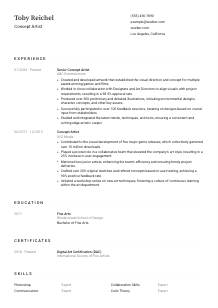
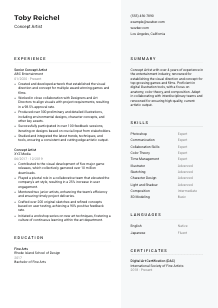
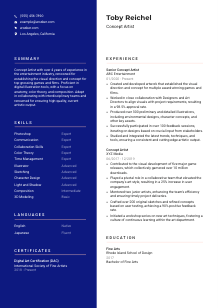
Breathing life into imagination, but your resume feels like a blank canvas? Check out this Concept Artist resume example, created with Wozber free resume builder. Learn how to artistically align your career with job expectations, painting a vivid path to your dream projects!
Concept art hiring moves fast when the work already speaks clearly, but the resume still has a job to do. Art directors and recruiters need a quick read on whether you can shape visual direction, work through feedback, and turn loose ideas into usable character, environment, and production concepts for games, film, or other media.
A tailored resume changes how your background is sorted and prioritized, especially when ATS filters are looking for terms tied to digital illustration, visual development, and cross-functional collaboration. Wozber's free resume builder helps you line up your wording with the role, keep an ATS-friendly resume format, and make it easier for a hiring team to see where your concept work fits into an actual production pipeline.
This section is straightforward, but it still affects how easily a studio can move you forward. For concept art roles, clean contact information and a visible portfolio link tell the team they can review your work, reach you quickly, and confirm practical requirements without extra back-and-forth.
Use your full name as the most visible text on the page. Keep it easy to scan and professionally formatted. In creative hiring, your portfolio will carry the visual weight, so your resume header should stay clean and legible rather than decorative.
Place the role title directly under your name if it matches the position you are pursuing. "Concept Artist" works well here because it immediately positions you for visual development work instead of broader illustration, design, or production art roles.
List a current phone number and a professional email address that would not look out of place in a studio inbox. Avoid casual handles. If someone wants to schedule an interview after reviewing your portfolio or resume, they should not have to guess how to reach you.
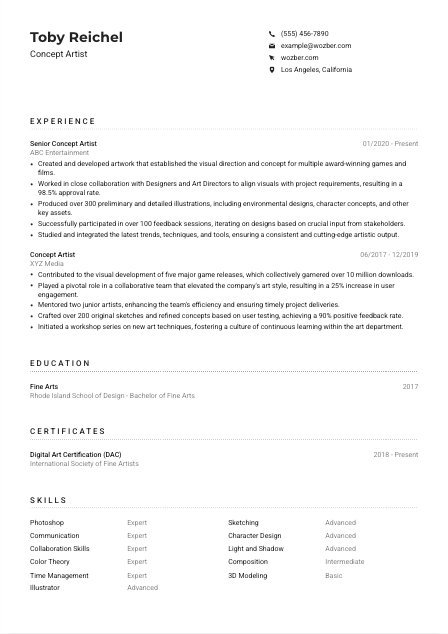
Some art roles are location-specific because of studio collaboration, hybrid schedules, or production needs. In the example posting, Los Angeles, California is a stated requirement, so listing Los Angeles, California in the header removes an avoidable concern early.
For a Concept Artist, a portfolio link is often as important as your phone number. Include your website, ArtStation, or other professional portfolio if it is current and reflects the same strengths named in your resume, whether that is character ideation, environment design, key art exploration, or fast iteration sketches.
Keep this section brief, current, and production-ready. The hiring team should see your role focus, know how to contact you, and have a direct path to the artwork that supports the rest of the resume.




This is where studios look for proof that you can contribute inside a real art pipeline. Your bullets should show what kind of concepts you produced, who you collaborated with, how you handled feedback, and what the work changed for the project, the team, or the player experience.
Read the posting closely and mirror the terminology that matches your actual work. For concept art roles, that often includes phrases such as visual direction, character concepts, environment design, iteration, stakeholder feedback, and collaboration with Designers or Art Directors. Using the employer's wording helps both ATS matching and human review.
Start with your most recent role and work backward. Each entry should include your title, company, and dates. For creative hiring, recent studio experience usually carries the most weight because it reflects your current software fluency, feedback process, and production pace.
Focus each bullet on work that mattered to the production. Instead of saying you "supported art development," name the output and context: established visual direction for a game, created environment callouts for level design, or developed character sheets that informed downstream modeling and animation. The sample resume handles this well by tying concept work to games, films, and project direction.
Numbers help when they reflect how concept art is actually measured. Useful examples include volume of concepts produced, approval rates, number of feedback rounds handled, game downloads, engagement lift, or delivery across multiple titles. In the example, figures like 300-plus illustrations, a 98.5% approval rate, and work tied to major releases make the scope easier to grasp.
Prioritize experience that supports visual development, ideation, and collaborative production. If a past role did not involve art direction support, asset exploration, or design iteration, trim it down or remove it. Space is better used on concept work, relevant freelance projects, or contributions that show how your art served the final product.
The best bullets show what you designed, how you collaborated, and what changed because of your work. Make each role help a studio picture you contributing to their visual development process from day one.
Education matters here because many studios still use it as a baseline check, especially early in the screening process. For concept art, this section should quickly confirm formal training in fine arts, illustration, or a related discipline without taking attention away from your portfolio and experience.
If the posting asks for a Bachelor's degree in Fine Arts, Illustration, or a related field, make that easy to find. Put your most relevant degree first and use the full degree and field name so there is no ambiguity during screening.
List the degree, field of study, school, and graduation year in a consistent order. Recruiters and coordinators often scan this section quickly, so clarity matters more than extra styling.
When you have multiple educational entries, give priority to the one that best supports concept art work. In the example, a Bachelor of Fine Arts in Fine Arts directly addresses the stated requirement and fits the visual development focus of the role.
You can include honors, a thesis, or major projects if they strengthen your case for concept work. This is most useful for early-career candidates whose student work involved environment design, character development, storyboarding, or advanced digital painting.
If you already have several years of entertainment industry experience, keep education concise. Once your resume shows shipped titles, large concept volumes, or strong collaboration with Art Directors, the degree becomes a confirmation point rather than the main story.
Use this section to satisfy formal requirements and show the training behind your draftsmanship and visual thinking. Then let your experience and portfolio carry the heavier argument.
Certificates are optional for many concept art roles, but the right one can support your technical range or continued development. Include them when they reinforce current digital illustration skills, specialized training, or commitment to keeping pace with changing tools and workflows.
Choose certifications that connect to the role's actual demands. Training in digital painting, visual development, anatomy, environment design, or industry-standard software is far more useful here than general creative learning with no production tie.
A certificate should add something your experience section does not fully cover. In the example, a Digital Art Certification supports the candidate's digital illustration background and reinforces the software-heavy side of the role.
Dates matter when the subject reflects evolving tools or workflows. Current or recent certification can show that your methods are up to date, especially if the training covers digital pipelines, rendering techniques, or software used in entertainment art teams.
Ongoing learning is worth mentioning when it stays close to the work. Courses or certifications in advanced Photoshop workflows, lighting for environment concepting, creature design, or 3D block-in methods can strengthen your resume if they reflect real capability.
This section works best when it reinforces your craft rather than trying to carry the application. Keep only the credentials that sharpen your profile for concept art and visual development work.
Studios look here for a fast snapshot of your technical toolkit and artistic fundamentals. The strongest skills sections balance software fluency, core art foundations, and the collaboration skills needed to move concepts through review and revision.
Extract the exact skills named in the posting, then compare them to your own background. In this case, that includes digital illustration software, anatomy, color theory, light and shadow, composition, and collaboration. These are not filler keywords. They point to the daily work of developing readable, usable concept art.
List the skills you can genuinely defend in an interview or portfolio review. If you are strong in Photoshop, Illustrator, character design, environment sketching, or iterative concept development, make those visible. The example resume does this effectively by pairing software skills with art fundamentals such as color theory and light and shadow.
Lead with the capabilities most likely to matter in screening and team discussions. For concept art, that usually means digital illustration tools, drawing fundamentals, design specialties such as character or environment work, and collaboration. Keep soft skills grounded in the work by framing them around feedback, communication, and teamwork with design and art leads.
A studio should be able to glance at this section and understand how you build concepts, what tools you use, and where your artistic strengths are most useful in production.
Language skills matter in creative production because feedback loops are constant. Concept artists discuss briefs, interpret notes, present visual ideas, and revise work with designers, directors, and other artists, so language proficiency can affect day-to-day collaboration.
If the posting specifies English proficiency, list English clearly and give it an honest proficiency level. In the provided role, strong command of English is stated directly, so it should appear near the top of the section.
Order languages by the level you can use professionally. For most U.S.-based concept art roles, English will come first, followed by any additional languages that may help in diverse teams, global studios, or international co-production settings.
Extra languages can support collaboration across distributed teams or broaden your usefulness on multinational projects. They are a plus, not a substitute for art ability, so keep the section concise and relevant.
Terms like Native, Fluent, Intermediate, and Basic are enough. Avoid vague descriptions. Clear proficiency helps teams understand whether you can handle critique sessions, written briefs, or client-facing discussion in that language.
For a concept artist, language ability matters most when it helps you understand direction and respond to notes accurately. If you speak more than one language well, that can support smoother collaboration, especially in studios with international partners or multilingual teams.
Treat this section as a communication check, not a personality detail. Clear language levels help a studio understand how comfortably you can work through briefs, reviews, and iteration cycles.
Your summary sits at the top of the resume, so it needs to establish your level, your specialization, and the kind of concept work you do best. Keep it concise, but make sure it reflects the realities of the role: visual development, technical art fundamentals, and collaboration inside a production team.
Before writing, identify the two or three priorities that define the job. For concept art roles, that often means entertainment industry experience, digital illustration strength, visual fundamentals, and the ability to iterate with directors and designers. Those should shape the summary language.
Start with a direct line that states who you are and how long you have worked in the field. The example summary opens with "Concept Artist with over 4 years of experience in the entertainment industry," which immediately sets seniority and domain.
Use the next sentence or two to name your strongest areas, such as character concepting, environment design, visual direction support, or digital painting expertise. If you have meaningful outcomes, include one. That might be work on award-winning titles, high-volume concept delivery, or strong approval rates during review cycles.
Aim for 3 to 5 sentences. Avoid generic claims about creativity or passion unless they are backed by concrete work. A concise summary that names your experience, tools, artistic foundations, and collaborative strengths gives the hiring team a sharper starting point for the rest of the resume.
When this section is done well, the reader understands your level, your artistic lane, and the type of production environment you know how to work in. That gives your portfolio and experience section a clearer context immediately.
A concept art resume should make your production value legible before anyone opens the portfolio in depth. When your experience, skills, and summary all point clearly to visual development, collaboration, and iterative concept work, the application reads like it belongs in a studio pipeline.
Use Wozber to build an ATS-compliant resume, refine wording with its AI resume builder, and check alignment with an ATS resume scanner so the final version stays tailored, readable, and easy to process. The result should make one thing clear fast: you can turn direction into visual concepts a team can build from.




