




Use Wozber and land your dream job
Create Resume
No registration required
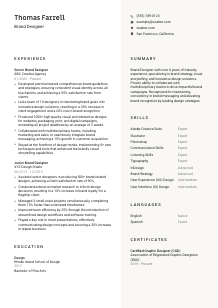
Shaping memorable logos, but your resume could use a refresh? Check out this Brand Designer resume example, created with Wozber free resume builder. Learn how to shape your design narrative to stand out as brilliantly as your brand concepts, setting your career on a path as impactful as a perfectly positioned logo!
Brand design work is rarely judged on visuals alone. Hiring teams want to see how you build a system people can use across campaigns, packaging, web pages, and brand touchpoints without losing consistency or momentum. Your resume should make that operating range clear, especially how you turn brand strategy into usable assets, guidelines, and design decisions that hold up in real production.
When a Brand Designer resume is tailored well, the reader can quickly tell whether you are a visual stylist, a marketing designer, or someone who can own brand consistency across channels. Wozber's free resume builder helps you shape that distinction into an ATS-compliant resume by aligning your wording with the job description and organizing the experience that matters most. That clarity helps hiring teams see your brand thinking, software fluency, and cross-functional collaboration in the right order.
For Brand Designer roles, the contact section should do one practical job well: make it easy to reach you and easy to confirm key basics such as role alignment, portfolio access, and location when required.
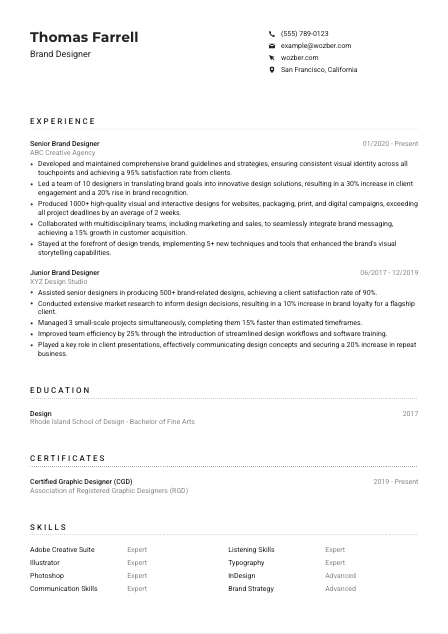
Your name should be the most visible text on the page, set in a clear and professional style that matches the overall polish of your resume. Brand design is a visual field, so even this small area reflects your judgment around hierarchy, spacing, and restraint.
Use the target title directly under your name, such as "Brand Designer," when that is the role you are applying for. This removes guesswork and keeps your application aligned with the language used in the posting, which also helps with ATS matching.
List a reliable phone number, a professional email address, and a portfolio link or personal website that opens quickly and shows relevant branding work. For this profession, your portfolio often carries as much weight as the resume, so make sure the link is current and leads straight to strong brand identity, campaign, packaging, or digital design samples.
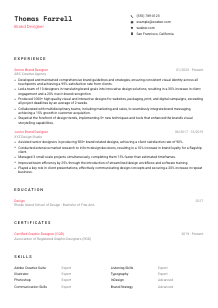
Some Brand Designer openings include an on-site or local requirement. In this example, listing "San Francisco, California" directly in the header immediately addresses the employer's location filter and avoids unnecessary doubt about availability.
If you include LinkedIn or another professional profile, make sure the title, dates, portfolio links, and featured work match the resume. For design hiring, inconsistency between your resume and online presence can raise questions about project ownership, timeline accuracy, or current focus.
This section does not need personality lines or extra detail. It should confirm who you are, what role you do, how to contact you, and where to review your work, with location included when the employer requires it.




This is the section where Brand Designers separate themselves from generalist creatives. Employers want to see the kind of brand systems you have built, the channels you have designed for, and the results your work supported across teams, campaigns, and client or business goals.
Read the posting closely and mark the responsibilities that define the job's day-to-day work. For this role, that includes maintaining brand guidelines, creating visual assets across print and digital formats, collaborating with multidisciplinary teams, and handling multiple projects at once. Those themes should show up clearly in your bullet points.
List each role in reverse chronological order with your title, company name, and employment dates. Prioritize positions that show brand identity work, agency exposure, campaign design, or experience managing deliverables across several touchpoints.
Each bullet should show what you were responsible for and what kind of brand work you produced. Good examples for this field include building brand guidelines, designing packaging systems, creating website visuals, supporting launch campaigns, or partnering with marketing, sales, or product teams to translate a brand direction into usable assets. The sample resume does this well by tying design output to brand consistency and client engagement rather than just listing software tasks.
Numbers help when they reflect real design impact. For Brand Designers, that can mean client satisfaction, engagement lift, repeat business, brand recognition, output volume, campaign delivery speed, or project turnaround. The sample's points such as a 30% increase in client engagement and delivery ahead of deadline work because they connect creative work to business results and production performance.
If a bullet does not show brand thinking, visual execution, collaboration, or measurable contribution, rewrite it or remove it. Space is limited, so use it on work that proves you can shape a brand system and deliver assets consistently across channels, rather than on generic duties that could belong to almost any design role.
A hiring manager should finish this section with a clear picture of the brands, deliverables, and outcomes you have handled. When your bullets connect visual work to brand consistency, team collaboration, and measurable results, your experience reads like practical ownership rather than task completion.
Education usually is not the most persuasive section for an experienced Brand Designer, but it still matters because many employers ask for a design-related degree and use this section to confirm formal training in visual communication, design thinking, and craft.
If the role asks for a Bachelor's degree in Design, Fine Arts, or a related field, make that qualification easy to find. In the example, "Bachelor of Fine Arts" in Design aligns directly with the posting and supports the candidate's professional background in branding.
List your degree, school, field of study, and graduation year in a straightforward layout. Recruiters and hiring managers usually scan this section quickly, so clarity matters more than extra wording.
Coursework, concentrations, or academic focus areas can help if they connect directly to brand design, such as typography, identity systems, visual communication, packaging, or digital design. This is especially useful for earlier-career candidates who need more role-specific context beyond the degree title.
Awards, thesis work, or capstone projects are worth mentioning if they show strong identity design, campaign thinking, or concept development. Keep these details concise and relevant so they support your positioning rather than crowding the section.
Design tools, digital channels, and brand systems evolve quickly. If you have completed later coursework in areas like UX, motion, packaging, or advanced Adobe workflows, mentioning it can show that your foundation has kept pace with current brand execution needs.
This section should confirm that you have the formal background the role asks for and, when helpful, point to training that supports brand identity, visual systems, and current design practice.
Certifications are rarely the deciding factor for Brand Designer hiring, but the right ones can strengthen your profile when they support your design craft, software expertise, or continued professional development.
Prioritize certificates that reinforce brand design, graphic design, typography, digital production, or software mastery. A credential such as Certified Graphic Designer works because it connects directly to visual communication practice rather than adding unrelated credentials for volume.
One or two relevant certifications are usually stronger than a long list. Include credentials that support the kinds of projects you want to work on, whether that is identity systems, print collateral, packaging, or digital brand assets.
Design software and production workflows change over time, so it helps to show when a certification was earned or whether it is current. That is particularly useful for credentials tied to Adobe tools, digital design workflows, or industry standards.
Ongoing certification can signal that you keep sharpening your craft beyond day-to-day client work. For a Brand Designer, that might mean staying current with new design tools, evolving visual trends, or adjacent skills that support stronger brand execution.
A concise certification section can reinforce your technical range and professional discipline. Keep it tied to design practice and current tools so it adds weight to the rest of the resume.
A Brand Designer skills section should read like a practical toolkit for building and maintaining visual identity across channels. That means balancing software proficiency with the collaboration and design judgment needed to turn brand direction into usable assets.
Start with the capabilities the employer named directly. Here, that includes Adobe Creative Suite, Illustrator, Photoshop, InDesign, communication, and collaboration. Matching those terms helps both ATS screening and human review, as long as every listed skill reflects real experience.
Put your strongest technical skills first, especially the software and craft areas most relevant to brand work. Adobe Creative Suite belongs near the top for this role, and supporting strengths such as typography, layout, brand systems, packaging, print production, or digital asset design can make the section feel more role-specific than a generic software list.
Brand Designers rarely work in isolation. Add people-facing strengths that reflect real workflow, such as presenting concepts, incorporating stakeholder feedback, working across marketing and product teams, or translating strategy into design direction. In the example resume, communication and listening are listed because the role depends on working smoothly with multidisciplinary teams.
A hiring team should be able to glance here and understand both how you design and how you work with others. Prioritize the tools, craft skills, and collaboration strengths that support consistent brand delivery across media.
Language ability matters most when the role names a requirement or when your work involves client communication, presentations, or global brand audiences. For Brand Designers, this section should stay concise and practical.
If the job description specifies English proficiency, list English first and state your level clearly. Since this role calls for strong English speaking and listening skills, placing English prominently helps confirm that you can handle meetings, feedback rounds, and stakeholder presentations.
Additional languages can be valuable when a company works across markets or serves multilingual audiences. They can also support research, collaboration, and culturally informed campaign work, but only include languages you can genuinely use in a professional setting.
Use straightforward labels such as Native, Fluent, Advanced, or Intermediate. Honest ratings matter because language skills often affect presentations, client communication, and cross-functional collaboration.
For some Brand Designer roles, extra languages are a real advantage, especially in agency work or brands with international reach. For others, they are secondary. Let the role determine how much emphasis this section deserves.
If you are actively improving a language that supports your market focus or client base, you can note it briefly. Otherwise, keep this section clean and factual so the main attention stays on your design experience and portfolio.
When language skills matter, this section should quickly show that you can communicate clearly with clients, teammates, and stakeholders. Keep it accurate and scaled to the needs of the job.
The summary is your opening case for the role. In a few lines, it should show your level of experience, the type of brand work you handle, and the outcomes your design contributes to across teams and channels.
Use the posting to decide which strengths belong in the first lines. For this role, that means highlighting brand strategy, visual consistency across touchpoints, cross-functional collaboration, and high-quality execution across print and digital materials.
Start with your title and years of experience, then name the parts of brand design you are strongest in. A line such as "Brand Designer with 6+ years of experience in brand strategy, visual identity, and campaign design" gives the reader immediate context.
Use concise achievements that connect creative work to business or client outcomes. The sample summary works because it mentions elevating brand recognition and leading design strategies, which gives substance to the candidate's positioning without turning the section into a list of metrics.
Aim for a compact paragraph of about three to five lines. The summary should frame the rest of the resume, not repeat the entire experience section. Focus on the mix of brand thinking, execution, and collaboration that makes you relevant for the role.
When this section works, the reader immediately understands your level, your specialty, and the kind of brand outcomes you help deliver. Keep it specific enough to distinguish you from general graphic or marketing design candidates.
A Brand Designer resume should show more than taste and software fluency. It should connect brand systems, campaign execution, stakeholder collaboration, and measurable outcomes in a way that feels consistent from top to bottom.
Wozber helps you build that kind of application with ATS-friendly resume templates, AI-assisted tailoring, and an ATS resume scanner that keeps your wording aligned with the role. The final result should make it easy to judge how well you can translate brand strategy into design work that performs across real touchpoints.