



Use Wozber and land your dream job
Create Resume
No registration required
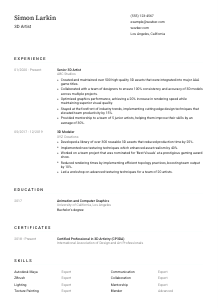
Sculpting virtual masterpieces, but your resume doesn't quite model success? Shape your future with this 3D Artist resume example, created with Wozber free resume builder. Learn how to present your technical and artistic talents to match the precise needs of a job opening, ensuring your career portfolio is as well-defined as your 3D work!
3D Artist resumes are read through the lens of production. Hiring teams want to see whether you can build assets that hold up in a real pipeline, from modeling and texturing through rendering and optimization, while keeping visual quality consistent with the rest of the project. Your resume needs to make that workflow visible, not just list software or artistic interest.
When the content is tailored well, the first scan quickly shows where you fit in the pipeline, which tools you actually use, and whether your work translates into usable assets, faster renders, or stronger team output. Wozber's free resume builder helps you shape that story into an ATS-compliant resume, so core terms like modeling, texturing, rendering, optimization, and collaboration are easy to read by both the system and the art lead reviewing your work.
Studios usually start with the basics before they review your work history. If your header is incomplete, inconsistent, or misses a stated requirement, you create friction before anyone reaches your asset counts, rendering wins, or software stack.
Your name should be the clearest text at the top of the page. Use the version attached to your portfolio, LinkedIn, and application records so recruiters, producers, and art leads can match your materials without confusion.
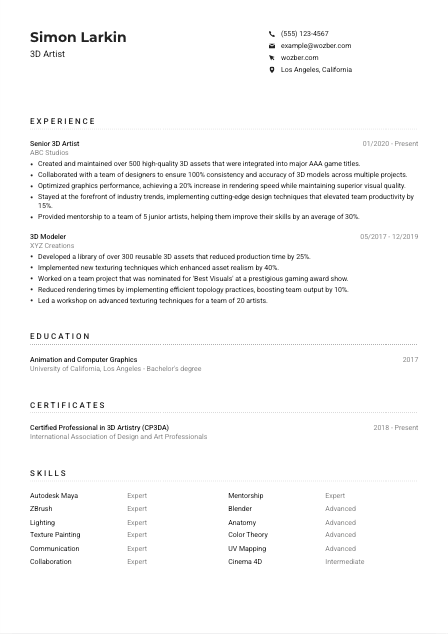
Use the exact role title "3D Artist" unless your background points to a closer variation that still fits the posting, such as Senior 3D Artist. In this case, the sample keeps "3D Artist" in the header even though the experience shows senior-level work, which is a smart way to align with the opening while still proving depth later in the resume.
List a phone number you answer and a professional email address. Add your portfolio or personal site if it shows finished models, textures, renders, wireframes, turntables, or breakdowns that support the claims in your experience section.
Some art roles are flexible, but some are tied to a studio, hybrid schedule, or local production setup. Here, Los Angeles, California is a stated requirement, so placing it in your personal details immediately addresses a concrete filter without overexplaining it.
A 3D Artist resume gets stronger when the header connects to proof. If you include a portfolio, make sure it reflects the same level of quality, style range, and tool proficiency you describe on the page. A polished link is far more useful than sending reviewers to an unfinished profile.
This section should make it easy to contact you, confirm any required location detail, and move straight into your work. Clean setup helps the rest of the resume do its job.




This is the section most likely to decide whether an art lead keeps reading. For a 3D Artist, experience needs to show what you made, how you made it, how well it performed in production, and how you worked with designers, animators, or other artists to get assets shipped.
Prioritize roles that show direct experience in 3D modeling, texturing, rendering, and asset maintenance. If the posting names tools like Autodesk Maya, Blender, or ZBrush, bring those into bullets where they are genuinely part of the work rather than leaving them buried in a skills list.
For every role, include your title, studio or company name, and dates in a consistent format. That simple structure helps reviewers quickly place your experience level, see your progression, and understand whether your background comes from games, animation, product visualization, or another 3D environment.
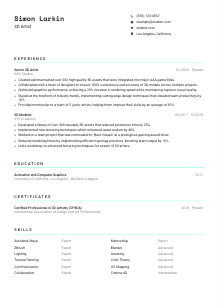
Replace broad task descriptions with concrete accomplishments. "Created and maintained high-quality 3D assets" becomes more convincing when tied to output, consistency, or collaboration. The sample does this well by showing asset volume, cross-team alignment, rendering gains, and mentoring activity instead of repeating generic duties.
Metrics are especially effective here when they reflect real studio outcomes. Asset counts, reduced production time, faster rendering, improved realism, output gains, or team training impact all help. Examples like "500 high-quality 3D assets," "20% increase in rendering speed," or "25% reduction in production time" tell a hiring team what changed because of your work.
Cut bullets that do not support the target role. A 3D Artist resume should stay focused on asset creation, visual quality, optimization, tool use, collaboration, and pipeline contribution. Even when you include awards or workshops, connect them to your 3D practice so the section stays grounded in the work studios hire for.
The best experience sections read like proof of production readiness. When your bullets connect asset quality, workflow contribution, and measurable results, hiring teams can picture you in the pipeline much faster.
Education matters most when it confirms the baseline training the role asks for. In 3D art, that usually means a degree connected to animation, computer graphics, game art, or another field that supports modeling, form, lighting, rendering, and digital production workflows.
If the posting asks for a bachelor's degree in Animation, Computer Graphics, or a related field, make that information easy to find. The sample works because "Bachelor's degree" and "Animation and Computer Graphics" directly answer the requirement without extra interpretation.
List degree, field of study, school, and graduation year or date. Recruiters do not need a paragraph here. They need a clean record that confirms your training and supports the technical side of your candidacy.
When your major directly supports the role, let that alignment speak for itself. Animation and Computer Graphics is a close match for a job that asks for anatomy, lighting, color theory, and production-ready 3D work.
Earlier-career candidates can get more value from education by including thesis work, game projects, environment builds, character studies, rendering assignments, or software-focused coursework. Use this only when it adds missing context that your professional experience does not yet cover.
Awards, student exhibitions, lab work, or leadership in graphics-related groups can help if they point to artistic development or technical discipline. Keep them relevant to 3D production, visual storytelling, or collaborative studio-style work.
This section does not need much space, but it does need to answer the role's academic requirement cleanly. Once that is clear, the rest of the resume can focus on professional output.
Certifications are not always required for 3D Artist roles, but they can help when they reinforce your tool proficiency, specialization, or commitment to keeping up with changing workflows. Use them to add depth, not to fill space.
Choose certifications that relate to 3D software, digital sculpting, rendering, texturing, or broader visual production. A credential such as "Certified Professional in 3D Artistry" supports the profile because it sits close to the actual work of asset creation and technical development.
A short list of strong, role-related certificates is better than padding the section with unrelated training. Prioritize credentials that reinforce the tools, methods, or artistic disciplines named in the posting.
Software and production practices change quickly. Showing when a certification was earned, renewed, or kept active helps employers see that your training is not outdated, especially if the role values current techniques and evolving visual standards.
If you keep building your skill set through advanced workshops, software certifications, or sculpting and lighting courses, update this section regularly. It supports the expectation that a strong 3D Artist keeps refining both artistic judgment and technical execution.
Relevant credentials can strengthen your profile when they echo the tools and methods the role depends on. Keep the section focused and current.
A 3D Artist skills section works best when it mirrors how the job is done. That means balancing software proficiency with core art fundamentals and a few collaboration skills, rather than dropping in every tool you have ever opened.
Read the job description closely and separate hard skills from supporting abilities. Here, software proficiency in Autodesk Maya, Blender, and ZBrush sits alongside anatomy, lighting, color theory, communication, and collaboration. Those belong near the top because they reflect both execution and team fit.
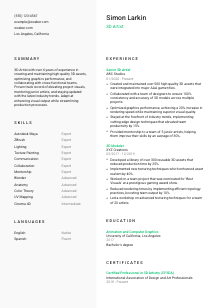
Order your skills so the most relevant tools and artistic competencies appear first. In the sample, Maya, ZBrush, lighting, texture painting, communication, and collaboration are all placed prominently, which helps a reviewer understand the candidate's fit within seconds.
Group your strongest, job-relevant skills and cut anything that distracts from the target role. If you include proficiency levels, be honest. A shorter list with believable strengths in modeling, UV mapping, texturing, rendering, anatomy, and optimization is more useful than a bloated inventory.
Studios want to know which tools you use well and which artistic fundamentals you can apply under production constraints. A focused list answers both.
Language sections carry more weight when communication is part of the work, and that is true in 3D production. Artists need to discuss feedback, review assets, explain revisions, and stay aligned with designers, animators, and leads. Clear communication matters for the job, not just for the application.
If the posting specifies clear English communication, list English first with an accurate proficiency level. That directly answers a stated requirement and supports the collaboration side of the role.
Any additional language can be worth listing if you can use it professionally or in collaborative settings. It is a secondary advantage, but it may help on distributed teams, international productions, or multicultural studio environments.
Stick to clear terms such as Native, Fluent, Advanced, or Intermediate. Inflated language claims create problems quickly once interviews move into portfolio walkthroughs, feedback discussions, or cross-functional meetings.
For artists, language skill is most useful when it improves critique, handoff clarity, and day-to-day teamwork. If you work across regions or with external partners, multilingual ability can support smoother production communication.
Do not overbuild the language section unless languages are central to the role. For most 3D Artist resumes, English proficiency should be clear, extra languages can be listed briefly, and the heavier emphasis should stay on work, tools, and artistic results.
For this kind of role, language skills matter most when they support reviews, revisions, and collaboration. Keep the section simple and credible.
A hiring manager should be able to read your summary and understand your level, your specialization, and the kind of production contribution you bring. For 3D Artists, that usually means a mix of asset creation, technical execution, visual quality, and teamwork.
Start from the work the employer needs done. If the role centers on 3D assets, modeling, texturing, rendering, optimization, and collaboration, those themes should guide the summary instead of generic creative language.
Name your role and level directly. "3D Artist with 4+ years of experience" tells the reader more than a vague line about passion or creativity. If you have a clear specialty such as characters, environments, materials, or real-time assets, include it when it helps target the role.
Use one or two details that show production value. The sample summary works because it mentions high-quality 3D assets, graphics performance optimization, cross-functional collaboration, and mentoring. Those points map cleanly to the job without sounding overloaded.
Aim for a few sentences that are easy to absorb on a first read. Avoid buzzwords and make every line carry useful information about your craft, tool-based work, or business impact. The summary should set up the rest of the resume, not repeat it in full.
A focused summary helps the studio understand where you fit before they reach the details. If it clearly presents your experience level, artistic scope, and workflow contribution, it has done its job.
With the right tailoring, your resume can show more than artistic potential. It can show that you build usable 3D assets, collaborate well with production teams, and improve visual output without losing performance. That is the combination most hiring teams want to spot quickly.
Use Wozber's free resume builder to shape that experience into an ATS-friendly resume format, then refine the language so the tools, outcomes, and production strengths in the posting are reflected naturally across the page. The finished resume should make it easy to judge your readiness for real 3D work.




