



Use Wozber and land your dream job
Create Resume
No registration required
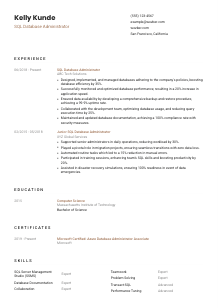
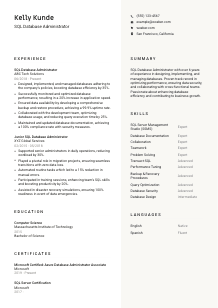
Querying databases, but your resume returns a null? Check out this SQL Database Administrator resume example, created with Wozber free resume builder. It shows how to link your database dexterity to the job description, so your career doesn't get stuck in a never-ending loop!
Database administration work is judged in production, where slow queries, weak backup discipline, or poorly managed changes can affect uptime, data integrity, and application performance in a hurry. A SQL Database Administrator resume needs to make those operating strengths visible fast, especially your command of SQL Server environments, recovery procedures, and the kind of database improvements you have delivered under real business constraints.
Hiring teams often sort DBA applicants by how clearly the resume separates hands-on SQL Server administration from broader IT support or development work. Using Wozber's free resume builder to tailor your wording and keep an ATS-compliant resume structure helps surface the right details early, from Transact-SQL and performance tuning to backup ownership and cross-team query optimization. That makes it easier to see whether you can keep critical databases stable, secure, and fast.
This section should answer the practical questions before the technical review even starts. For an SQL Database Administrator, that means presenting a clean professional identity, accurate contact information, and any location detail the employer specifically asked for, without clutter or filler.
Place your full name at the top in a clear, readable format. Keep it simple and professional. In technical hiring, especially for infrastructure and data roles, a clean header sets the same expectation as well-maintained documentation: organized, precise, and easy to reference.
If you are applying for an SQL Database Administrator job, use that title directly under your name when it reflects your actual background. This helps frame the resume immediately around database administration rather than general IT operations, support, or data analysis.
List a phone number you answer and an email address that looks business-ready. Small errors here create avoidable delays, and for a role trusted with backups, access controls, and production systems, accuracy matters even in the basics.
Some DBA openings are explicit about on-site or local availability. In the example role, San Francisco, California is stated as a requirement, so showing that location in the header removes an immediate screening question. If a posting does not require a specific location, city and state are usually enough.
A LinkedIn profile, portfolio, or certification page can help when it reinforces your SQL Server work, Azure database credentials, or project history. Make sure the details match your resume, especially job titles, dates, and certifications, so the hiring team sees consistency across your professional record.
Your personal details should clear the path to the technical parts of the resume. If this section is accurate, concise, and aligned with the posting, the reader can move straight to your database administration background without distraction.




For SQL Database Administrator hiring, experience carries the most weight because it shows how you handle live systems, performance issues, restore readiness, and collaboration with engineering teams. Focus less on generic responsibilities and more on what you improved, protected, or stabilized in the environments you managed.
Read the job description for the operational themes behind the wording. Here, the clear priorities are SQL Server administration, performance monitoring, backup and recovery, security and compliance, and work with developers on query efficiency. Mirror those ideas using your real experience, so the resume speaks the same language as the role.
List each job in reverse chronological order with title, employer, and dates. That structure helps the reviewer track your progression from support-level database work into ownership of administration, tuning, maintenance, migrations, or disaster recovery. If you have grown from junior DBA work into full production responsibility, make that progression easy to see.
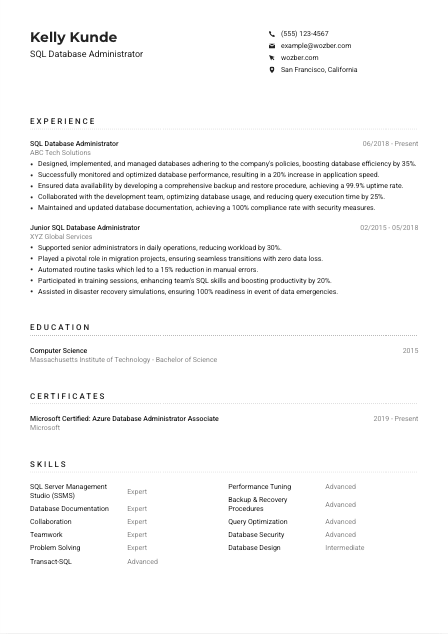
Each bullet should show what changed because of your work. Instead of writing that you "monitored database performance," show the result, such as reduced query execution time, faster application response, fewer incidents, or stronger uptime. The sample resume does this well by linking monitoring and optimization to a 20% increase in application speed and collaboration with developers to a 25% reduction in query execution time.
Metrics make DBA work more concrete when they reflect the job properly. Good examples include uptime, recovery success, performance gains, automation savings, migration accuracy, incident reduction, or compliance completion. In the example, 99.9% uptime, zero data loss during migrations, and a 35% database efficiency improvement give the reader a much sharper picture of production impact.
Keep the section centered on database design, maintenance, tuning, restore readiness, documentation, access control, and developer support. Broad IT tasks belong only if they strengthen your DBA profile. If a bullet does not help show how you manage SQL environments reliably and efficiently, it is taking space from stronger material.
The strongest experience sections make your day-to-day administration visible through outcomes. When your bullets connect SQL Server work to uptime, recovery readiness, performance, and safer operations, your value as a DBA becomes much easier to judge.
Education matters here because employers often use it as a baseline check for technical depth, especially when the posting asks for a degree in Computer Science, Information Technology, or a related field. Present it clearly, then let experience and certifications carry the more advanced proof of database expertise.
If the job asks for a bachelor's degree in Computer Science, Information Technology, or a related field, make that alignment obvious. In the example, a Bachelor of Science in Computer Science directly satisfies the stated requirement, so there is no reason to bury it.
For experienced DBAs, the essentials are usually enough: degree, field, school, and graduation year. Add honors, strong GPA, or standout coursework only when they reinforce database, systems, or data-management credibility. Early-career candidates can use relevant projects or database courses more heavily.
Use a straightforward structure: degree, field of study, institution, and year. This keeps the section easy to scan and avoids distracting from the parts of the resume where your SQL Server administration work is proven in detail.
If your degree title is broad, or if you are earlier in your career, database design projects, systems administration coursework, data architecture labs, or capstone work involving SQL can help connect your academic background to the job. For a senior candidate with 5+ years of DBA experience, this is usually optional.
Database administration changes with cloud platforms, tooling, and security standards, so certifications can strengthen what your degree started. Microsoft database credentials are especially relevant when the role mentions Azure administration or SQL Server certification as a preference.
This section does not need to do all the work. It should confirm that you meet the academic requirement cleanly, then support the broader picture of a candidate who has built real SQL administration depth through practice and continued learning.
In SQL Database Administrator hiring, certifications are most useful when they confirm platform-specific capability and recent technical investment. They are especially valuable when the employer names Microsoft or Azure credentials, because those directly support trust in your SQL Server administration background.
When a posting mentions credentials such as Microsoft Certified: Azure Database Administrator Associate or SQL Server certifications, move those to the top of the section. That instantly connects your training to the database stack named in the job description.
List certifications that support the work you want to be hired for, not every course you have ever completed. SQL Server, Azure database administration, security, backup strategy, and related Microsoft credentials are far more useful here than unrelated general IT badges.
Show the certification name, issuing organization, and date or active period where relevant. This helps the reader place the credential in context and shows whether your learning is current. The example resume handles this clearly by naming Microsoft as issuer and showing ongoing validity.
Database administration changes with cloud services, security practices, and high-availability tooling. Refresh this section as you add new credentials, renew existing ones, or complete training that supports the environments you administer. Up-to-date certifications are particularly useful if your recent job titles undersell your current technical scope.
Relevant certifications help confirm that your SQL Server and Azure knowledge is current and role-specific. When they match the employer's stack, they add weight without needing much space.
A hiring manager scanning an SQL Database Administrator resume wants to see the platform, administration tasks, and technical strengths that support reliable database operations. Build this section around tools and capabilities you actually use, with enough specificity to support both ATS optimization and human review.
Start with the required stack and responsibilities named in the posting. For this role, SQL Server Management Studio, Transact-SQL, performance tuning, backup and recovery, documentation, and security measures all belong near the top if they reflect your real work. This kind of direct terminology helps your resume match both the job language and the expected DBA workflow.
Lead with the skills that define database administration: SQL Server tooling, query optimization, restore procedures, monitoring, access control, and database design. Teamwork and problem solving can stay, but they should not crowd out harder technical signals. In the example resume, the strongest entries are the ones tied directly to SQL operations and platform management.
Put the most job-critical skills first so the resume communicates your platform fit quickly. Wozber's ATS-friendly resume format helps keep the section readable while preserving the exact terms employers search for. When the top of the list reflects the target environment, your skills section starts working before the reviewer reaches your experience bullets.
A well-built skills section should sound like the operating environment you know how to manage. Prioritize the tools, commands, and administration tasks that define your DBA work, and let everything else support that core picture.
For most SQL Database Administrator roles, language requirements are practical rather than decorative. Teams need DBAs who can document procedures clearly, coordinate with developers, and communicate during incidents or recovery work, so list language proficiency in a way that supports that reality.
If the posting requires English, show it clearly and use an accurate proficiency level. That matters in database administration because runbooks, change records, documentation, security procedures, and cross-team communication all depend on precise written and verbal communication.
Additional languages can help if you work with distributed teams, international stakeholders, or multilingual support environments. They are a bonus, not a substitute for technical depth, so include them when they reflect your real working context.
Choose ratings that match what you can actually handle in meetings, written documentation, and problem resolution. Native, fluent, advanced, and intermediate are more useful than vague claims, especially if the role involves collaboration across engineering, support, and compliance teams.
A DBA may need to explain performance issues, document recovery procedures, or coordinate changes during maintenance windows. If a second language has helped you do that in previous roles, it is worth listing. If not, keep the section brief and accurate.
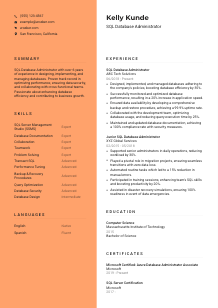
For most SQL Database Administrator resumes, languages should support the application rather than dominate it. The example's English and Spanish entry works because it is concise and leaves the main emphasis on database performance, recovery, and SQL Server expertise.
This section works best when it reinforces your ability to document, coordinate, and respond clearly in the environments where databases are managed. Keep it truthful, concise, and tied to real working use.
The summary is where you establish your technical identity before the reader gets into the detail. For an SQL Database Administrator, that usually means years of experience, database platform strength, and a short statement about the operational outcomes you are known for, such as performance, availability, or secure administration.
Pull the strongest recurring themes from the posting before you write. In this case, that includes SQL Server administration, Transact-SQL, performance tuning, backup and recovery, developer collaboration, and security-conscious database management. Those points should shape the summary, not generic claims about being results-driven.
Start with your professional identity and years in the field, such as "SQL Database Administrator with 6+ years of experience." That immediately places you in the right hiring lane and helps distinguish you from database developers, BI analysts, or general systems administrators.
Use the next sentence to name the database responsibilities you have owned. Good options include designing and managing SQL Server databases, improving query performance, maintaining backup and restore procedures, supporting compliance, or partnering with developers to optimize usage. The sample summary works because it stays close to those DBA responsibilities.
Aim for 3 to 5 lines with direct language and no filler. You do not need to list every tool or achievement here. A short summary that accurately frames your platform, tenure, and main operational strengths will set up the rest of the resume much better than a broad paragraph full of buzzwords.
Your summary should tell the reader, quickly and credibly, what environments you can manage and what outcomes tend to improve under your watch. If that is clear in the opening lines, the rest of the resume has a much easier job.
A tailored SQL Database Administrator resume should now show the essentials clearly: the SQL Server tools you know, the production responsibilities you have owned, and the outcomes you have delivered in performance, recovery, security, and uptime.
Use Wozber's AI resume builder, ATS resume scanner, and ATS-friendly resume template to align your wording with the posting, strengthen ATS optimization, and present your experience in a clean technical structure. The final version should make one thing easy to judge: you can manage databases with the reliability the role demands.




