



Use Wozber and land your dream job
Create Resume
No registration required
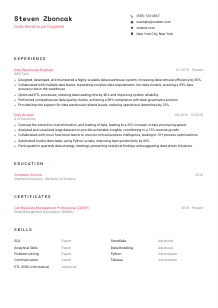
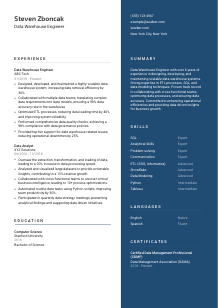
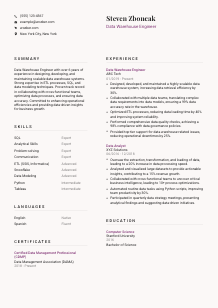
Crafting data flow, but your resume seems bottlenecked? Check out this Data Warehouse Engineer resume example, built with Wozber free resume builder. Learn how to streamline your data hierarchy to match job blueprints, building a career foundation as reliable and scalable as your warehouses!
Data Warehouse Engineer resumes are read through the lens of system design, data reliability, and throughput. Hiring teams want to see how you build warehouse structures that hold up under growing data volume, how you shape source data into usable models, and how you improve ETL performance without compromising governance or accuracy. If your resume stays at the level of generic data work, it can miss the parts of the job that matter most.
A tailored resume changes which strengths become visible first. For data warehouse hiring, that usually means surfacing platform experience, SQL depth, ETL ownership, and measurable improvements in load time, retrieval speed, or data quality in an ATS-friendly resume format. Wozber's free resume builder helps organize that language around the target posting and sharpen ATS optimization, so the resume quickly shows whether you can support the warehouse environment the team actually runs.
The header section is brief, but it still carries useful signals. For a Data Warehouse Engineer, it should confirm who you are, where you are based if the role requires it, and how easily a hiring team can connect your resume to the exact position they are filling.
Use your full name at the top in a clean, readable format. Keep the presentation straightforward so the focus stays on your technical background, warehouse experience, and measurable results rather than decorative styling.
Place "Data Warehouse Engineer" directly under your name when that is the role you are applying for. Matching the job title makes the resume easier to classify during early screening and aligns your profile with the employer's search terms.
Include a working phone number and a professional email address with no formatting errors. If a recruiter wants to ask about your ETL stack, warehouse platform, or availability for a technical screen, your contact details should never slow that down.
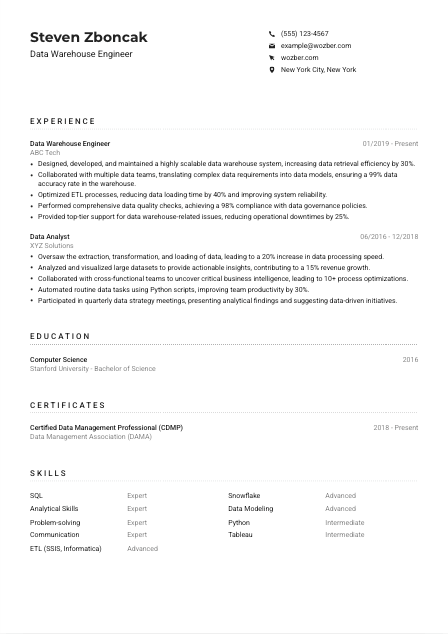
If the posting asks for a specific location, include it plainly. In the example, listing "New York City, New York" immediately addresses a stated requirement and removes doubt about local availability.
Add LinkedIn or a personal site if it supports your resume with project context, platform exposure, or data engineering work. A profile that reflects warehouse architecture, SQL-heavy work, or ETL implementation is far more useful than a generic online presence.
Your personal details should settle the basics quickly: identity, target role, contact path, and any location requirement the posting makes explicit. Keep it clean so the hiring team can move straight to your warehouse experience.




This section carries the most weight for Data Warehouse Engineer hiring. Employers look for proof that you have built or maintained warehouse environments, improved ETL performance, modeled data for reporting and analytics, and handled data quality issues in production rather than only observing them from the side.
Start by isolating the work themes in the posting: scalable warehouse design, ETL optimization, data modeling, data quality checks, governance support, and troubleshooting. Then make sure your bullets show direct experience in those areas using the same terminology when it accurately reflects your work.
List each role in reverse chronological order with title, company, and dates. For data warehouse positions, your title progression matters because it helps employers distinguish between hands-on warehouse engineering, adjacent analytics work, and broader data engineering responsibilities.
Describe what changed because of your work. Good warehouse bullets show improvements in query performance, load efficiency, model accuracy, uptime, governance compliance, or stakeholder support. The example does this well with results such as a 30% increase in data retrieval efficiency and a 40% reduction in load time.
Numbers are especially useful here because data warehouse work is often judged by speed, reliability, scale, and accuracy. Include metrics such as reduced ETL duration, improved SLA performance, fewer data quality defects, higher model accuracy, or lower downtime when you can support them.
Earlier roles can stay on the resume if they build the story toward warehouse engineering, but prioritize bullets tied to SQL, ETL pipelines, modeling, platform work, and collaboration with analysts or data teams. In the sample, the earlier Data Analyst role still earns space because it shows ETL ownership, automation, and cross-functional data work that supports the move into warehouse engineering.
After reading your experience section, the employer should understand the warehouse environments you have supported, the data problems you have solved, and the operational results you delivered. That is the level of detail that moves a Data Warehouse Engineer resume forward.
Education matters most here as a qualification check and technical foundation. For Data Warehouse Engineer roles, a degree in Computer Science, Information Systems, or a related field helps confirm formal grounding in databases, systems, and structured problem-solving.
If the posting asks for a bachelor's degree in Computer Science, Information Systems, or a similar field, present that information clearly. The example resume does this by listing a Bachelor of Science in Computer Science, which maps directly to the requirement.
Keep the format simple: degree, field, school, and graduation year. That lets recruiters and hiring managers confirm the requirement quickly without interrupting their review of your technical experience.
For technical roles, the field often matters as much as the degree level. If your background is in Computer Science, Information Systems, Data Science, or another related discipline, place it prominently rather than leaving it implied.
If you have limited warehouse experience, relevant coursework can help bridge the gap. Database systems, data modeling, distributed systems, SQL, or data warehousing courses can reinforce your readiness for ETL and warehouse-focused work.
Mention honors, capstone work, or projects only when they support the role. A project involving dimensional modeling, warehouse schema design, ETL automation, or large-scale data analysis adds more value here than unrelated academic activity.
Your education section should confirm that you meet the degree expectation and have a technical foundation relevant to database and warehouse work. Keep it direct, and let it support the stronger evidence in your experience section.
Certifications are optional for many Data Warehouse Engineer roles, but the right ones can strengthen your profile. They are most useful when they reinforce warehouse architecture, data management, cloud platforms, governance, or ETL-related expertise.
Include credentials that align with the role's technical focus. A certification such as Certified Data Management Professional can support your profile because it connects to data quality, governance, and management practices that often sit close to warehouse operations.
A short list of certifications tied to data platforms, database systems, cloud analytics, or governance is more effective than a long list of loosely related courses. Hiring teams want to see depth that supports your day-to-day engineering work.
Include the earned date or active period when it helps show current knowledge. For platform-specific certifications especially, recency can matter because tooling, cloud services, and implementation practices change quickly.
Review certificates regularly and remove stale items that no longer support your target role. If your recent learning reflects Snowflake, Redshift, ETL modernization, or data governance, that will usually carry more weight than older, generic technical training.
Relevant certifications can add technical credibility, especially when they reinforce data management discipline or platform knowledge that the role touches every day. Use them to deepen your story, not to pad the resume.
The skills section should read like a focused snapshot of your warehouse toolkit. For this role, that means balancing core technical capabilities such as SQL, ETL, modeling, and warehouse platforms with the analytical and communication skills needed to work across data teams and business stakeholders.
Review the posting for explicit requirements and recurring technical language. Here, that includes SQL, ETL tools such as SSIS or Informatica, warehouse platforms like Snowflake, Redshift, or Teradata, data modeling, analytical problem-solving, and communication.
List the skills you genuinely have using terms close to the posting. This improves ATS matching and helps hiring teams connect your background to their stack. The sample resume handles this well by naming SQL, ETL tools, Snowflake, data modeling, analytical skills, and communication directly.
Do not overload the section with every tool you have touched once. Lead with the warehouse and ETL skills most likely to matter on the job, then add supporting tools like Python or BI platforms if they reinforce your broader data workflow.
Your skills list should make your warehouse profile legible in seconds. When the right tools and capabilities appear early, the rest of the resume has a much clearer technical frame.
Data Warehouse Engineers spend a large part of the job translating between technical systems and human requirements. Clear language matters when gathering business rules, documenting transformations, explaining data issues, and working with analysts, engineers, and stakeholders across teams.
If the posting specifies communication in English, list English prominently with your level. That is especially important in roles where requirements gathering, issue support, and cross-functional collaboration are part of the day-to-day work.
Use standard labels such as Native, Fluent, Intermediate, or Basic. Hiring teams should be able to tell quickly whether you can handle technical discussions, written documentation, and stakeholder communication without extra clarification.
Extra languages can be helpful, especially in global organizations or support environments with distributed teams. They are a secondary advantage, though, so they should not distract from warehouse engineering qualifications.
Do not overstate fluency. If you can read documentation in a language but not lead meetings in it, rate it accordingly. Precision matters here in the same way it does when you describe SQL depth or platform expertise.
For this profession, communication skill is rarely abstract. It supports tasks like clarifying source-to-target mappings, documenting ETL logic, responding to production issues, and working with non-technical stakeholders on data definitions.
Language ability supports collaboration, documentation, and issue resolution across the warehouse lifecycle. Present it clearly, especially when the posting explicitly calls for strong English communication.
Your summary should establish your technical identity fast. For Data Warehouse Engineer roles, that means naming your experience level, your core warehouse strengths, and the kind of results you deliver across ETL, data modeling, and performance or quality improvement.
Read the job description closely before writing this section. If the role centers on scalable warehouse systems, ETL optimization, data quality, and support across teams, those themes should shape your opening lines instead of a generic data professional profile.
Open with your title and years of experience in data warehousing or related engineering work. The sample resume does this effectively by identifying more than 6 years of experience and tying it directly to scalable warehouse systems.
Mention the capabilities most relevant to the role, such as SQL, ETL, data modeling, warehouse platform work, or cross-functional collaboration. Add one or two business or operational outcomes, like improving retrieval efficiency, reducing load times, or maintaining high data accuracy.
Aim for a short paragraph that can be read quickly before the experience section. Avoid broad claims that could belong to any data role. A precise summary helps distinguish warehouse engineering from analytics, reporting, or general BI work.
A good summary gives the employer an immediate read on your warehouse focus, technical strengths, and the operational results you tend to produce. It should make the rest of your resume feel coherent before they reach the first job entry.
A Data Warehouse Engineer resume works best when it makes your technical ownership obvious: warehouse design, ETL performance, data modeling, quality controls, platform knowledge, and support for the teams that depend on the data. Keep the language close to the posting, use metrics where they reflect real outcomes, and make sure each section strengthens the same story.
Use Wozber's free resume builder to tighten the structure, align phrasing with the role, and produce an ATS-compliant resume that surfaces the right warehouse experience early. The finished document should make it easy to judge one thing quickly: whether you can build and maintain reliable data warehouse systems in a production environment.




