



Use Wozber and land your dream job
Create Resume
No registration required
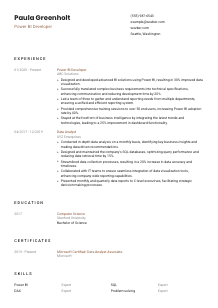
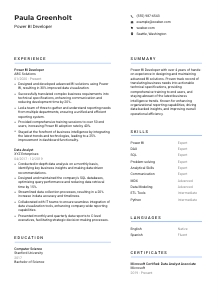
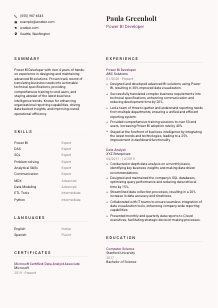
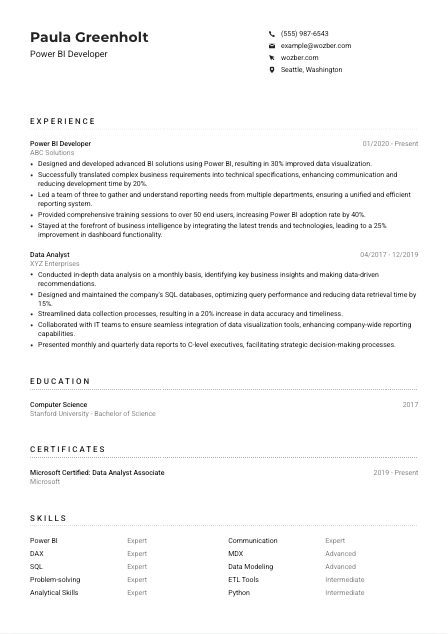
Crafting data stories, but your resume feels like a pie chart in a bar graph world? Check out this Power BI Developer resume example, showing how to present your analytics acumen as dynamically as your dashboards, created with Wozber free resume builder. Plot the points where your data-driven expertise meets job requirements, turning your narrative into a visually impactful career journey!
Power BI hiring moves quickly past generic reporting claims. Teams want to see whether you can turn messy business questions into reliable dashboards, clean data models, and DAX-driven reporting that people actually use. Your resume should make that practical value visible from the start, especially how you connect business requirements to usable BI deliverables.
When a Power BI resume is tailored well, the first screening pass can immediately separate dashboard builders from candidates who understand data modeling, SQL, stakeholder intake, and user adoption. Wozber's free resume builder helps you shape that story in an ATS-friendly resume format, so the right keywords and project details surface clearly and the hiring team can quickly see your depth in Power BI development.
This section is simple, but it still does real work. For a Power BI Developer, clear contact details and the right location signal help remove avoidable friction before anyone reads your DAX, reporting, or dashboard experience.
Use your full name in a clean, readable format at the top of the page. Keep it more prominent than the rest of the header so your resume looks polished and easy to reference during interview scheduling and internal review.
Place "Power BI Developer" directly under your name when that is the role you are pursuing. This creates immediate alignment with the posting and avoids confusion with adjacent profiles such as Data Analyst, BI Analyst, or Report Developer.
Include a working phone number and a professional email address. Small errors here create outsized problems, especially when recruiters are moving fast to schedule technical screens or follow-up conversations about reporting projects and tool experience.
If the employer asks for a specific location, include it plainly. In the example, listing Seattle, Washington directly supports the stated requirement and saves the hiring team from guessing about availability or relocation.
A LinkedIn profile, portfolio, or personal site can strengthen your application if it shows dashboard samples, BI project summaries, SQL work, or reporting case studies. Only include links that reinforce your experience with data visualization and business intelligence.
Keep this section clean, accurate, and relevant. For a Power BI Developer, the header should confirm who you are, how to reach you, and whether you meet any location requirement without making the reader hunt for basics.




This is where a Power BI Developer resume earns attention. Hiring teams look for proof that you have built reporting solutions, handled business requirements well, and improved how people use data across the organization.
Pull out the actual work themes from the job description and reflect them in your bullets. For this role, that includes Power BI development, data visualization, technical specification writing, collaboration with business stakeholders, and end-user training. Use that language where it honestly matches your background so both recruiters and ATS tools can connect your experience to the role.
List jobs in reverse chronological order with title, company, and dates. That structure matters in BI hiring because reviewers often trace how you progressed from analysis or reporting work into deeper ownership of dashboards, data models, and Power BI solutions.
Each bullet should show what you built, improved, or solved. A line such as "designed and developed advanced BI solutions using Power BI, resulting in 30% improved data visualization" works because it ties the tool to an outcome. Do the same with dashboard adoption, reporting speed, data quality, or stakeholder turnaround time.
Numbers make BI work easier to evaluate. Include metrics that fit the work, such as reduced development time, faster query performance, increased dashboard adoption, better data accuracy, or broader reporting coverage. The sample resume does this well with gains like 20% faster development and 40% higher adoption after training sessions.
Prioritize experience that supports Power BI development directly or through adjacent work such as SQL reporting, data analysis, ETL support, or executive reporting. Earlier roles can stay if they show useful foundations, like improving database performance or presenting insights to leadership, but cut unrelated detail that does not strengthen your BI profile.
Your experience section should leave no doubt that you can build dashboards, translate business questions into technical work, and improve reporting outcomes. When the bullets are specific, measurable, and aligned to Power BI workflows, the value of your background becomes much easier to judge.
For Power BI roles, education usually supports rather than leads the decision, but it still matters when the employer asks for a degree in Computer Science, IT, or a related field. Present it clearly so the requirement is easy to confirm.
If the posting names a bachelor's degree in Computer Science, IT, or a related field, make sure your degree is easy to find and written clearly. In the example, "Bachelor of Science" in "Computer Science" aligns directly with the stated requirement.
List degree, field of study, school, and graduation year in a consistent order. Clean formatting helps both ATS parsing and quick human review, especially when recruiters are checking baseline qualifications before moving deeper into technical experience.
When your education directly matches the posting, do not bury that connection in vague wording. "Bachelor of Science in Computer Science" is stronger than an abbreviated or overly casual label because it mirrors the qualification the employer is screening for.
If you are earlier in your career, coursework or academic projects can help fill out your profile. Focus on subjects that support Power BI work, such as databases, data warehousing, business intelligence, statistics, or systems analysis. Skip this if you already have several years of strong professional experience.
Honors, awards, or thesis work can help if they connect to analytics, data systems, or visualization. Keep the section concise. Once your work history includes solid Power BI delivery, education should confirm your foundation rather than compete with your experience.
A clear education section closes one of the simpler checks in the hiring process. When your degree matches the posting and is presented cleanly, the reviewer can move on quickly to the part that matters most for this role: your BI work.
Certifications are useful in Power BI hiring because they show current platform knowledge and ongoing investment in analytics tools. They are especially helpful when they reinforce practical skills in reporting, modeling, and Microsoft data products.
Even when a posting does not require a certification, relevant credentials can improve credibility. For a Power BI Developer, Microsoft certifications tied to data analysis, Power BI, or Azure data services are often the most useful additions.
Include certificates that support your work with Power BI, DAX, SQL, data modeling, or related BI tooling. The example uses "Microsoft Certified: Data Analyst Associate," which fits naturally because it supports the reporting and visualization focus of the role.
Add the year earned and, if applicable, the current validity period. This matters in BI work because tools, interfaces, and reporting practices change regularly, and recent certification can help show that your knowledge is current.
Update this section when you complete new certifications that reflect the kind of reporting environment you want to work in. If your target roles lean more into enterprise BI, semantic models, or cloud data platforms, your certifications should gradually reflect that direction.
Certificates are most effective when they support the story told in your experience section. Keep them relevant, current, and connected to the BI tools and reporting responsibilities employers actually care about.
Power BI employers scan the skills section quickly, but they do not treat it as decoration. They are looking for a workable technical stack that supports dashboard development, data modeling, query work, and communication with business users.
Start with the specific skills the posting names, then add closely related strengths you genuinely use. Here, Power BI, DAX, MDX, SQL, data modeling, data warehousing, analytical thinking, problem-solving, and communication all belong because they match the role's day-to-day work.
Put the most relevant technical skills first. For a Power BI Developer, that usually means Power BI, DAX, SQL, data modeling, and visualization before broader tools or general business software. This helps recruiters and hiring managers see your core BI capability quickly.
Do not overload the section with every tool you have touched once. A tighter list is stronger when it reflects the environment you can actually work in. The sample resume balances core BI skills with supporting strengths like ETL tools, Python, communication, and analytical skills without losing the main focus.
A well-built skills section should quickly show that you can handle both the technical and collaborative parts of Power BI work. Prioritize the tools and capabilities that support dashboard delivery, data logic, and stakeholder communication.
Language skills are usually a smaller section, but they still matter when a posting explicitly asks for written and spoken English. In reporting roles, communication affects requirement gathering, documentation, training, and how insights are presented to business users.
If the job specifies English proficiency, list English clearly and use an honest proficiency level such as "Native" or "Fluent." That is especially relevant for Power BI work involving requirement intake, documentation, user training, and cross-functional meetings.
Include additional languages when they are real working strengths. They can be useful in global companies, distributed teams, or business environments where reporting support reaches multiple regions or user groups.
Choose simple, recognizable levels such as Native, Fluent, Intermediate, or Basic. Clear labeling avoids confusion and helps the reader understand whether you can handle business communication, technical documentation, or only casual conversation.
Some Power BI roles involve training, stakeholder workshops, or support across departments and geographies. In those settings, extra language capability can add value, though it should stay secondary to your BI and data skills unless the posting emphasizes it.
Only list languages you can use at the level stated. If you are actively improving one, update the rating as your ability changes. Accuracy matters here just as much as it does in your technical claims.
For this kind of role, language proficiency supports collaboration, training, and documentation. Keep the section brief, accurate, and anchored in how you actually communicate at work.
Your summary should quickly establish what kind of Power BI professional you are. In a few lines, it needs to connect your years of experience with the kind of reporting, modeling, and business-facing work you handle well.
Before writing, identify the two or three requirements that define the job. Here, those include Power BI development, data visualization, business requirement translation, and collaboration. Build your summary around those themes rather than using a generic analytics profile.
Start with your title, years of experience, and main area of expertise. A direct opening like the sample's "Power BI Developer with over 4 years of hands-on experience" works because it immediately places you in the right lane.
Use the next lines to highlight the kind of work you do best, such as building BI solutions, writing technical specifications, supporting end users, improving reporting capability, or driving data-backed decisions. Keep the language close to the posting when it reflects your actual background.
Aim for a short paragraph with real substance, not a long introduction packed with buzzwords. Three to five sentences are usually enough to show your experience level, technical focus, and business impact without repeating bullets from the experience section.
A good summary should make the reader understand your level, specialty, and reporting impact within a few seconds. With Wozber's AI resume builder and ATS resume scanner, you can tighten the wording, align it to the job description, and make your Power BI experience surface clearly from the top of the page.
A well-tailored Power BI Developer resume should show more than tool familiarity. It should connect dashboards, data models, SQL work, stakeholder collaboration, and training support to measurable business results.
Use Wozber's free resume builder to organize that experience in an ATS-compliant resume, then refine it with an ATS resume scanner so the language, structure, and emphasis match the role you want. The finished resume should make it easy to see that you can build reporting solutions people trust and use.




