



Use Wozber and land your dream job
Create Resume
No registration required
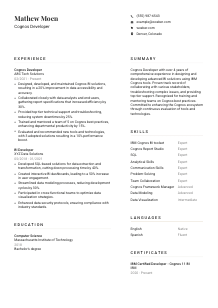
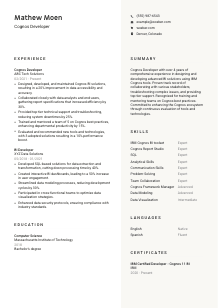
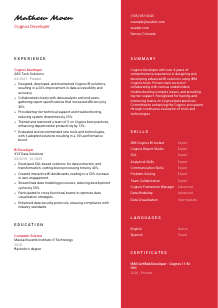
Churning out insightful reports, but your resume struggles to communicate the data? Check out this Cognos Developer resume example, created with Wozber free resume builder. Learn how to blend your analytics acumen with job specifics, making your career narrative as clear and dynamic as the dashboards you create!
Cognos Developer hiring usually turns on one practical question fast: can you build reporting solutions that business teams actually trust. Employers look for people who can model data cleanly in Framework Manager, turn requirements into usable reports and dashboards, and troubleshoot query or platform issues without slowing down decision-making. Your resume should make that delivery record easy to see.
A tailored resume changes how your background is interpreted, especially when BI roles overlap with general reporting or broader data development work. Wozber's free resume builder helps you shape an ATS-compliant resume around the exact Cognos language in the posting, so hiring teams can quickly connect your experience with report development, data accuracy, and production support. That distinction matters when they need someone who can contribute inside a Cognos environment right away.
For a Cognos Developer, the header should establish professional alignment without clutter. Keep it clean, accurate, and easy to scan so the hiring team can move straight into your BI experience, technical stack, and reporting background.
Put your full name at the top in a readable format, then use a professional title that matches the role you are targeting. If you are applying for a Cognos Developer opening, stating "Cognos Developer" directly under your name helps frame the rest of the resume around BI reporting, modeling, and platform support.
Mirror the posted title when your experience genuinely supports it. This is especially useful for candidates whose recent title was broader, such as BI Developer or Report Developer, but whose actual work included Cognos Framework Manager models, Report Studio development, or Cognos support responsibilities.
List a reliable phone number and a professional email address, and check both carefully. Technical hiring often moves quickly once a candidate appears to match the platform and reporting requirements, so avoid small errors that create friction at the first point of contact.
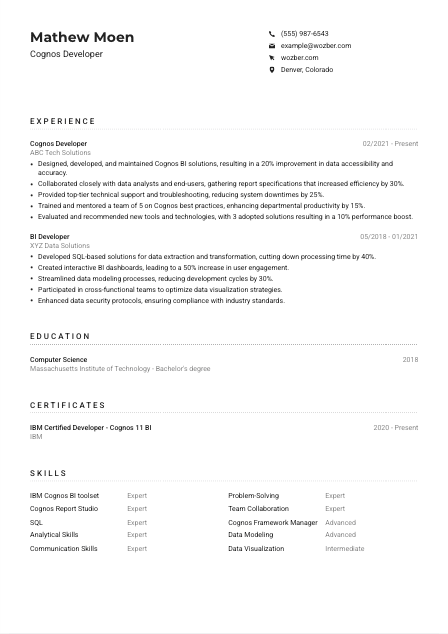
Some Cognos roles include a location filter before anyone reviews technical depth. In this example, Denver, Colorado is specifically requested, so showing that location in your header immediately removes a logistical question. If a role is remote or flexible, follow the wording in that posting instead of assuming location matters everywhere.
A LinkedIn profile or personal site can help if it reinforces your BI background, project scope, or technical progression. Keep it current. For a Cognos Developer, that might mean showing report development work, data platform experience, or a broader business intelligence path that supports the role.
This section does not need personality statements or extra detail. It should confirm who you are, how to reach you, and any practical requirement such as location, then clear the way for your Cognos experience to do the heavy lifting.




This is the section most likely to decide whether you move forward. Cognos teams want to see how you handled reporting requests, data modeling, user support, and platform issues in real environments, not just that you worked somewhere with BI tools.
Read the job description for the actual delivery needs behind the keywords. Here, the recurring themes are Cognos BI solution development, Framework Manager modeling, cube or multidimensional work, complex reports and dashboards, collaboration with analysts and end-users, and technical support. Use those themes to choose which accomplishments deserve space on the page.
List jobs in reverse chronological order and emphasize roles that show hands-on reporting and data work. If your past title was not exactly "Cognos Developer," your bullets should still make the connection clear by naming the Cognos environment, reporting responsibilities, SQL work, model design, or dashboard development that overlaps with the target role.
Each bullet should show what you built, improved, supported, or solved. For this profession, that often means report packages, Framework Manager models, dashboards, query tuning, user support, or data validation. The example bullet about improving data accessibility and accuracy by 20% works because it ties Cognos solution development to a result the business can feel.
Numbers make more sense when they reflect how reporting teams are measured. Think reduced downtime, faster report turnaround, fewer data discrepancies, shorter development cycles, better dashboard adoption, or improved query performance. The sample resume does this well with metrics like a 25% reduction in downtime and a 30% increase in efficiency after gathering clearer report specifications.
Prioritize experience that supports the employer's actual Cognos needs. If you have broader BI or SQL roles, keep the bullets that connect to reporting, data modeling, stakeholder collaboration, or troubleshooting. A prior BI Developer role can still help if it shows dashboard creation, ETL or SQL support, and data modeling discipline that feeds directly into Cognos development work.
A hiring manager should be able to see the systems you supported, the reports you built, and the business problems you helped solve. When your experience section is this specific, your resume reads like someone who can step into Cognos delivery, not just someone familiar with BI in general.
Education usually will not outweigh hands-on Cognos experience, but it still matters in BI hiring because it confirms your technical foundation in data structures, systems, and analytical thinking. Present it clearly and keep the emphasis on relevance.
If the posting asks for a Bachelor's degree in Computer Science, Information Technology, or a related field, list that information plainly. In this case, a Bachelor's degree in Computer Science aligns cleanly with the requirement and supports the technical depth expected in reporting and BI development roles.
Use a consistent structure with degree, field of study, school, and graduation year or date. Education is usually reviewed quickly, so clarity matters more than added description unless a specific academic detail strongly supports the role.
A degree in Computer Science, Information Systems, Data Analytics, or another related field signals preparation for work involving SQL, data modeling, reporting logic, and BI platforms. If your degree title is less obvious, the field of study can help connect it to Cognos development work.
This is most useful for early-career candidates or those transitioning from school into BI roles. Include database coursework, data warehousing projects, reporting systems, or analytics work if it helps explain your foundation in model design or business intelligence development.
Honors, technical clubs, or thesis work are worth listing when they reinforce your profile and you do not yet have a long work history. Once you have solid professional Cognos experience, those extras should stay brief unless they are directly connected to data engineering, analytics, or enterprise reporting.
This section should confirm that you meet the baseline requirement and support the rest of the resume with a solid technical foundation. In Cognos hiring, clean relevance beats detail overload.
Certifications are not always mandatory for Cognos Developer roles, but they can add useful weight when they are closely tied to the BI platform, reporting tools, or broader analytics discipline. They work best when they reinforce skills already visible in your experience.
Lead with certifications that connect directly to Cognos or business intelligence work. An IBM Cognos certification is especially relevant because it supports your claim that you can work within the product ecosystem, not just in BI generally.
Choose certifications that strengthen your case for reporting, modeling, analytics, or enterprise BI development. The example resume uses "IBM Certified Developer - Cognos 11 BI" and CBIP effectively because both support the target profile without drifting into unrelated technical badges.
Certification dates help employers understand how current your platform knowledge is. This matters in software environments where versions, features, and best practices evolve over time, especially when a posting references experience with Cognos 10 and above.
Ongoing certification or recent training can strengthen your resume if it reflects relevant progress, such as newer Cognos capabilities, reporting architecture, data modeling, or analytics disciplines. It tells the employer you stay engaged with the tools and methods used in enterprise reporting environments.
Use this section to reinforce platform credibility and current knowledge. The best entries make your Cognos experience feel deeper and more current, rather than simply adding extra credentials.
The skills section should reflect how Cognos work is actually done. That means platform knowledge, reporting and modeling tools, data skills, and the communication ability needed to gather requirements, resolve issues, and work with analysts or business users.
Pull the technical skills named in the posting and list the ones you genuinely use. For this role, that includes IBM Cognos BI, Framework Manager, Report Studio, multidimensional modeling or cube work, dashboards, and likely SQL. These should appear near the top because they are central to day-to-day delivery.
Cognos development is rarely isolated work. Include analytical thinking, problem-solving, communication, and collaboration when they are true strengths, especially if your job involved gathering report specifications, validating data with analysts, or supporting end-users after deployment.
Put the most role-critical skills first, then follow with adjacent capabilities. In a Cognos resume, toolset expertise and reporting development should come before broader traits. A list that starts with IBM Cognos BI toolset, Cognos Report Studio, Framework Manager, SQL, and data modeling tells the reader far more than a generic mix of technical and soft skills.
The section works best when it reflects your real working stack and the language used in the target job description. Clear prioritization helps hiring teams spot Cognos depth quickly, and it also improves ATS alignment without turning the section into a keyword dump.
Cognos Developers spend plenty of time translating business questions into reports, validating numbers with analysts, and explaining issues to users. Language skills matter most when they affect that day-to-day communication.
If the posting explicitly asks for clear English communication, show English prominently with an accurate proficiency level. That simple line supports your ability to gather requirements, explain report logic, document issues, and work with technical and non-technical stakeholders.
Extra languages can be helpful in global teams, shared service environments, or user-facing BI support settings. If you speak another language fluently, list it with the same clear format used for English. In the sample resume, Spanish adds useful breadth without distracting from the core Cognos profile.
Terms such as Native, Fluent, Professional Working, or Conversational are usually enough. Avoid vague descriptions. Hiring teams should be able to tell quickly whether you can lead requirement discussions, support users, or collaborate across teams in that language.
Not every Cognos role needs more than strong English. Add extra languages when they are relevant to the employer's user base, support model, or team structure, rather than treating them as automatic resume fillers.
For BI work, communication is tied to execution. Clear language skills support cleaner requirements, fewer reporting misunderstandings, and smoother handoffs with business users. That is the context in which this section matters most.
List the languages you can genuinely use at work, with English positioned appropriately when the role requires it. In Cognos development, strong communication supports better reporting outcomes, not just smoother conversations.
The summary should quickly place you in the right part of the BI market. It needs to tell the reader that you work in Cognos, what level of experience you bring, and which parts of the reporting lifecycle you handle well.
Before writing, identify the two or three capabilities the posting emphasizes most. Here, that would include Cognos BI development, Framework Manager or reporting expertise, collaboration with analysts and end-users, and support or troubleshooting. Those priorities should shape the language of your opening lines.
Start with your title or specialization, then state your experience level in a natural way, such as "Cognos Developer with 4+ years of experience." That immediately tells the employer whether you likely meet the minimum threshold and belong in the right candidate pool.
Use the next sentence to highlight work that matches the posting most closely, such as designing BI solutions, creating complex reports, improving data accuracy, troubleshooting platform issues, or mentoring team members. The example summary works because it combines technical scope with collaboration and support responsibilities instead of listing vague strengths.
Aim for a short paragraph that can be read in seconds. Avoid generic claims about being motivated or results-driven unless you tie them to Cognos work, reporting outcomes, or user support. A concise summary with platform-specific language will do more for you than a longer paragraph filled with broad professional adjectives.
By the end of these first lines, the reader should know that you are a Cognos professional, how experienced you are, and what kind of BI work you can handle. That clarity sets up the rest of the resume to confirm the details.
A Cognos Developer resume should show more than tool familiarity. It should connect your BI platform knowledge to reporting outputs, data accuracy, user support, and measurable business improvement. When each section points back to that pattern, your background reads as immediately relevant.
Use Wozber's free resume builder to tighten role-specific wording, improve ATS optimization, and present your experience in an ATS-friendly resume format that stays easy for hiring teams to review. The final version should make one thing clear without effort: you can build, support, and improve Cognos reporting solutions in a production environment.




