



Use Wozber and land your dream job
Create Resume
No registration required
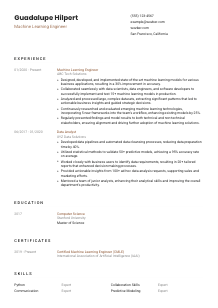
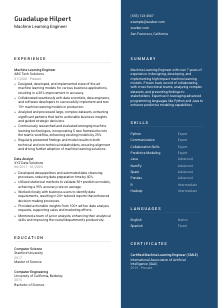
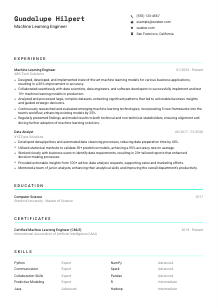
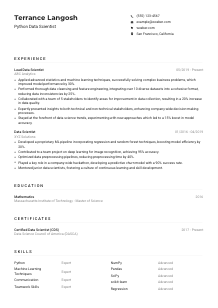
Teaching machines, but your resume seems stuck in loops? Check out this Machine Learning Engineer resume example, made with Wozber free resume builder. Learn how to train your ML talent to shine in sync with job algorithms, propelling your career to learn, grow, and evolve exponentially!
Machine learning engineering work is judged in production, not in notebooks alone. Hiring teams look for people who can move from model development to deployment, work with messy large-scale data, and explain technical tradeoffs to engineers, analysts, and business stakeholders without losing accuracy or momentum.
When your resume is tailored well, it quickly shows whether your background matches the stack and delivery scope behind the opening, from Python-based model development to big data tooling and cross-functional rollout. Wozber's free resume builder helps organize that experience into an ATS-friendly resume format, so the screening process can surface what matters first: your ability to build, ship, and improve machine learning systems in a real business environment.
For a Machine Learning Engineer, the header should remove friction immediately. Hiring teams should be able to see who you are, what role you target, and whether you meet practical requirements such as location and professional contact details without hunting through the page.
Your name should be the most visible text in the header, set in a clean format that matches the rest of the resume. Keep it simple and readable. In technical hiring, cluttered styling can make the document feel less polished before anyone even reaches your model development or deployment work.
Place "Machine Learning Engineer" directly under your name if that is the role you are targeting. This helps frame the rest of the resume around model design, predictive analytics, production implementation, and collaboration with data and software teams. It also keeps your wording aligned with ATS parsing and the employer's job title conventions.
List a working phone number and a professional email address that you check often. If you include a website, GitHub, or LinkedIn profile, make sure it supports your resume with relevant code samples, project context, publications, or technical achievements. Broken links or outdated profiles weaken credibility fast in engineering hiring.
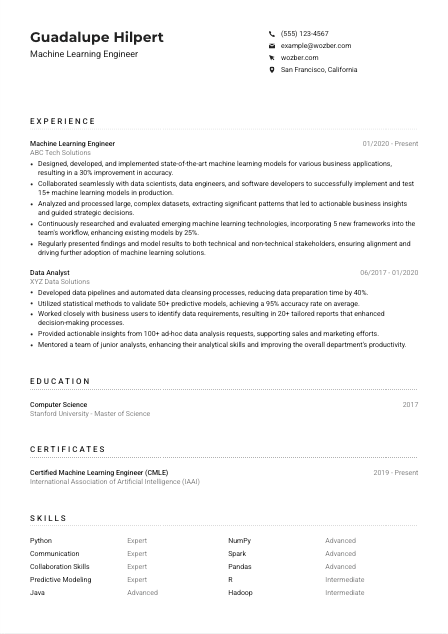
If the role requires local presence or a specific city, show that clearly in your header. In this example, listing "San Francisco, California" answers a stated requirement up front and avoids unnecessary uncertainty about availability. For other machine learning roles, include location only when it helps clarify onsite, hybrid, or relocation expectations.
A strong online profile can reinforce your resume with project repositories, published work, Kaggle activity, conference talks, or a portfolio of deployed ML solutions. Only include it if the content is current and consistent with the experience and tools you present on the resume itself.
This section does not need personality flourishes. It needs accuracy, role alignment, and any practical detail that clears an early screening hurdle for the machine learning position you want.




This is the section where Machine Learning Engineer candidates separate themselves from adjacent profiles like data analysts, research scientists, or software engineers. Your bullets should show model work, production collaboration, data scale, tooling, and business results in a way that makes your operating level easy to understand.
Read the job description for its real operating demands, not just its keywords. If the role centers on developing machine learning models, working with large datasets, and partnering with data engineers and developers to deploy them, your bullets should cover those same workflows. Use the employer's language where it matches your experience, especially around predictive modeling, supervised and unsupervised learning, production testing, and stakeholder communication.
Use reverse chronological order so the hiring team sees your current or most advanced machine learning work first. That structure is especially useful when your earlier background sits in analytics, software, or data engineering. In the example, the move from Data Analyst to Machine Learning Engineer makes the progression into model development and production delivery easy to follow.
Focus each bullet on a meaningful contribution: what you built, how you built it, what environment it supported, and what changed because of it. For this profession, strong bullets often cover model design, feature work, experimentation, deployment support, pipeline collaboration, large-scale data analysis, or presenting results to technical and business audiences. The sample bullet about implementing 15+ models in production works because it ties engineering collaboration to a concrete delivery outcome.
Numbers should reflect how machine learning engineering is actually measured. That can include model accuracy, latency improvements, deployment volume, data processing time, workflow automation, framework adoption, model lift, or business impact tied to predictions. The example's 30% improvement in accuracy and 25% enhancement to existing models are useful because they translate technical work into performance gains hiring teams can quickly interpret.
Space is limited, so prioritize accomplishments that support the machine learning scope of the job. A bullet about generic reporting matters less than one about validating predictive models, building data pipelines, or extracting patterns from complex datasets. Even when earlier roles were not pure ML positions, keep the content centered on transferable work such as statistical modeling, automation, experimentation, and stakeholder-facing analysis.
By the end of this section, the reviewer should understand the kind of models you worked on, the teams you partnered with, the scale of data involved, and the business or technical outcomes your work influenced.
Education matters in machine learning hiring because it often signals mathematical foundation, engineering discipline, and exposure to advanced topics such as optimization, statistics, and large-scale computing. Present it cleanly, with enough detail to show alignment, especially when the posting specifies degree expectations.
If the posting requires a bachelor's degree and prefers a master's or PhD, list your highest relevant degree first. That immediately addresses the requirement. In the example, a Master of Science in Computer Science strengthens alignment because it matches both the field and the preferred education level.
For each degree, include the degree name, field of study, school, and graduation year. This is enough for most experienced Machine Learning Engineer resumes. Clean formatting helps recruiters and ATS systems identify the credential quickly, especially when they are screening for computer science, engineering, or related technical disciplines.
Degrees in Computer Science, Computer Engineering, Data Science, Statistics, Applied Mathematics, or similar disciplines all support this profession differently. Choose the wording that best reflects your academic background. The sample's Computer Science and Computer Engineering combination works well because it signals both software fundamentals and technical problem-solving depth.
Most experienced candidates do not need to list classes unless they strengthen a transition into machine learning or support a less obvious degree. If you use coursework, keep it relevant to ML engineering, such as machine learning, distributed systems, data mining, algorithms, probability, or statistical modeling. Make sure those additions support the target role rather than filling space.
Projects, thesis work, honors, or research can help if they demonstrate applied model development, large dataset analysis, or engineering rigor. This is especially useful for earlier-career candidates or applicants coming from research-heavy programs. For experienced professionals, keep these details only if they deepen the story your work experience already tells.
This section should reassure the reader that you have the formal grounding for machine learning engineering work, while leaving most of the heavy proof to your experience, projects, and results.
Machine learning changes quickly, and certificates can help show continued development in tools, frameworks, and applied methods. They are usually secondary to hands-on experience, but the right credential can strengthen your profile, especially when it supports production ML, cloud platforms, or specialized model work.
List credentials that connect to machine learning engineering, MLOps, data engineering, cloud-based model deployment, or advanced analytics. A certificate like "Certified Machine Learning Engineer" is relevant because it aligns with the role's technical core instead of adding unrelated training noise.
A short list of credible, current certifications is stronger than a long list of loosely related courses. Focus on certifications that support the requirements in the posting, such as machine learning development, big data tooling, or applied programming environments. That keeps the section targeted and useful.
Add the issue date or active period when it helps show that the credential is current. In a field where frameworks, deployment practices, and tooling evolve quickly, recency matters. A date also helps reviewers distinguish between foundational training completed years ago and more recent professional development.
Use this section to show that you stay current with the practical side of the discipline, whether that means model serving, distributed processing, feature pipelines, or newer ML frameworks. Ongoing certification is one way to show that your knowledge is active rather than frozen at the point of your last degree.
Relevant certifications will not replace shipped work, but they can strengthen your case by showing continued investment in the methods, platforms, and engineering practices used in modern machine learning teams.
Machine Learning Engineer skill sections work best when they reflect the actual stack behind the job. That means balancing programming languages, data libraries, modeling capabilities, data infrastructure, and the collaboration skills needed to move models into production with other technical teams.
Start with the tools and capabilities the employer named. Here, that includes Python, Java, or R, data manipulation libraries such as Pandas and NumPy, big data platforms like Hadoop and Spark, and core modeling knowledge across supervised, unsupervised, and predictive techniques. Put the skills you genuinely use most often near the top.
A Machine Learning Engineer is rarely evaluated on algorithms alone. Teams also need someone who can collaborate with data scientists, data engineers, and software developers, then explain results to non-technical stakeholders. The example resume includes communication and collaboration alongside technical tools, which makes sense because those skills are directly tied to production rollout and stakeholder presentations.
Group or order your skills in a way that reflects how the work is done. You might lead with programming languages and modeling methods, then list libraries, big data tools, and soft skills. If you use proficiency levels, keep them realistic. A clean structure helps reviewers quickly see whether your background matches the engineering environment they are hiring for.
Every item here should point back to work you can defend in interviews, coding discussions, architecture conversations, or model review scenarios. Relevance matters more than length.
Language ability matters more in machine learning roles than many candidates assume. Engineers need to explain assumptions, report findings, document model behavior, and work across functions, so language proficiency should reflect how you actually communicate in technical and business settings.
If the posting specifies English proficiency, list English first and state your level clearly. That requirement often matters because the role involves presenting results, writing technical documentation, and collaborating across engineering and business teams. In the example, marking English as "Native" answers that point directly.
Additional languages can be useful in global teams, multinational product environments, or customer-facing analytics contexts. Include them if they are relevant and if you can use them professionally. They are usually a secondary factor for ML engineering, but they can still broaden your profile.
Stick to plain descriptors such as "Native," "Fluent," "Intermediate," or "Basic." Avoid vague terms. Hiring teams need a realistic sense of how comfortably you can participate in meetings, write documentation, or discuss technical results.
This section has the most value when it connects to real work. If your role involves presenting model findings, coordinating with distributed teams, or translating technical insight for non-technical audiences, language ability supports that part of the job directly.
For most Machine Learning Engineer resumes, languages should stay concise unless multilingual communication is central to the position. Include what is useful, keep the labels accurate, and let the section support the broader story of technical collaboration and stakeholder communication.
For this profession, language proficiency helps confirm that you can present findings clearly, document work responsibly, and operate smoothly with cross-functional teams.
A Machine Learning Engineer summary should quickly show your level, technical focus, and the kind of outcomes your work drives. The best summaries connect model development with implementation, collaboration, and measurable results rather than staying at the level of broad technical interest.
Start from the responsibilities in the posting. If the job centers on designing models, analyzing complex datasets, collaborating on production implementation, and presenting findings, your summary should touch those same areas in compact language. This keeps the opening aligned with how the team likely defines the role internally.
Lead with your title and years of relevant experience so the reader can place you quickly. For example, "Machine Learning Engineer with 7+ years of experience" gives immediate context before you move into tools, modeling methods, or industry impact. Keep the opening factual and specific.
Mention the programming languages, modeling strengths, and collaboration patterns most relevant to the target role. In this example, Python, Java, predictive modeling, large-scale dataset analysis, and cross-functional work are all worth surfacing because they mirror the posting closely and reflect real machine learning engineering scope.
Aim for three to five lines that show what you build, how you work, and what results you help create. The sample summary works because it combines model development, collaboration, and business-facing analysis without drifting into buzzwords. A hiring manager should finish this section with a clear picture of your technical level and delivery style.
Your summary should quickly establish whether you can design models, work across the engineering stack, and turn machine learning output into decisions or products. If it does that cleanly, the rest of the resume has a strong frame.
A Machine Learning Engineer resume should make four things easy to read: your modeling depth, your engineering stack, your production collaboration, and the results your work delivered. When those points are clear, the document starts sounding like someone who can contribute to model development and deployment from day one.
Use Wozber's free resume builder to shape that story into an ATS-compliant resume, strengthen role-specific wording with AI support, and check alignment with an ATS resume scanner before you apply. The final result should help a hiring team quickly understand how you build, ship, and improve machine learning solutions.




