



Use Wozber and land your dream job
Create Resume
No registration required
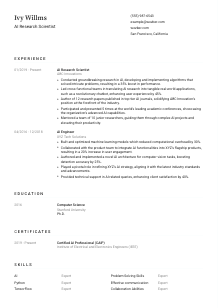
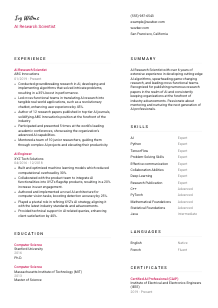
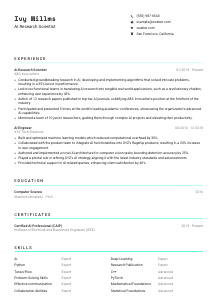
Working in deep learning, but your CV isn't saying it all? Sync up with this AI Research Scientist resume example, created with Wozber free resume builder. Learn how to match your cutting-edge algorithms to job specs, preparing a career path where intelligence meets innovation!
AI Research Scientist hiring usually turns on one question fast: can this person move from theory to usable results? A resume in this field needs to show more than model familiarity. It should make your research agenda, technical depth, and downstream impact visible through work on algorithms, experiments, publications, and product translation.
That becomes much easier when your resume uses the same technical language the role uses. Wozber's free resume builder helps shape that alignment into an ATS-compliant resume, so terms like deep learning, NLP, computer vision, PyTorch, or TensorFlow are easy to surface where they belong. The point is not keyword stuffing. It is making your actual research scope and execution easy to recognize.
This section is brief, but it sets the context for everything that follows. For an AI Research Scientist, your header should immediately show professional alignment and remove any friction around contactability, role targeting, and location expectations when those matter for the job.
Use your full name in the largest, cleanest text on the page. In research-driven hiring, your name will often be associated later with papers, conference talks, GitHub work, patents, or lab collaborations, so make it easy to spot and remember.
Place "AI Research Scientist" directly under your name when that is the role you are pursuing. Matching the posted title helps frame the rest of your resume around research, experimentation, and publication, instead of leaving you looking closer to a general ML engineer or software developer.
Make it easy for hiring teams, recruiters, or research leads to reach you without hunting through the page.
If a posting names a location requirement, reflect that clearly in your header. Here, San Francisco, California is explicitly requested, so including it signals that you already meet or can support that requirement. For other AI research roles, only add location when it affects eligibility, relocation, or onsite collaboration expectations.
Link to a personal website, Google Scholar, LinkedIn, GitHub, or portfolio that supports your claims. For this profession, external links are especially useful when they show publications, code repositories, benchmark results, talks, or project summaries that deepen the story your resume starts.
Do not include age, marital status, photo, or other unrelated identifiers unless a specific region or employer explicitly asks for them. Keep attention on your research profile, technical stack, and publication track record.
When the top of the page clearly shows who you are, what role you are targeting, and whether you meet practical requirements, the reader can move straight to your research credentials. That is exactly where an AI Research Scientist resume should earn attention.




For AI Research Scientist roles, experience is where abstract expertise becomes credible. Hiring teams look for evidence of original research, experimental rigor, model performance gains, publication output, and the ability to move ideas into production or product settings with engineers, product teams, and stakeholders.
Start by marking the research areas, technical tools, and business expectations named in the job description. In this case, that includes AI research, innovative algorithm development, deep learning or NLP or computer vision, multidisciplinary collaboration, publication activity, and mentoring. Those themes should guide which bullets you keep, expand, or rewrite.
Use reverse chronological order so your current research level is visible first. For each role, include title, organization, and dates. That structure helps a reader quickly understand whether your path has moved from implementation work into deeper research ownership, which often matters in AI scientist hiring.
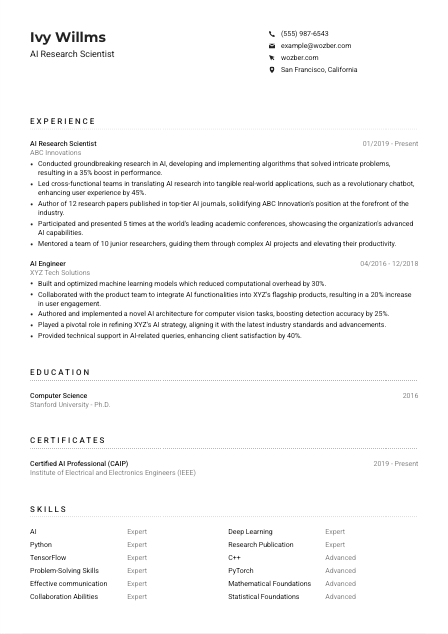
Each bullet should capture a research problem, what you built or tested, and what changed because of it. For this profession, that often means algorithm improvements, accuracy gains, inference efficiency, publication output, successful transfer into product features, or adoption by internal teams. The sample resume does this well by linking research work to a 35% performance lift and a chatbot application that improved user experience by 45%.
Metrics make advanced work easier to trust. Use numbers tied to model accuracy, latency, computational overhead, benchmark improvement, publication count, conference presentations, team size, user impact, or efficiency gains. In the example, 12 published papers, five conference presentations, and measurable model improvements give the reader a concrete sense of scale and credibility.
If you have experience across engineering and research, lead with the work that proves scientific depth. Emphasize model design, experimentation, mathematical problem-solving, publication, collaboration with product or research teams, and mentorship of junior researchers. Earlier engineering work can still help, especially when it shows production deployment or model optimization, but your top bullets should point clearly toward research leadership.
The strongest experience section makes it easy to see that your work changes something measurable, whether that is model quality, product capability, research visibility, or team output. For AI Research Scientist roles, that combination of novelty and execution carries real weight.
Education carries unusual importance in AI research hiring because it often signals depth in theory, experimentation, and independent inquiry. When a role specifically asks for doctoral training or a focused background in AI or ML, your education section should make that qualification unmistakable.
Read the posting carefully and mirror the academic threshold it sets. Here, a Ph.D. in Computer Science, Electrical Engineering, or a related field with AI or ML focus is a direct requirement, so that credential should appear first and be easy to spot.
List your degrees clearly so readers can scan them in seconds. Research hiring often involves technical leaders as well as recruiters, and both benefit from a clean structure that shows discipline, degree level, institution, and timing without extra interpretation.
If your degree title is broad, clarify the specialization through field naming, dissertation topic, lab affiliation, or a brief note. That matters when a hiring team is trying to distinguish general computer science candidates from researchers with sustained work in deep learning, computer vision, NLP, reinforcement learning, or related areas.
Relevant academic detail is especially useful for early-career researchers or candidates moving from academia to industry. Mention dissertation focus, major research projects, advisor-led lab work, or advanced coursework when it connects directly to the role's research domain and methods.
Awards, fellowships, notable publications during graduate study, or participation in respected research groups can reinforce your credibility. Use them selectively. Include the academic achievements that say something meaningful about your research quality or specialization.
For this profession, education is not filler. It often confirms the theoretical grounding behind your experiments, papers, and model design choices. When the degree, field, and research emphasis are clear, the rest of your resume lands faster.
Certificates are secondary to research output, formal education, and work history in most AI Research Scientist searches, but they can still help. Used well, they show continued development in tooling, specialized methods, or adjacent engineering skills that support your research practice.
Only include certifications that strengthen your case for the work at hand. For an AI Research Scientist, that usually means credentials tied to machine learning, deep learning frameworks, cloud ML workflows, model deployment, or advanced data science topics. If a certificate does not sharpen that picture, leave it out.
Choose certifications that complement the requirements in the posting. For this role, certificates related to AI, machine learning, TensorFlow, PyTorch, or applied research methods make more sense than generic professional development courses. The example resume keeps the list short and relevant, which is the right instinct.
Add earned dates and renewal periods when applicable. In fast-moving technical fields, recency helps a reader understand whether a credential reflects current practice or older exposure to a framework or method.
A certificate will not outweigh publications, experimental results, or a strong Ph.D. profile, but it can show that you keep updating your toolkit as research and production ecosystems evolve. That is useful when your work spans both scientific exploration and implementation.
Certificates should strengthen the technical story already established by your education and experience. A concise list of relevant credentials works better than a long catalog that distracts from research achievements.
The skills section should read like the operating toolkit behind your work. For AI Research Scientist roles, that means balancing research domains, programming languages, frameworks, mathematical foundations, and collaboration strengths without turning the section into a generic keyword dump.
Start with the exact skills named in the posting, then add closely related terms you genuinely use. Here, obvious anchors include Python, C++ or Java, TensorFlow or PyTorch, deep learning, NLP, computer vision, mathematics, statistics, problem-solving, communication, and collaboration. These are useful both for human reviewers and ATS scanning when they reflect real experience.
Order your list around the target role, not around everything you have ever touched. Lead with the capabilities that matter most for AI research work, such as model development, experimental design, deep learning frameworks, scientific programming, and domain specialties. In the sample resume, AI, Python, TensorFlow, deep learning, and research publication are positioned near the top, which supports the target role well.
Keep the section easy to review by clustering related items or ordering by strength. A clear list of technical and research skills gives hiring teams a fast read on how you work, whether that is in PyTorch, statistical modeling, paper writing, or cross-functional collaboration. Brevity matters here. Include the tools and competencies you can defend in an interview or through project details elsewhere on the resume.
When your skills section reflects the actual methods, tools, and communication demands of AI research, it supports every other section on the page. It should confirm that you can design experiments, build models, discuss findings, and help move strong ideas forward.
AI research is collaborative work. You may need to explain experiments to engineers, present findings to leadership, write papers, or contribute at conferences. That is why language proficiency can matter, especially when a role explicitly calls for strong English literacy.
Check whether the job asks for a specific working language and make sure your resume reflects it. In this case, strong English literacy is named directly, so English should be listed clearly with an accurate proficiency level.
Lead with the language that affects the role most. For many AI research jobs, that will be English because it shapes paper writing, technical presentations, documentation, and cross-team collaboration.
Additional languages can help if the team is international, the company operates globally, or your work involves collaboration across regions. They are useful supporting details, but they should not crowd out more important research qualifications.
Choose familiar proficiency terms so the reader knows what to expect in meetings, writing, and presentations.
If you have presented internationally, collaborated with global labs, or supported multilingual research partnerships, extra language ability can be worth showing. Keep the emphasis practical. The real question is whether the language helps you communicate research clearly and work effectively with others.
For an AI Research Scientist, language proficiency matters most when it improves publication, presentation, and collaboration. Show that plainly, especially for English when the role asks for it.
Your summary should quickly establish the level and direction of your work. For AI Research Scientist applications, that means signaling research depth, technical specialization, and applied impact in a few lines without repeating generic claims about passion or innovation.
Use the posting to decide what belongs in the opening lines. For this position, the summary should touch on advanced AI research, relevant specializations such as deep learning, NLP, or computer vision, strong programming foundations, publication activity, and collaboration across technical and non-technical teams.
Lead with your current professional identity and experience level so the reader can place you immediately. Phrases like "AI Research Scientist with 6+ years of experience" work because they establish seniority and focus in one line.
After the opening, include concrete strengths tied to the role. That could be published research, algorithm performance improvements, productized AI systems, conference presentations, or mentorship. The sample summary points in the right direction by combining years of experience, cutting-edge algorithm work, research output, and team leadership.
Aim for a short paragraph that can be read in seconds. Choose specifics over slogans. A concise summary with real technical substance gives the reader a reliable frame for the deeper detail in your experience and education sections.
A well-written summary tells the reader early whether your background belongs in serious consideration for research work. When it combines specialization, track record, and applied relevance, the rest of the resume has a much stronger starting point.
You now have the structure for an AI Research Scientist resume that speaks to research depth, technical execution, and real-world application. Wozber's free resume builder and ATS resume scanner can help you align section wording, surface missing requirements, and keep the document in an ATS-friendly resume format.
Before you send it out, check that the final version reflects the target role's language accurately across publications, frameworks, programming tools, and collaboration scope. Whether you start from scratch or refine an existing draft in an ATS-friendly resume template, the finished resume should make one thing clear fast: you can do rigorous AI research and help turn it into results.




